Quantum Zeno Effect Explained: Physics, Myths & Applications
In the fifth century BCE, Zeno of Elea posed a question that still cuts to the bone of physics: if an arrow occupies a definite position at every instant, and every instant is a frozen snapshot, then when exactly does the arrow move? The arrow paradox suggests that motion is an illusion stitched together from an infinity of stillnesses. For over two millennia, this remained a philosophical provocation—until quantum mechanics revealed that nature actually obeys a version of it.
In 1954, Alan Turing made a profound observation during discussions with colleagues shortly before his death. He noted that standard quantum axioms imply a system's evolution could be arrested entirely under continual observation—a system transitioning from one state to another would be pinned in place simply by the act of watching it. This idea, often remembered as the Turing paradox, sat dormant for decades before the physics community formally analyzed it.
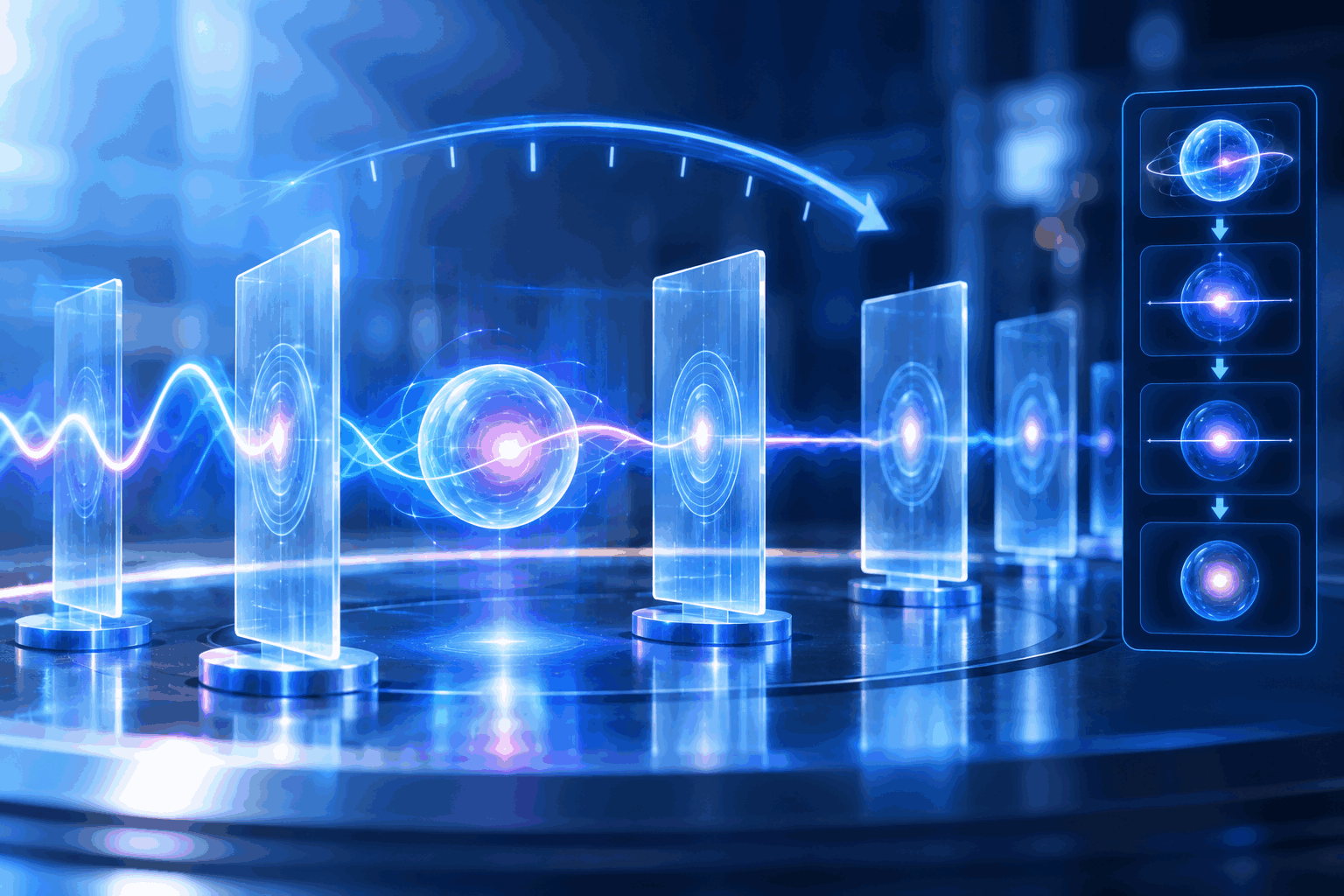
The folk saying "a watched pot never boils" captures the intuition, but quantum mechanics sharpens it into something far more radical. In the quantum domain, sufficiently frequent observation does not merely slow a process down. It can halt it completely. The system becomes trapped in its initial state, as though time itself has been locally suspended. This is the quantum Zeno effect, and it is not a metaphor. It is a theorem with experimental confirmation.
The Physics Engine: Why Measurement Freezes Decay
The Quadratic Short-Time Law
Most textbooks present radioactive decay as a clean exponential process: the survival probability drops as e−λt, implying a constant decay rate at every moment. This picture is accurate over intermediate timescales, but it fails at the very shortest times. The reason is structural. Quantum evolution is governed by the Schrödinger equation, which is unitary and deterministic between quantum measurement events. Unitarity imposes a constraint that exponential decay violates at t → 0.
Expanding the time-evolution operator U(t) = e−iHt/ℏ to second order and computing the overlap with the initial state |ψ₀⟩, one finds that the survival probability takes the form:
P(t) ≈ 1 − αt²
Here α is a positive constant determined by the energy variance of the initial state under the full Hamiltonian: α = (ΔH)²/ℏ². The critical point is the quadratic dependence on time. The decay probability grows as t², not as t. This means that in the earliest moments, the system barely moves at all. The transition rate, defined as the derivative of the decay probability, starts at zero and builds up gradually.
The Projection Postulate as a Reset Button
Under the Copenhagen interpretation, a measurement of whether the system remains in its initial state constitutes a projection. If the answer is "yes, still in |ψ₀⟩," the wavefunction collapses back to |ψ₀⟩. All accumulated amplitude in other states is erased. The system is reset to the starting line.
This reset is the mechanical heart of the Zeno effect. Each measurement wipes out the small amplitude that had begun to leak into decay channels, forcing the system to restart its quadratic buildup from scratch.
Step-by-Step: How Infinite Measurements Lock the System
Suppose we wish to observe a system over a total time t. We divide this interval into N equal sub-intervals, each of duration Δt = t/N, and perform a measurement at the end of each sub-interval.
The probability of finding the system still in its initial state after one sub-interval is:
P(Δt) ≈ 1 − α(Δt)² = 1 − α(t/N)²
Because each measurement resets the state, the probabilities multiply independently. After all N measurements, the total survival probability is:
Ptotal = [1 − α(t/N)²]N
For large N, we can use the approximation (1 − x)N ≈ 1 − Nx when x is small. This gives:
Ptotal ≈ 1 − αt²/N
Now take the limit. As N → ∞, the correction term αt²/N vanishes. The survival probability approaches unity. The system never leaves its initial state. Evolution is frozen not by any external force, but by the sheer frequency of interrogation.
This is not a perturbative trick or an approximation artifact. Misra and Sudarshan proved in 1977 that under general conditions on the Hamiltonian, the limit is rigorous: continuous observation yields a projection-valued dynamics that confines the system to the eigenspace of the measured observable.
From Blackboard to Reality: Experimental Verification
The theoretical edifice was laid by Baidyanath Misra and E.C.G. Sudarshan in their 1977 paper "The Zeno's Paradox in Quantum Theory," published in the Journal of Mathematical Physics. They demonstrated that the quantum measurement postulate, applied repeatedly, produces a dynamical superselection rule: the system is confined to a subspace and cannot evolve out of it. The paper was mathematically airtight but experimentally ahead of its time.
The breakthrough came in 1990 at the National Institute of Standards and Technology (NIST). A team led by Wayne Itano and David Wineland trapped an ensemble of approximately 5,000 beryllium-9 ions (9Be+) in a Penning trap and drove a two-level transition using a resonant radio-frequency field. The "decay" here was not nuclear but a coherent Rabi oscillation between two hyperfine ground states. To implement the Zeno measurements, they applied short ultraviolet laser pulses that scattered photons only if the ion occupied one specific state. Each scattered photon constituted a measurement: the ion was found to be "still here" or "already gone."
The results were unambiguous. With no measurement pulses, the ion underwent full Rabi oscillations. As the number of measurement pulses increased during a fixed evolution time, the transition probability dropped dramatically. At the highest measurement rates, the ion remained in its initial state with near-unit probability. The data matched the quadratic-law prediction quantitatively.
Since then, the effect has been confirmed across physical platforms. Superconducting transmon qubits have demonstrated Zeno dynamics through repeated dispersive readout. Nuclear magnetic resonance experiments have shown Zeno suppression of spin transitions. Photonic systems have used repeated weak measurements to inhibit photon tunneling between coupled waveguides. Each platform tests a different facet of the same underlying principle: frequent projection inhibits coherent evolution.
The Flip Side: The Quantum Anti-Zeno Effect
The Zeno effect is not the whole story. Under certain conditions, frequent measurements do the opposite: they accelerate decay. This is the quantum anti-Zeno effect, and its existence shatters the naive belief that observation always freezes dynamics.
The key lies in the spectral structure of the environment. The quadratic short-time law holds only when the measurement interval is shorter than a characteristic timescale set by the reservoir's spectral density. If measurements are frequent but not frequent enough—landing in an intermediate regime where the system samples the non-Markovian structure of the bath—the effective decay rate can increase. The measurements, rather than resetting the system, repeatedly push it into energy regions where the density of final states is higher, enhancing the transition rate.
Experimentally, the anti-Zeno effect was observed in 2001 by Mark Raizen's group at the University of Texas, using ultracold sodium atoms in an accelerating optical lattice. By tuning the measurement interval, they demonstrated both suppression and enhancement of tunneling, confirming that the boundary between Zeno and anti-Zeno behavior is controlled by the ratio of the measurement period to the reservoir correlation time.
| Dimension | Classical Observation | Quantum Zeno Effect | Quantum Anti-Zeno Effect |
|---|---|---|---|
| Mechanism | Passive information gathering; no back-action on the system | Repeated projective measurement resets the wavefunction, exploiting quadratic short-time survival | Measurements at intermediate frequency couple the system to high-density regions of the reservoir spectrum |
| Timescale Regime | Irrelevant; observation rate does not alter dynamics | Measurement interval ≪ reservoir correlation time (deep quadratic regime) | Measurement interval comparable to reservoir correlation time (non-Markovian crossover) |
| Effect on Evolution | None; system evolves identically whether observed or not | Decay or transition is suppressed; system is frozen in initial state | Decay or transition is accelerated beyond the natural rate |
| Classical vs. Quantum Nature | Purely classical; no wavefunction collapse involved | Inherently quantum; requires superposition, projection postulate, and unitary short-time dynamics | Inherently quantum; arises from spectral overlap between measurement-induced broadening and bath density of states |
Practical Frontiers: Protecting Quantum Technologies
The quantum Zeno effect is not merely a conceptual curiosity. It has become a design principle in quantum engineering, particularly in the fight against decoherence—the process by which fragile quantum superpositions leak information into the environment and collapse into classical mixtures.
One promising approach uses the Zeno effect to define protected computational subspaces, sometimes called Zeno subspaces. The idea is straightforward: if you repeatedly measure whether the system has left a designated code space, the measurement itself prevents the leakage. The system is dynamically confined without requiring strong corrective pulses. This is conceptually distinct from standard quantum error correction, which detects errors after they occur and applies recovery operations. Zeno-based protection is preemptive. It stops errors from accumulating in the first place.
In superconducting qubit architectures, researchers have implemented Zeno stabilization by coupling ancilla qubits to data qubits in a way that continuously monitors for leakage out of the computational manifold. When leakage is detected, the measurement back-action projects the system back. The net effect is an extended coherence time without the overhead of full syndrome extraction.
Another application is measurement-driven state preparation. Instead of applying a sequence of unitary gates to steer a system toward a target state, one can engineer a measurement protocol that gradually funnels the system into the desired state through repeated projection. This "dissipative state engineering" leverages the Zeno mechanism to make the target state an attractor of the measurement dynamics. The approach has been demonstrated in trapped-ion systems and photonic networks, offering a route to robust state preparation that is inherently fault-tolerant against certain classes of control errors.
Perhaps most intriguingly, the Zeno effect enables a form of quantum control that requires minimal energy input. Because the freezing mechanism relies on information extraction rather than force application, it is possible to steer quantum systems using only weak, non-demolition measurements. This has implications for quantum sensing, where one wishes to probe a system without disturbing it, and for quantum thermodynamics, where the energetic cost of control operations is a central concern.
Epilogue: The Nature of Quantum Observation
In the classical world, observation is passive. A thermometer does not change the temperature of the room it measures. A camera does not alter the trajectory of the object it photographs. Information flows one way: from system to observer. The system does not know it is being watched.
Quantum mechanics demolishes this separation. Measurement is not a passive act of reading. It is a physical interaction that restructures the state of the system. The quantum Zeno effect is the starkest demonstration of this principle: the mere act of asking "are you still here?" forces the system to answer by collapsing into a definite configuration, erasing the coherent superposition that would have carried it elsewhere.
Zeno's ancient arrow, frozen at every instant, finds its true home not in philosophy but in the Hilbert space of quantum theory. The arrow does not move because we keep looking. And in that looking, we do not discover reality—we participate in making it.
Frequently Asked Questions
Does the Quantum Zeno Effect require a human conscious observer?
No. In quantum mechanics, a "measurement" does not require consciousness. It requires a physical interaction between the quantum system and an environment or measuring apparatus that decoheres the superposition and extracts state information (a projective operation).
What is the difference between the Quantum Zeno and Anti-Zeno effects?
The Quantum Zeno Effect freezes or suppresses decay by measuring the system faster than the reservoir's correlation time (quadratic regime). The Quantum Anti-Zeno Effect accelerates decay when measurement intervals match intermediate timescales, coupling the system to a higher density of environmental states.
How is the Quantum Zeno Effect used in quantum computers?
It is used for decoherence suppression, Zeno subspace confinement, and dissipative state preparation. Instead of applying active quantum error correction code cycles after errors occur, continuous non-destructive monitoring prevents qubits from leaking out of their computational manifold in the first place.
Contact Us
 (+86) 177 3001 9472
 market@originqc.com