Quantum Error Correction? A Simple Guide for Beginners
Quantum Error Correction (QEC) is an algorithmic framework that protects quantum information from environmental noise and hardware faults. Because the no-cloning theorem and wave-function collapse prevent direct copying or measurement, QEC entangles an arbitrary quantum state across an ensemble of physical qubits to form a single, highly resilient logical qubit, diagnosing errors via non-destructive syndrome measurements.
A quantum computer does not fail in the same way a classical computer fails. A classical bit is designed to settle into one of two stable states, 0 or 1. A qubit can occupy a coherent superposition, acquire a relative phase, and become entangled with other qubits. Those properties make quantum computation powerful, but they also leave the information exposed to tiny disturbances from the hardware and its environment.
That is the central problem addressed by quantum error correction (QEC). The goal is not to make a physical qubit perfect. It is to spread one fragile quantum state across many physical qubits so that errors can be detected, diagnosed, and corrected without directly measuring the quantum information being protected.
This distinction matters. Useful quantum computing cannot simply depend on having more physical qubits. The machine must turn unreliable physical qubits into reliable logical qubits. That transition is one of the defining engineering problems of fault-tolerant quantum computing.
Why Quantum Computers Are Hopelessly Fragile
Quantum information lives on a narrow physical ledge. A superconducting qubit can be disturbed by electromagnetic fluctuations, imperfect control pulses, leakage into unwanted energy states, thermal effects, crosstalk, and defects in the surrounding materials. Trapped ions and neutral atoms face different error sources, but the underlying problem is similar: the physical system is never perfectly isolated.
Quantum coherence is especially vulnerable. A useful quantum state depends not only on the probabilities of measuring 0 or 1, but also on the phase relationship between components of the superposition. Environmental interaction gradually leaks information about that state into degrees of freedom we do not control. That process is called decoherence.
There is a simple way to see why this becomes catastrophic in a real computation. Suppose a physical gate has a small probability of introducing an error. A circuit containing thousands or millions of operations gives those small probabilities many opportunities to accumulate. Increasing circuit depth without reducing the underlying error rate eventually turns a coherent computation into noise.
This is why quantum error correction is not an optional refinement added after a quantum computer becomes large. It is the mechanism that makes long computations physically possible at all.
Why Classical Error Correction Fails
Classical error correction has an intuitive trick. If a bit is important, copy it several times. Store 000 for a logical 0 and 111 for a logical 1. If one storage element flips, the majority vote recovers the original information.
We cannot do the same thing to an arbitrary unknown quantum state.
The reason is the no-cloning theorem. Quantum mechanics does not permit a universal operation that takes an unknown state |ψ⟩ and produces two independent copies, |ψ⟩|ψ⟩. The prohibition is not a limitation of current hardware. It is built into the linearity of quantum mechanics.
Think of an unknown quantum state as a soap bubble whose surface contains the information we care about. You cannot photograph that bubble perfectly, print the photograph, and produce an identical second bubble without learning something that quantum mechanics forbids you from learning. The problem is fundamental, not technological.
Direct measurement creates a second obstacle. Measuring an unknown qubit in the computational basis tells us whether the outcome is 0 or 1, but it does not preserve an arbitrary superposition such as |ψ⟩ = α|0⟩ + β|1⟩. The measurement projects the state onto an eigenstate of the measurement basis.
So a naive strategy fails twice: we cannot make ordinary copies of the unknown state, and we cannot simply inspect the qubit to find out whether an error occurred without potentially destroying the information we are trying to protect.
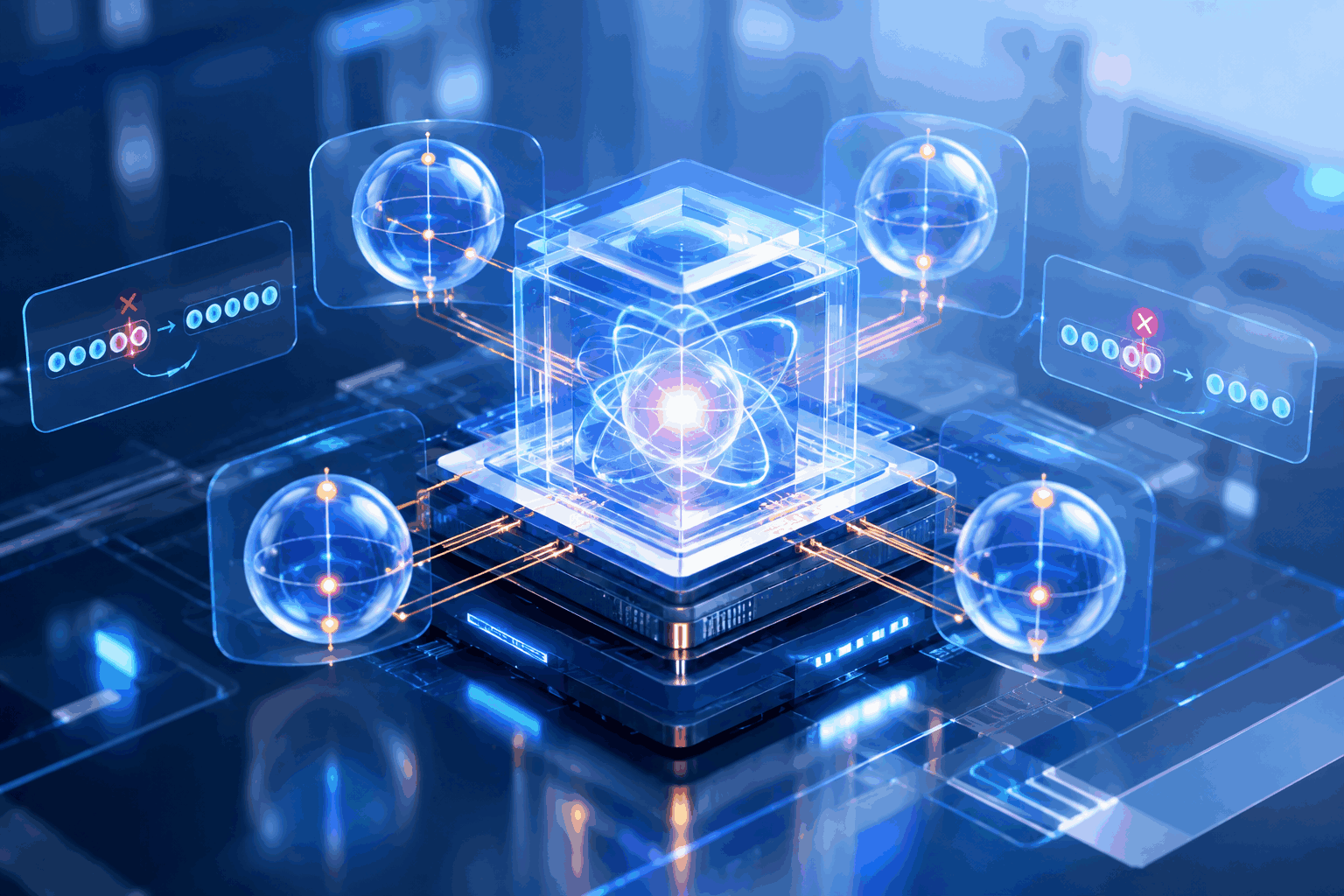
Quantum error correction gets around this trap by encoding information into a larger entangled state. We do not ask, “What is the state of my logical qubit?” We ask a narrower question: “Which error pattern has occurred?”
How Quantum Error Correction Works Without “Looking”
The key object is the error syndrome. A syndrome contains information about the error affecting an encoded state, while deliberately avoiding information about the logical state itself.
To see the principle, consider the two basic Pauli errors: an X error, usually described as a bit flip, and a Z error, a phase flip.
An X error transforms |0⟩ into |1⟩ and |1⟩ into |0⟩. A Z error behaves differently: it leaves |0⟩ unchanged but adds a minus sign to |1⟩. That minus sign may sound harmless when looking at one isolated qubit. It is not. In a quantum superposition, relative phase controls interference, so a phase error can change the outcome of an entire computation.
This is one reason quantum error correction cannot simply be a classical repetition code with quantum hardware. The code must protect both kinds of information.
The trick is to introduce ancilla qubits. These extra qubits interact with the encoded data through carefully chosen gates. We then measure the ancillas rather than directly measuring the logical qubit. Their measurement results reveal parity information about the encoded state.
A useful analogy is a sealed mechanical gearbox. We do not open the casing and examine the gears. Instead, we place a few sensors on the housing and listen for characteristic vibrations. The sensor readings tell us that something changed inside, but they do not reveal the exact position of every gear.
Quantum syndrome measurement works in a similar spirit. The stabilizer measurements tell the decoder whether the error pattern is compatible with “no error,” an X-type error, a Z-type error, or some combination. The protected quantum state remains encoded throughout the process.
| Feature | Classical Error Correction | Quantum Error Correction |
|---|---|---|
| Redundancy | Copies or parity bits can directly replicate classical information. | Quantum information is encoded across entangled physical qubits. |
| Copying | Arbitrary classical bits can be copied. | An unknown quantum state cannot be universally cloned because of the no-cloning theorem. |
| Error types | Often modeled as bit flips or symbol corruption. | Must account for bit-flip (X), phase-flip (Z), and combined errors. |
| Measurement | Reading a bit normally does not destroy its classical value. | Direct measurement of an unknown quantum state can disturb or collapse the state. |
| Error detection | Parity checks can identify inconsistent copies or symbols. | Ancilla-assisted syndrome measurement extracts parity information without directly measuring the logical state. |
| Protected object | A classical bit or block of bits. | A logical qubit encoded across many physical qubits. |
| Decoder | Chooses the most likely original bit pattern. | Infers a likely physical error pattern from noisy syndrome measurements. |
| Goal | Recover the original digital value. | Preserve coherent quantum information and perform gates while suppressing logical errors. |
Real devices make the problem harder because the syndrome measurements themselves are noisy. A decoder must therefore reason from a time series of imperfect measurements rather than from a clean list of facts. Modern surface-code experiments increasingly treat decoding as a systems problem involving specialized classical hardware, real-time processing, and increasingly sophisticated algorithms.
Surface Codes: The Industry's Favorite Frontrunner
Among the many proposed quantum error-correcting codes, surface codes have become one of the most extensively developed approaches for superconducting and other architectures with local two-qubit interactions.
The basic structure is geometric. Qubits are arranged on a two-dimensional lattice, with data qubits interleaved with measurement qubits that repeatedly check stabilizer constraints. Instead of storing one logical qubit in one physical location, the logical information is encoded in a collective property of the entire patch.
The important parameter is the code distance, usually written as d. Roughly speaking, a larger distance means that more physical errors are required to create an undetectable logical error. In a surface-code lattice, the code distance is related to the shortest nontrivial logical operator connecting opposite boundaries of the code.
Suppose a single physical qubit suffers an X error. The surrounding stabilizers can produce a characteristic pattern of syndrome changes. A decoder examines these detection events and infers where the error most likely occurred. If the errors remain sparse enough, the decoder can identify a correction before the accumulated damage becomes a logical operation.
But there is a threshold.
Below the fault-tolerance threshold, increasing code distance can push the logical error rate down rapidly. Above it, adding more qubits does not rescue the computation. The additional qubits introduce roughly as many new opportunities for errors as they provide redundancy.
The often-quoted “about 1%” threshold is a useful rule of thumb, not a universal constant. The actual threshold depends on the code, physical error model, leakage, connectivity, measurement circuit, decoder, and correlated-error assumptions. For practical surface-code systems, the relevant question is whether the complete error process—including gates, measurements, resets, and decoding—sits below the effective threshold.
Physical Qubits vs. Logical Qubits
This is where the elegant theory meets uncomfortable engineering.
A physical qubit is a hardware element: a superconducting circuit, trapped ion, neutral atom, photon, or another quantum degree of freedom used to carry information. A logical qubit is an encoded quantum state whose reliability comes from the coordinated behavior of many physical qubits.
The conversion rate is not one-to-one.
For a simplified rotated surface-code patch, the number of physical data and syndrome qubits grows roughly with the square of the code distance. A larger distance provides stronger protection, but it also demands more qubits, more gates, more measurements, more control wiring, more decoding capacity, and more opportunities for correlated failures.
That is why figures such as 1,000 physical qubits per logical qubit sometimes appear in engineering discussions. The number is not a fundamental law of quantum computing. It is an order-of-magnitude planning figure that can become reasonable for demanding fault-tolerant workloads once realistic code distances, syndrome extraction, routing, leakage handling, spare capacity, and logical-gate overhead are included.
The exact ratio can be dramatically lower or higher depending on the error-correcting code and the hardware architecture. Quantum low-density parity-check codes, for example, are being investigated specifically because they can achieve higher encoding rates than conventional surface-code constructions, although they impose harder connectivity and decoding requirements. Neutral-atom architectures are particularly interesting here because reconfigurable atom arrays can provide connectivity patterns that are awkward for fixed planar hardware.
There is another hidden cost: not every logical qubit is equally useful. A fault-tolerant processor needs reliable logical gates, logical measurements, qubit movement or routing, fast syndrome processing, and often large resources for preparing high-quality non-Clifford resources such as magic states.
The machine is therefore not simply converting “1,000 bad qubits into 1 good qubit.” It is building an entire error-corrected computing stack around those qubits. For more information, please see: Physical Qubits vs Logical Qubits
Current Milestones and the Road to Commercial Fault Tolerance
The field has crossed an important boundary: quantum error correction is now an experimental engineering discipline rather than a purely theoretical promise. The harder question is whether today's demonstrations can be assembled into machines capable of running useful computations for long enough to justify their enormous physical overhead.
Google Quantum AI has demonstrated below-threshold surface-code memory scaling on its superconducting platform, including a 101-physical-qubit distance-7 logical memory. More recent work reported further improvements in logical stability and a surface-code logical error rate below 10-3 per cycle under the tested conditions. These results show continuing progress in controlling drift, calibration, decoding, and repeated error correction, but they do not by themselves amount to a large universal fault-tolerant computer.
IBM is pursuing a different combination of hardware scaling, connectivity improvements, quantum-classical control, and error-correction architectures. Its public roadmap calls for real-time error-correction decoding work in 2026 and targets a first fault-tolerant system, Starling, for 2029. Those dates are company roadmap targets, not established delivery dates, and IBM explicitly notes that its roadmap represents current intent and may change.
Neutral-atom platforms are pushing along another route. Experiments have demonstrated repeated surface-code error correction, logical operations, qubit reuse, and fault-tolerant architecture components using reconfigurable atom arrays. A 2026 Nature study used up to 448 neutral atoms to explore below-threshold error correction, logical entanglement, teleportation-based universal operations, and physical-qubit reset strategies.
The break-even point provides a more useful scientific milestone than a headline qubit count. A QEC system reaches break-even when the encoded logical qubit can survive longer, or operate with lower error, than the best comparable unencoded physical qubit. Experiments have achieved break-even improvements in several architectures, including superconducting cavity-based codes and neutral-atom logical processors.
Frequently Asked Questions About Quantum Error Correction
Why can't classical error correction methods protect quantum computers?
Classical error correction relies on duplicating data (e.g., repetition codes) and direct parity checks. This fails in quantum systems for two fundamental physics reasons: the No-Cloning Theorem strictly forbids creating identical copies of an unknown quantum state, and direct measurement collapses the fragile superposition wavefunction, instantly destroying the computational information.
Why does a logical qubit require around 1,000 physical qubits?
To run deep fault-tolerant circuits, the logical error rate must drop exponentially (e.g., to 10-12 or lower). In 2D surface codes, physical qubit counts scale quadratically with code distance (d²). Accounting for data qubits, syndrome ancillas, routing overhead, and magic state distillation factories, realistic engineering architectures typically require hundreds to thousands of physical qubits per single protected logical qubit.
What is the "break-even point" in quantum error correction?
The break-even point is the critical milestone where an encoded logical qubit demonstrates a longer coherence lifetime and lower error rate than the single best unencoded physical qubit in the same system. Crossing break-even proves that the error-suppression benefits of QEC outweigh the noise introduced by the extra hardware and syndrome-extraction circuits.
Contact Us
 (+86) 177 3001 9472
 market@originqc.com