History of Quantum Computing: Timeline, Pioneers & Breakthroughs
Quick Summary: The history of quantum computing is a 40-year evolution from theoretical physics to computational reality. Originating with Yuri Manin and Richard Feynman's early 1980s proposals to simulate nature using quantum mechanics, the field gained strategic urgency through Peter Shor's 1994 factoring algorithm. Today, the discipline has moved past the noisy intermediate-scale quantum (NISQ) era into experimental fault-tolerant, error-corrected quantum architecture.
Picture a chalkboard at MIT, May 1981. Richard Feynman—Nobel laureate, bongo player, notorious prankster—stands before a room of physicists and says something that sounds almost like a complaint. He's frustrated. Not with people. With machines.
His problem was deceptively simple. Physicists had spent decades writing down the equations that govern atoms, electrons, and photons. The math was beautiful. The predictions were stunningly accurate. But when they tried to feed those equations into the best computers available, the machines choked. A system of just 50 interacting quantum particles required more memory than all the computers on Earth could provide. The numbers grew exponentially, like a debt compounded every nanosecond.
Feynman's insight was blunt, almost rude in its simplicity: "Nature isn't classical, and if you want to make a simulation of nature, you'd better make it quantum mechanical." He wasn't proposing a product. He was pointing at a wall and saying, we cannot climb this with the tools we have.
Around the same time, a physicist named Paul Benioff at Argonne National Laboratory was quietly publishing papers showing that a computer could, in principle, operate under the rules of quantum mechanics without violating any known law of physics. Benioff's work was theoretical—ink on paper, no hardware. But it proved the concept wasn't forbidden by the universe. That distinction mattered enormously. It turned Feynman's provocation from a philosophical wish into a legitimate engineering target.
This is where the history of quantum computing truly begins. Not with a chip. Not with a lab. With a physicist's irritation at a limitation, and another physicist's quiet proof that the limitation could, in theory, be overcome.
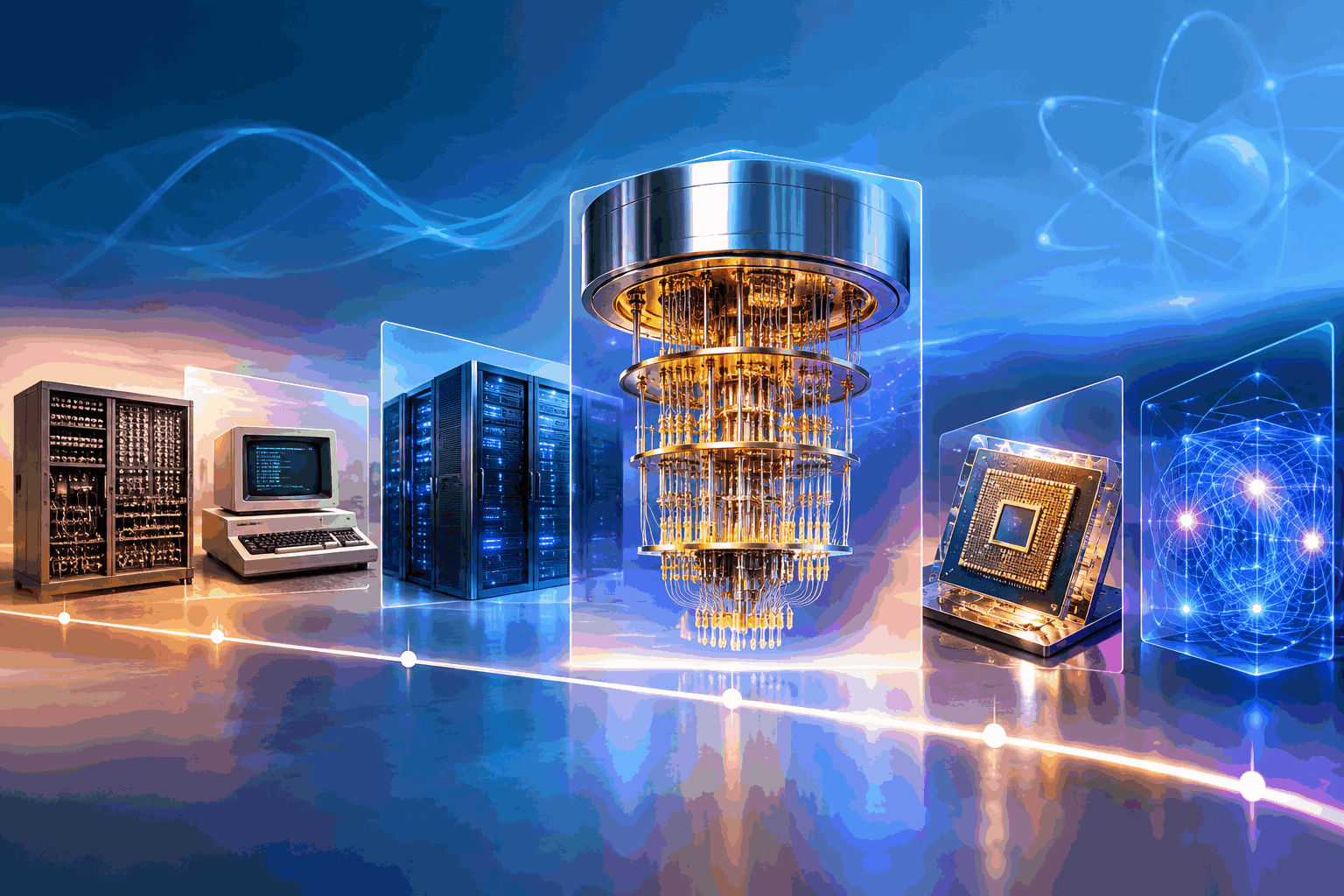
From Blackboard to Blueprint: The Mathematical Breakthroughs (1985–1996)
For most of the 1980s, quantum computing lived in a strange limbo. Physicists knew it was possible. Nobody could say it was useful. The field needed someone to show what a quantum computer could actually do that a classical one could not.
David Deutsch, a physicist at Oxford, provided the first real answer in 1985. He described a "universal quantum computer"—a theoretical machine that could simulate any other quantum system, the same way a classical universal Turing machine can simulate any classical computation. Deutsch's paper didn't excite governments. It didn't attract funding. But it gave the field a formal language, a grammar. Without it, everything that followed would have been hand-waving.
Then came 1994. Peter Shor, a mathematician at Bell Labs, published Shor's algorithm, which could factor large numbers exponentially faster than any known classical method. On its face, this sounds like a niche number theory result. In practice, it was a detonation.
Here's why. The security of nearly every online transaction, every military communication, every encrypted email in the world rested—and still rests—on the assumption that factoring large numbers is computationally infeasible. RSA encryption, the backbone of internet security, is built on that assumption. Shor's algorithm said: give me a sufficiently powerful quantum computer, and I can crack that assumption like a walnut.
The reaction was not academic excitement. It was institutional alarm. The U.S. National Security Agency, the Department of Defense, and intelligence agencies worldwide began pouring money into quantum computing research almost overnight. The field went from a curiosity discussed at small workshops to a strategic priority with classified briefings. Shor didn't just publish a paper. He changed the funding equation for an entire discipline.
Two years later, Lov Grover at Bell Labs published a different kind of algorithm. Grover's method sped up unstructured database searches—finding a needle in a haystack, essentially—from a linear scan to something proportional to the square root of the haystack's size. Less dramatic than Shor's result, but it broadened the case. Quantum computers weren't just codebreakers. They were general-purpose accelerators for specific classes of problems.
The Battle for the First Qubit
Theory was one thing. Building a machine was another entirely.
A quantum bit—a qubit—is not a tiny switch that flips between 0 and 1. Think of it more like a coin spinning on a table. While it spins, it is neither heads nor tails. It exists in a blend of both states simultaneously. The moment you slap your hand down to look—that's measurement—the coin falls. The quantum superposition collapses. You get heads or tails, and the delicate "both-at-once" quality is gone forever.
Now imagine trying to keep thousands of those coins spinning at once, without any vibration, any stray heat, any electromagnetic whisper from the outside world disturbing them. That's the engineering challenge. Physicists call the enemy decoherence—the process by which a quantum system leaks its quantum-ness into the environment and becomes boringly classical. Keeping qubits coherent is like trying to balance a soap bubble on the tip of a needle during a windstorm.
In the late 1990s and early 2000s, several competing approaches emerged, each with fierce advocates:
- Nuclear Magnetic Resonance (NMR): Researchers used the nuclear spins of molecules in liquid solution as qubits. It was the first platform to demonstrate small quantum algorithms. But NMR qubits were weak, noisy, and impossible to scale beyond a handful of particles. The approach was a proof of concept, not a path forward.
- Trapped Ions: Individual atoms, stripped of electrons and suspended in electromagnetic fields, could hold quantum states for remarkably long times. The coherence was beautiful. The problem was speed and scalability—controlling hundreds of individual ions with laser beams was painstakingly slow.
- Superconducting Circuits: Tiny loops of superconducting metal, cooled to temperatures colder than outer space, could behave as artificial atoms. They were fast and could be fabricated using techniques borrowed from the semiconductor industry. But they were fragile, and wiring them together without introducing noise was a nightmare of cryogenic engineering.
No single approach won. The field fractured into competing camps, each convinced the others were chasing dead ends. This rivalry, messy and personal as it sometimes was, drove progress faster than any single roadmap could have.
The Commercial Awakening (2010s)
In 2011, a Canadian company called D-Wave Systems announced it had built a "quantum computer" with 128 qubits and was selling it. The reaction from the academic physics community was, to put it mildly, skeptical.
D-Wave's machine used a technique called quantum annealing—specialized for optimization problems, not general-purpose computation. Critics argued it wasn't a "real" quantum computer in the sense Shor or Deutsch had envisioned. Supporters pointed to speedups on certain benchmark problems. The debate was never fully settled. What D-Wave did accomplish was something arguably more important: it forced the question of quantum computing out of university labs and into boardrooms.
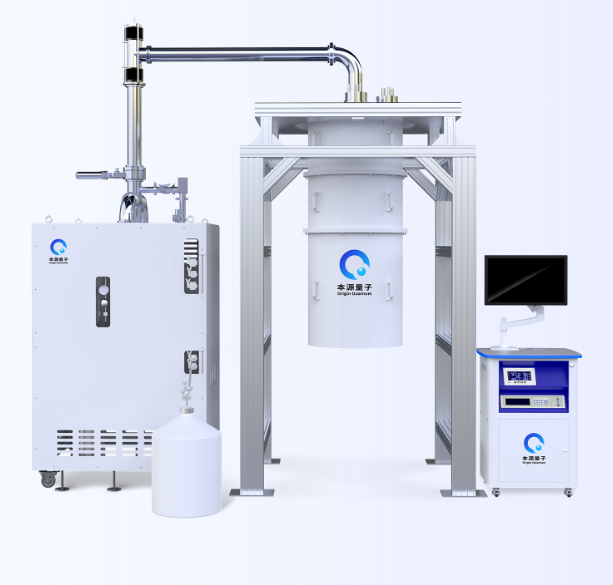
By the mid-2010s, IBM, Google, Intel, and Microsoft had all launched dedicated quantum computing divisions. The machines they built looked nothing like conventional computers. Google's processors sat inside dilution refrigerators—gleaming chandeliers of gold-plated copper and stainless steel, cooled to 15 millikelvin, colder than the void between galaxies. The engineering was as much about plumbing and vibration isolation as it was about physics.
Then came October 2019. Google published a paper claiming its 53-qubit Sycamore processor had performed a specific calculation in 200 seconds that would take the world's most powerful supercomputer approximately 10,000 years. They called it "quantum supremacy."
IBM published a rebuttal within days. Their counter-argument: with clever classical algorithms and enough disk storage, the same task could be done in 2.5 days, not 10,000 years. The gap was real, they conceded, but the framing was misleading.
This public spat was, historically speaking, a healthy sign. It meant the field had matured enough for its claims to be stress-tested in the open, rather than accepted on authority.
Milestones of Quantum History at a Glance
| Year | Pioneer / Institution | Historical Breakthrough | Why It Mattered |
|---|---|---|---|
| 1981 | Richard Feynman (MIT) | Argued that quantum systems require quantum computers to simulate efficiently | Defined the problem that motivated the entire field |
| 1994 | Peter Shor (Bell Labs) | Published factoring algorithm exponentially faster than classical methods | Transformed quantum computing from academic curiosity into a national security priority |
| 1998 | Isaac Chuang et al. (IBM/Stanford) | First experimental demonstration of a quantum algorithm (Deutsch's problem) on a 2-qubit NMR device | Proved quantum computation was physically realizable, not just mathematically consistent |
| 2011 | D-Wave Systems | Commercial sale of a 128-qubit quantum annealing machine | Forced industry and governments to confront quantum computing as a market reality, not a distant promise |
| 2019 | Google AI Quantum | Claimed quantum supremacy with 53-qubit Sycamore processor | First credible claim of a quantum machine outperforming classical supercomputers on any task; sparked public and scientific debate |
| 2023 | IBM / Harvard-MIT / Quantinuum | Demonstrations of logical qubits with error rates below physical qubit error rates | Marked the shift from "more qubits" to "better qubits"—the beginning of the fault-tolerance era |
Fault-Tolerant Era: The Shift from Qubit Count to Quantum Error Correction
For most of the 2010s, the public conversation around quantum computing was dominated by a single number: qubit count. Companies issued press releases like arms dealers advertising caliber. 50 qubits. 72 qubits. 127 qubits. The implicit message was that more qubits meant more power, the same way more horsepower means a faster car.
That analogy was always wrong, and by the early 2020s, the field collectively admitted it.
A physical qubit is noisy. It makes errors. Without correction, a computation involving thousands of gate operations will produce garbage long before it finishes. The solution, known since the mid-1990s in theory but brutally hard in practice, is quantum error correction. You encode one "logical qubit" across many physical qubits, using redundancy to detect and fix errors without collapsing the quantum state.
The catch: you might need 1,000 or more physical qubits to create a single reliable logical qubit. So a machine with 1,000 noisy physical qubits might yield only one useful logical qubit. The raw count becomes almost meaningless without context.
By 2023 and 2024, research groups at IBM, Harvard, MIT, and Quantinuum demonstrated that logical qubits could actually outperform the physical qubits underneath them—that error correction was not just theoretically sound but experimentally achievable. This was a quiet milestone, far less photogenic than a "supremacy" headline, but arguably more significant for the long arc of the history of quantum computing. It meant the field had moved from asking "can we build this?" to asking "can we make it reliable enough to matter?"
Common Historical Misconceptions
Were quantum computers designed to replace classical consumer PCs?
No. Quantum computers operate on linear algebraic transformations over Hilbert spaces, offering polynomial or exponential speedups exclusively for specific mathematical topologies (such as Hamiltonian simulation, discrete logarithms, and combinatorial optimization). They are fundamentally ill-suited for serial processing tasks like web browsing, operating systems, or general business computing.
Did the intelligence community invent quantum computing to break encryption?
No. The foundations of quantum information science originated purely in fundamental physics—specifically Benioff's analysis of reversible Turing machines and Feynman's need to simulate many-body quantum mechanical phenomena. Peter Shor's 1994 cryptanalysis discovery occurred over a decade after the field's formal physical inception.
Is quantum computing an experimental discovery from the past decade?
No. The mathematical formalisms, basic quantum logic gates, and early physical implementations were established in the late 20th century. Modern acceleration reflects advancements in cryogenic control, high-frequency microwave engineering, and nanoscale fabrication, rather than recently formulated physical theories.
The history of quantum computing is not characterized by a single sudden epiphany. It represents forty years of interdisciplinary friction—mathematicians formalizing complexity bounds, physicists taming thermal noise, and engineers fabricating nanoscale devices that manipulate individual quantum states. The era of noise-dominated proofs of concept is receding; the era of fault-tolerant logical computation has quietly begun.
Contact Us
 (+86) 177 3001 9472
 market@originqc.com