The Quantum Mechanical Model of the Atom: A Complete Guide
The quantum mechanical model of the atom is the modern atomic theory that treats electrons not as localized particles in planetary orbits, but as matter waves described by mathematical wavefunctions (ψ). Developed by Erwin Schrödinger, it uses three-dimensional probability distributions—known as atomic orbitals—to predict the statistical likelihood of locating an electron within an atom.
That is the formal definition. But to truly understand what electrons are doing inside an atom, we first have to unlearn the most famous diagram in the history of science.
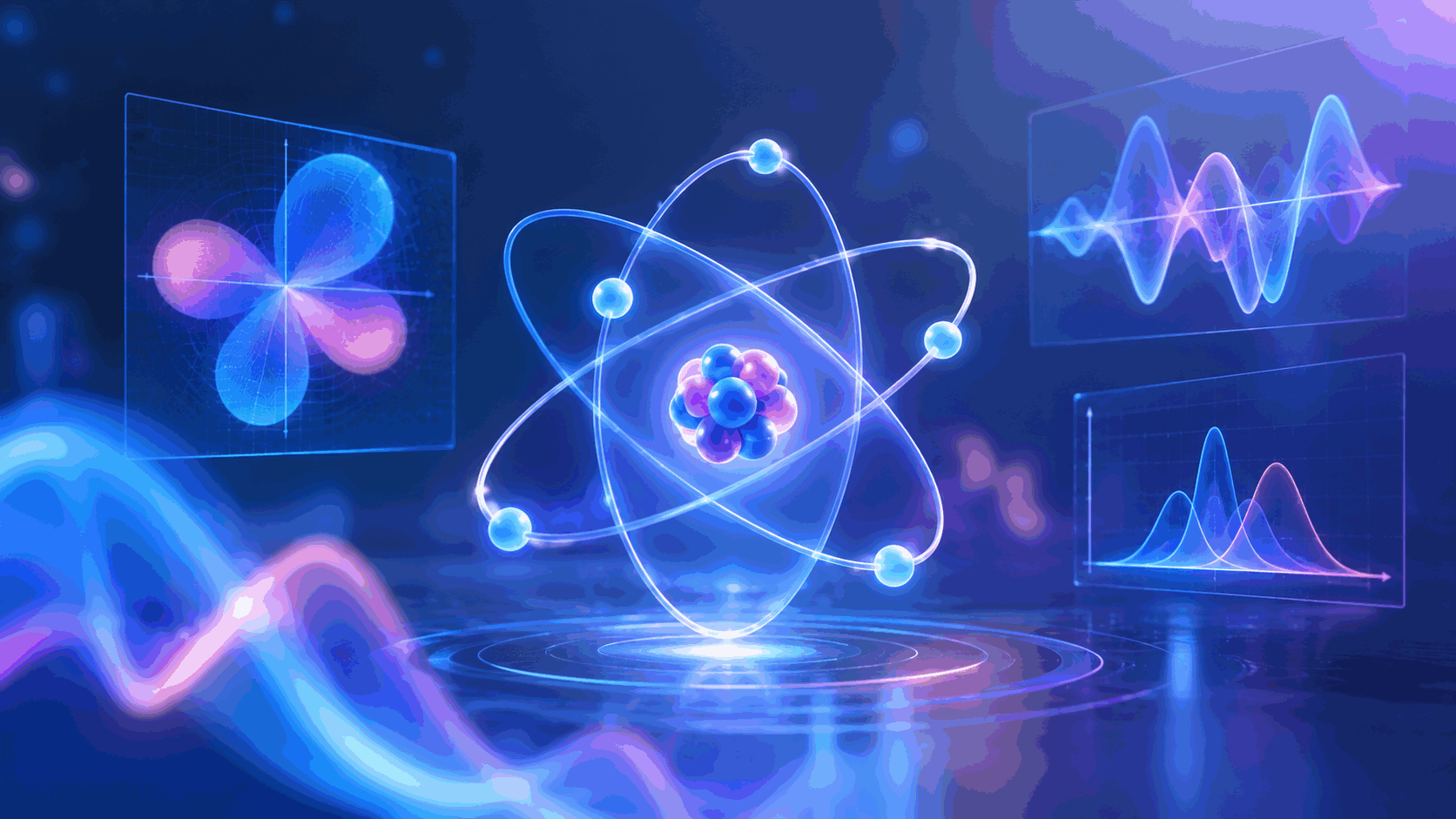
The Flaw in the Solar System Analogy
Open any middle school science book and you will see it: a neat nucleus circled by tidy planetary rings with electrons dotted along them like beads on a wire. This is the Bohr model. It is intuitive, visually clean—and fundamentally, catastrophically wrong.
Here's the physics that kills it. An electron carries electric charge. Classical electromagnetism—Maxwell's equations, stuff verified to absurd precision—tells us that any accelerating charged particle must radiate energy as electromagnetic waves. An electron moving in a circle is accelerating (centripetal acceleration, even at constant speed). So a Bohr-style electron should continuously bleed energy, spiral inward, and crash into the nucleus in roughly 10-11 seconds.
Every atom in your body should have self-destructed before you finished reading this sentence. Obviously, that doesn't happen. Something is deeply off about the planetary picture.
Niels Bohr tried to patch this by declaring certain orbits "allowed" and forbidding radiation within them. That's not an explanation. That's a rule imposed by fiat. It works numerically for hydrogen, sure, but it falls apart the moment you add a second electron. Helium already breaks it.
The Quantum Mechanical Model doesn't patch the old picture. It demolishes the premise entirely.
The Paradigm Shift: From Certainty to Probability
Two ideas, arriving almost simultaneously in the mid-1920s, shattered the notion that we can pin down an electron's exact location and velocity at the same time.
Louis de Broglie proposed that matter has wave properties. Not just light—matter. An electron with momentum p carries a wavelength λ = h/p. For a baseball, that wavelength is so absurdly tiny it's meaningless. For an electron confined to an atom? That wavelength is comparable to the atom's own size. The electron can't be treated as a point particle tracing a line. It behaves like a standing wave wrapped around the nucleus.
Werner Heisenberg then delivered the knockout punch. His Uncertainty Principle states that the more precisely you know a particle's position, the less precisely you can know its momentum, and vice versa. This isn't a measurement limitation. It's not about clumsy instruments. It's baked into the geometry of reality. The electron does not possess a simultaneous exact position and exact momentum. The question itself is malformed.
So what do we have instead?
Erwin Schrödinger wrote down a wave equation. Its solution, the wavefunction ψ, doesn't tell you where the electron is. It tells you where the electron is likely to be found if you go looking. Square the wavefunction—ψ²—and you get a probability density map. A three-dimensional landscape of "more likely here, less likely there."
Let's be honest: the word "cloud" gets thrown around a lot, and it's not terrible, but it's lazy. Here's a sharper mental model. Imagine a ceiling fan spinning at full speed. You can't see individual blades. You see a blurred disc. Now ask: where is a given blade at any instant? You can't say. But you can say with confidence that it's somewhere within that disc, and it's more likely to be near the outer edge (where the blade spends more linear distance per rotation) than near the hub. The blurred disc is your probability distribution. The blade is the electron. You never see the blade directly—only the statistical shape it traces over time.
Or try this one. Picture a firefly inside a dark room, moving erratically. You hold a butterfly net and take a thousand random snapshots of where the firefly is when you swing. Plot all those positions on a 3D graph. The resulting density pattern—that's ψ². The firefly was never following a track. It was sampling a probability landscape.
Demystifying Orbitals: They Aren't Physical Roads
This is where vocabulary causes real damage. "Orbit" and "orbital" sound almost identical. They are not synonyms. Not even close.
An orbit is a defined path—a line in space, like a train on a rail. An orbital is a region of space where the probability of finding an electron exceeds some threshold (conventionally 90–95%). It has no boundary wall. The probability just fades asymptotically toward zero. An orbital is a shape, not a route.
There are four families of orbital shapes, labeled s, p, d, and f. Forget the letters' historical origins (sharp, principal, diffuse, fundamental—spectroscopist jargon from the 1800s). What matters is the geometry:
- s orbitals — Spherically symmetric. A ball. The electron probability is the same in every direction from the nucleus. Simple. Elegant. Every energy level has one.
- p orbitals — Dumbbell-shaped. Two lobes on opposite sides of the nucleus, with a node (zero probability) right at the center. Three orientations: px, py, pz. Think of a figure-eight inflated into 3D.
- d orbitals — Four of the five look like four-leaf clovers. The fifth (dz²) resembles a dumbbell with a donut wrapped around its waist. Five orientations total.
- f orbitals — Genuinely weird. Multi-lobed, complex shapes that look like someone crumpled a p orbital and glued extra lobes on. Seven orientations. Rarely encountered outside lanthanide and actinide chemistry.
None of these are physical containers. They're probability sculptures. The electron isn't "inside" the orbital like a marble in a bowl. The orbital is the description of where the electron tends to manifest.
The "Address System" of an Electron: Quantum Numbers Made Human
Every electron in every atom carries a unique set of four quantum numbers. Think of them as a cosmic mailing address. No two electrons in the same atom can share an identical address. That's the Pauli Exclusion Principle, and it's the reason matter has volume, chemistry has structure, and you don't fall through your chair.
Here's the address breakdown:
- Principal quantum number (n) — The city. It sets the energy level and overall size of the orbital. n = 1 is the innermost shell, closest to the nucleus. Higher n means the electron is, on average, farther out and higher in energy.
- Angular momentum quantum number (l) — The street. It determines the orbital's shape. l = 0 gives an s orbital, l = 1 gives p, l = 2 gives d, l = 3 gives f. For a given n, l ranges from 0 to (n − 1).
- Magnetic quantum number (ml) — The house number. It specifies the orbital's orientation in space. For p orbitals (l = 1), ml can be −1, 0, or +1, corresponding to the three spatial directions.
- Spin quantum number (ms) — The roommate's preference. Each orbital can hold at most two electrons, and they must have opposite spins: +½ or −½. This is Pauli's rule in action. Two electrons, same orbital, opposite spin. Like two people sharing a room but insisting on sleeping head-to-toe.
Why should you care about this bookkeeping? Because it explains the periodic table. The entire structure of chemical elements—their reactivity, their bonding behavior, why sodium explodes in water and neon ignores everything—flows directly from how these quantum numbers fill up, shell by shell, subshell by subshell.
Direct Comparison: Bohr Model vs. Quantum Mechanical Model
| Dimension | Bohr Model (1913) | Quantum Mechanical Model (1926–present) |
|---|---|---|
| Core Assumption | Electrons travel in fixed circular orbits at specific radii | Electrons exist as probability distributions described by wavefunctions |
| Electron Path | Defined, deterministic trajectory (like a planet) | No defined path; only statistical likelihood of detection |
| Certainty | Position and momentum simultaneously knowable | Heisenberg Uncertainty Principle forbids simultaneous exact knowledge |
| Applicability | Works only for hydrogen (one-electron systems) | Applies to all atoms, molecules, and solids |
| Key Limitation | Cannot explain multi-electron atoms, chemical bonding, or spectral fine structure | Mathematically complex; exact analytical solutions limited to hydrogen |
The Bohr model isn't useless—it's a pedagogical stepping stone. But treating it as reality is like using a flat-Earth map to navigate ocean currents. It gets you oriented; it won't get you there.
Why This "Abstract Math" Matters in Everyday Life
Here's the catch: the Quantum Mechanical Model isn't just a physicist's thought experiment. It's the load-bearing wall under nearly every technology you touched today.
Chemical bonding. Why does carbon form four bonds? Why is water bent, not linear? Why does diamond differ from graphite despite both being pure carbon? The answers live in orbital overlap, hybridization, and electron probability distributions. Without the quantum model, chemistry is just a list of recipes with no underlying logic.
Semiconductors and transistors. The band theory of solids—which explains why silicon can be coaxed into conducting or insulating depending on doping—is a direct consequence of solving the Schrödinger equation for periodic crystal lattices. Every transistor in your phone, every LED in your screen, every solar cell on a rooftop traces its operating principle back to atomic orbitals merging into energy bands.
Medical imaging and spectroscopy. MRI machines exploit nuclear spin states. Laser eye surgery relies on stimulated emission between quantized energy levels. The colors of neon signs, the absorption spectra used to identify distant stars' compositions—all of it is the Quantum Mechanical Model made visible.
Frequently Asked Questions About the Quantum Mechanical Model
Who actually discovered or proposed the Quantum Mechanical Model?
No single person invented it. Erwin Schrödinger formulated the central wave equation in 1926, but the model stands on contributions from Louis de Broglie (matter waves), Werner Heisenberg (matrix mechanics and uncertainty), Max Born (probability interpretation of ψ²), and Wolfgang Pauli (exclusion principle). Think of it as a cathedral built by several architects, with Schrödinger pouring the foundation.
Why did the Quantum Mechanical Model replace the Bohr Model?
The Bohr model fails for any atom with more than one electron and contradicts the Heisenberg Uncertainty Principle by assigning electrons definite positions and momenta simultaneously. It also cannot explain chemical bonding, spectral line intensities, or fine structure splitting. The Quantum Mechanical Model handles all of these because it abandons fixed paths entirely and works with probability distributions instead.
Does the Quantum Mechanical Model mean electrons can be anywhere in the universe?
Technically the wavefunction extends to infinity, but the probability drops off exponentially with distance. Roughly 90–95% of an electron's probability density is confined within a region about 10-10 meters across—roughly the size of the atom itself. The electron isn't teleporting across the galaxy. It's overwhelmingly localized, with only a vanishingly small tail of probability reaching far away.
What is the main difference between an "orbit" and an "orbital"?
An orbit is a fixed one-dimensional path with a definite radius, like a train locked to its track. An orbital is a three-dimensional probability region with no sharp boundary, describing where an electron is statistically likely to be detected. One is a line you can draw; the other is a volume you can shade.
Contact Us
 (+86) 177 3001 9472
 market@originqc.com