What Is Quantum Measurement? Simple Explanation & Examples
What is quantum measurement? In quantum mechanics, quantum measurement is the physical interaction between a macroscopic measuring apparatus and a microscopic quantum system. This interaction forces a superposition of multiple potential states to collapse into a single, definite outcome governed by the Born rule.
In the everyday world, measurement is passive. You glance at a thermometer, check your speed on a dashboard, read a scale. The thing you're measuring was already there, doing its own thing, and you simply looked. No big deal.
In the quantum world, measurement is something entirely different. It is the act of forcing a particle to choose one definite state out of a cloud of possibilities. Before you measure, the particle isn't secretly hiding a single answer. It genuinely exists in multiple potential states at once. The measurement doesn't reveal a pre-existing fact—it creates the fact.
Here's the analogy that makes this click: imagine a coin spinning on a table. While it spins, it's neither heads nor tails. It's a blur of both. Only when you slap your hand down on it—only at that exact moment of contact—does it become heads or tails. That slap is quantum measurement. The coin didn't have a hidden answer the whole time. Your hand made it decide.
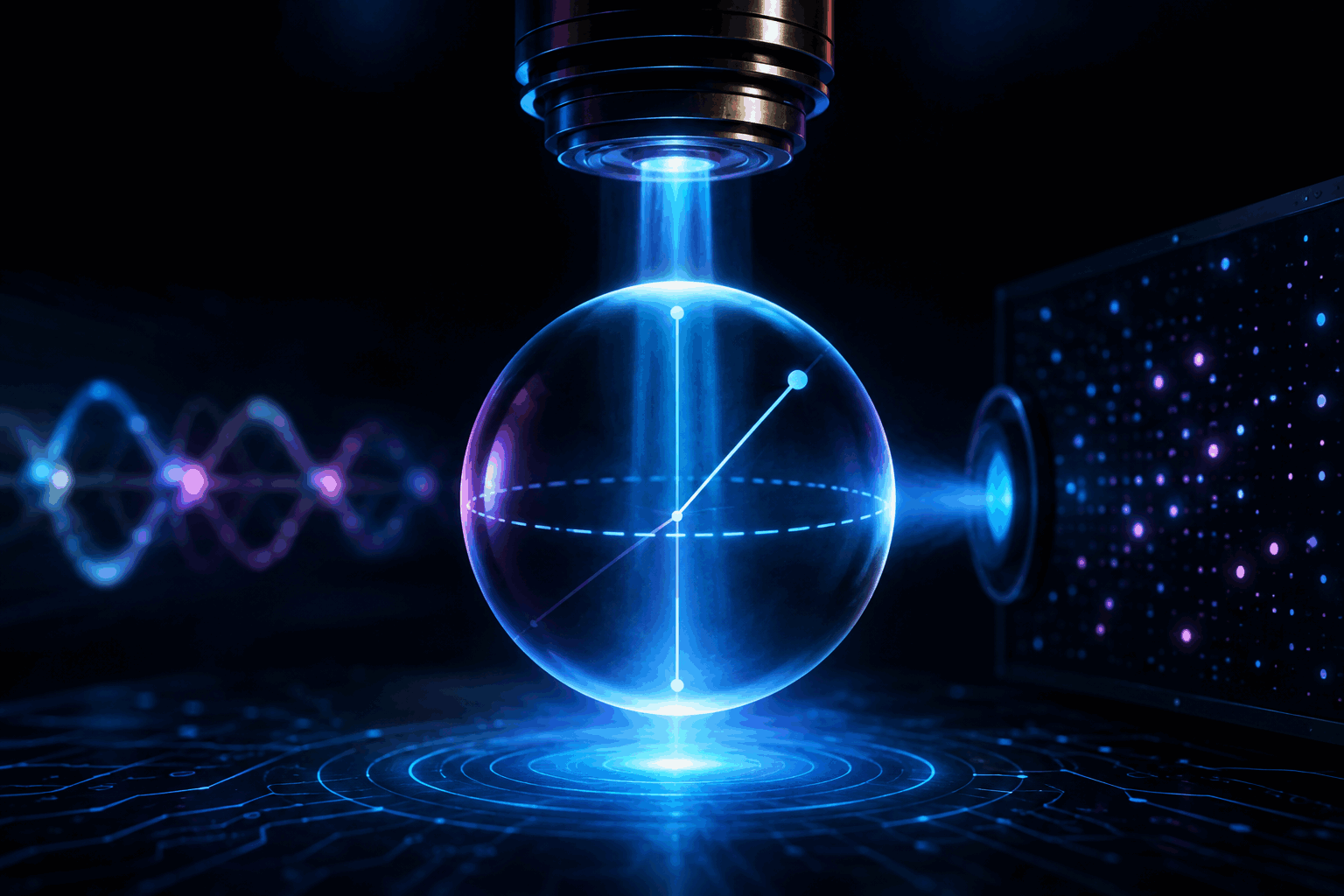
Everyday Measurement vs. Quantum Measurement
Let's make the contrast sharper with something you do every morning.
Classical measurement: You put a thermometer under your tongue. The mercury rises. Your body temperature was already 37°C before the thermometer touched you. The instrument reads a value that existed independently of the reading. You are a passive audience member watching a show that's already in progress.
Quantum measurement: Now shrink yourself down to the scale of an electron. You want to know where it is. To "see" it, you must send something at it—a photon, a detector, some physical interaction. But at this scale, that interaction isn't gentle. It's a collision. You've just kicked the thing you're trying to locate.
Think of it this way: you're standing in a pitch-black room, and someone tells you there's a shuttlecock somewhere on the floor. You have a flashlight, but here's the catch—each photon that leaves your flashlight carries enough momentum to knock the shuttlecock into a different position. The moment your light touches it, it moves. You can find it, but the "it" you found is no longer where it was a nanosecond ago. Pure observation without disturbance is physically impossible at the quantum scale.
This isn't a technology problem. It isn't that our instruments are clumsy. It's a fundamental feature of how nature works.
What Actually Happens During a Quantum Measurement?
Let's walk through the process in three stages, from "before" to "the moment of contact" to "after."
Step 1: Before Measurement — Superposition
Before anyone looks, a quantum particle doesn't sit at one location or carry one fixed value. It exists in what physicists call a superposition—a blend of all its possible states simultaneously.
Picture a roll of undeveloped film. Every possible image is latent in there, but none of them is "the" image yet. That's superposition. The particle is a probability cloud, spread across multiple outcomes, and no single outcome has been selected.
Step 2: The Wave Function — Nature's Probability Map
Physicists describe this probability cloud mathematically using something called the wave function. You don't need the math to get the idea. Think of the wave function as a treasure map where the "X" isn't in one spot—instead, the map shows you shading. Darker regions mean higher probability of finding the particle there. Lighter regions mean lower probability. The particle isn't hiding at one secret location. It is genuinely smeared across the map according to those probabilities.
Step 3: The Moment of Touch — Wave Function Collapse
Now you measure. A detector clicks. A photon hits a screen. A Geiger counter fires.
In that instant, the entire probability cloud collapses into a single, definite point. The balloon of possibilities pops. Out of all the places the particle could have been, you find it in exactly one. The wave function, which was spread wide and fuzzy a moment ago, snaps into a sharp spike at the measured location.
This is wave function collapse, and it is the heart of what quantum measurement means. It's not that we learned where the particle was. It's that the particle, in a very real physical sense, decided where to be—at the moment we asked.
The "Observer Effect" Explained: Does Consciousness Matter?
When physicists say "observation" or "measurement" in quantum mechanics, they do not mean a conscious human looking at something. No brain is required. No awareness is needed. No one has to be in the room.
An "observer" in quantum mechanics is any macroscopic physical interaction that extracts information from a quantum system. That could be:
- A photodetector clicking
- A particle hitting a fluorescent screen and leaving a dot
- An atom bumping into a stray air molecule
- A stray cosmic ray passing through the system
The universe doesn't care whether a human is watching. A rock can be an "observer." A dust mote can collapse a wave function. What matters is that information leaks from the quantum system into the larger, messier environment. Once that happens, the superposition is gone. The measurement has occurred, whether or not anyone checked the results.
The word "observer" is an unfortunate historical relic. "Interaction" would be a far better word, and many modern physicists prefer it.
Schrödinger's Cat
You've probably heard this one. Schrödinger's Cat is sealed in a box with a radioactive atom, a Geiger counter, and a vial of poison. If the atom decays, the poison is released and the cat dies. If it doesn't decay, the cat lives. Quantum mechanics says the atom is in a superposition of decayed and not-decayed until measured. So… is the cat both alive and dead?
Here's what most people miss: Schrödinger proposed this thought experiment to show how absurd it would be to apply quantum rules to everyday objects. He wasn't claiming cats actually exist in half-alive states. He was saying, "Look, if you take this logic seriously at macroscopic scales, you get ridiculous conclusions. Something must be missing from our understanding."
So why don't we ever see a cat that's both alive and dead? The answer is decoherence. In the real world, a cat is made of roughly 1027 atoms. Every single one of those atoms is constantly interacting with air molecules, thermal radiation, the walls of the box, and each other. Each of those interactions acts like a tiny, unconscious measurement. The superposition doesn't survive long enough for anyone to notice it. The environment "measures" the cat trillions of times per second, collapsing any quantum weirdness into a single, boring, classical reality almost instantly.
Quantum superposition is real, but it's fragile. It survives only in extremely isolated systems—single atoms cooled to near absolute zero, photons traveling through vacuum, carefully shielded quantum circuits. The noisy, warm, crowded macroscopic world destroys it almost immediately.
Key Differences at a Glance: Classical vs. Quantum Measurement
| Dimension | Classical Measurement | Quantum Measurement |
|---|---|---|
| State before measurement | The object has a definite, pre-existing value (e.g., temperature is already 37°C) | The particle exists in a superposition of multiple possible states; no single value is "chosen" yet |
| Effect of measurement | Negligible or zero disturbance; reading doesn't change the object | The act of measuring fundamentally alters the system; the superposition collapses to one outcome |
| Role of the instrument | Passive reader; records what already exists | Active participant; the interaction with the instrument is what produces the definite result |
| Outcome predictability | Deterministic in principle; with enough information, you can predict the exact result | Probabilistic; you can predict the odds of each outcome but never which one will occur in a single trial |
FAQ About Quantum Measurement
Can you measure a quantum particle without destroying its state?
Generally, no. A standard measurement collapses the superposition and resets the particle into the state you just measured. However, there is a special class of techniques called quantum non-demolition (QND) measurements that can extract one specific property (like the number of photons in a cavity) without destroying that particular property. The catch? You still disturb other properties of the system. You can never get a completely free, consequence-free reading. Nature always charges a price.
Why can't we just build gentler measuring tools?
To pinpoint a particle's position more precisely, you must use shorter-wavelength (higher-energy) probes, which kick the particle harder. To disturb it less, you need longer wavelengths, which give you blurrier position information. This isn't an engineering limitation we'll solve with better technology. It's a mathematical constraint baked into the structure of the universe. You can redistribute the uncertainty, but you can never eliminate it entirely.
Is quantum measurement completely random?
The individual outcome of a single measurement is genuinely unpredictable—no hidden variable, no secret mechanism that we've found so far determines which result you'll get. But the statistical pattern across many measurements is perfectly predictable. The wave function tells you the exact probability distribution. Roll a quantum die a million times, and the histogram of results will match the wave function's prediction with stunning precision. So: individual events are random; the overall pattern is not. It's randomness with a shape.
Contact Us
 (+86) 177 3001 9472
 market@originqc.com