Quantum Computer Temperature: 5 Architectures Compared
Ten millikelvins. On paper, that number barely registers. Let’s put it into perspective: it equals -273.14 °C (0.01 K), just one-hundredth of a degree above absolute zero (-273.15 °C). Deep space, our universal benchmark for cosmic cold, sits at a relatively balmy 2.7 K (-270.45 °C) due to cosmic microwave background radiation. This means a superconducting quantum chip operating at 15 mK runs at an absolute temperature 180 times colder than intergalactic space (and up to 270 times colder when cooled down to 10 mK). And this isn't an engineering quirk—quantum thermodynamics relentlessly demands it.
Temperature isn't an abstract concept; it is physical agitation. It is every atom in a material vibrating, colliding, and chaotically transferring energy. The hotter something gets, the more violent this microscopic dance becomes. A qubit—that fragile entity existing in a simultaneous superposition of "0" and "1"—is extraordinarily sensitive to any external disturbance. A single stray thermal vibration brushing against the system is enough to knock the wave function out of phase, break coherence, and reduce the qubit to a useless classical bit. This phenomenon is known as thermal decoherence, and it is the primary reason why quantum computer temperature has become the most defining design variable across the entire industry.
Think of it through a foolproof analogy: maintaining qubit coherence at room temperature is like trying to hear a whisper in the front row of a heavy metal concert. The whisper is there, it exists, but the roaring noise annihilates it. Cooling the system down is the equivalent of clearing the venue and shutting off the amplifiers, leaving a silence so absolute that the quantum whisper—phase, interference, and entanglement—can finally be heard.
The Quantum Thermometer: At What Temperature Does Each Type of Quantum Computer Operate?
Here is the nuance that mainstream coverage almost always misses. The dominant narrative repeats that "quantum computers need absolute zero" as if it were a universal law. It isn't. Every quantum architecture has a radically different relationship with heat, and these differences aren't trivial: they dictate the cost, scalability, and commercial viability of each platform.
Superconducting Qubits (IBM, Google, Origin Quantum): The Realm of Millikelvins
IBM and Google processors are built using aluminum circuits equipped with Josephson junctions: two superconducting layers separated by a one-nanometer insulator. For electrical current to flow with zero resistance—an indispensable requirement—the aluminum must stay below its critical temperature of 1.2 K (-271.95 °C). Yet simply being superconducting isn't enough. At 1 K, residual thermal noise can still excite the qubit and destroy its quantum state. That is why engineers push the system down to 15 mK (-273.135 °C), where thermal energy (kBT) drops well below the qubit's transition energy (~5 GHz, equivalent to roughly 240 mK). Only then does the probability of unwanted thermal excitation fall below 1%.
Trapped Ions (IonQ, Quantinuum): The Elegance of the Vacuum
Trapped-ion quantum computers encode information within the electronic states of individual atoms—such as ytterbium or barium—suspended in a vacuum using electromagnetic fields. The fundamental difference here is that the qubit isn't a macroscopic circuit exposed to a solid substrate, but an electron confined inside an isolated atom. Thermal decoherence is neutralized by laser-cooling each ion down to the microkelvin range (µK, millionths of a degree above -273.15 °C), while the vacuum chamber housing them can remain at 4 K (-269.15 °C) or even at room temperature in certain architectures. What matters is the effective temperature of the ion, not the chamber walls—eliminating the need for a massive dilution refrigerator.
Photonic Quantum Computing (Xanadu, PsiQuantum): The Thermal Immunity of Photons
Photons have zero rest mass. They do not experience thermal lattice vibrations (phonons), nor do they suffer from environmental thermal bombardment the way electrons or solid-state circuits do. A photon traveling through a waveguide at 300 K (27 °C) keeps its quantum state completely intact. Consequently, photonic quantum processors can execute core computations—propagation, quantum interference, and photon manipulation—at room temperature. The catch lies in the detectors: superconducting nanowire single-photon detectors (SNSPDs) required to register individual photons still need cooling to 1–4 K (-272.15 °C to -269.15 °C). However, the quantum logic gates themselves operate entirely without extreme cryogenics.
Neutral Atoms (QuEra, Pasqal): Optical Tweezers and Microkelvins
This platform traps neutral rubidium or cesium atoms in arrays formed by optical tweezers—ultra-focused laser beams that create potential wells holding each atom in place. Cooling is achieved via laser techniques (Doppler cooling and evaporative cooling) that bring the atoms down to a few microkelvins (µK). No dilution refrigerator is required; a precision laser array and an ultra-high vacuum chamber do the job. The surrounding apparatus operates at room temperature because the atoms remain remarkably isolated from the outside world.
Silicon Spin Qubits: The "Hot Qubits" Promising an Industrial Revolution
Perhaps the most disruptive frontier in hardware today. Breakthroughs over recent years have demonstrated that silicon spin qubits can maintain quantum coherence at 1 K (-272.15 °C) and even higher. Researchers call them "hot qubits"—an almost ironic nickname, given that 1 K is still unimaginably freezing by everyday standards, yet compared to the 15 mK of superconducting circuits, it represents a two-order-of-magnitude leap. Why does this matter? Because 1 K can be reached using conventional helium-4 cryostats, which are far more affordable and compact. Even better, silicon is the backbone of the global semiconductor industry: as spin qubits mature, leveraging standard CMOS wafer fabrication offers an unmatched competitive edge.
Quantum Computing Temperature Comparison by Architecture
| Qubit Type | Typical Operating Temperature | Cooling Method | Primary Thermal Advantage | Key Companies |
|---|---|---|---|---|
| Superconducting | 10–20 mK (-273.14 °C) | Dilution refrigerator (He-3/He-4) | Fast, mature electronic control | IBM, Google, Origin Quantum |
| Trapped Ions | ~µK (ion); 4 K to 300 K (chamber) (-269 °C to 27 °C) | Doppler laser cooling | No extreme system-wide cryogenics required | IonQ, Quantinuum |
| Photonic Quantum | 300 K compute (27 °C); 1–4 K detectors (-272 to -269 °C) | Compact cryostat for detectors only | Natural thermal immunity of photons | Xanadu, PsiQuantum |
| Neutral Atoms | ~µK (atom); room temp (environment) (27 °C) | Cooling lasers and optical tweezers | Free of heavy cryogenic infrastructure | QuEra, Pasqal, Atom Computing |
| Silicon Spin | 1–4 K target (-272 to -269 °C); 15 mK current (-273.14 °C) | He-4 cryostat or dilution fridge | Compatible with standard CMOS manufacturing | Intel, Diraq, Silicon Quantum Computing |
Extreme Cryogenic Engineering: How Do We Reach 15 Millikelvins?
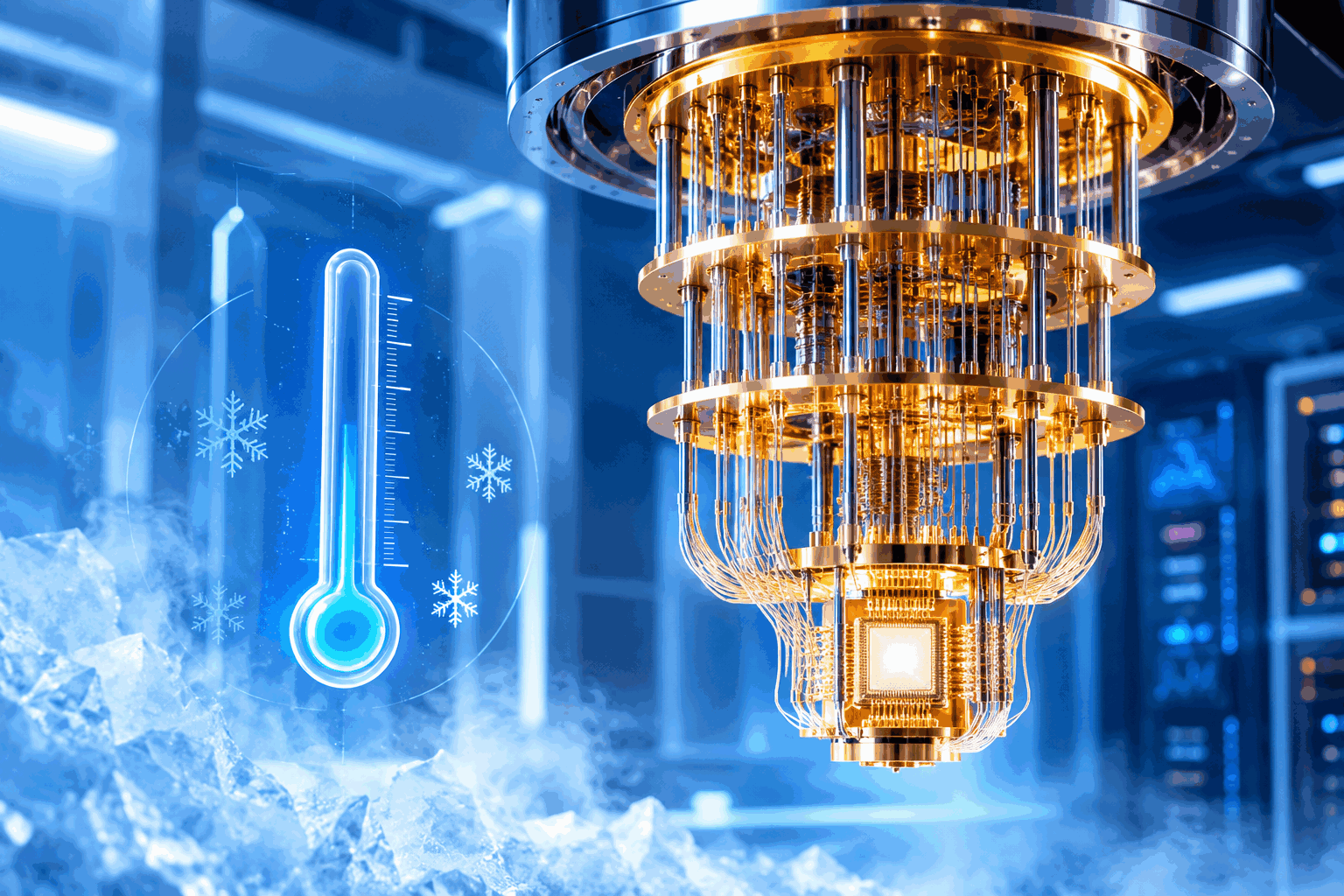
That gleaming golden structure resembling an 18th-century chandelier in every photo from IBM or Google labs isn't for show. It is a dilution refrigerator—the specialized machine capable of continuously sustaining the lowest temperatures ever achieved by humankind.
The underlying physics relies on an elegant trick using a mixture of two helium isotopes: helium-3 (³He) and helium-4 (⁴He). Below 0.87 K (-272.28 °C), this mixture spontaneously separates into two distinct phases: a concentrated ³He phase and a dilute phase where ³He atoms float in a sea of superfluid ⁴He. When a ³He atom crosses the boundary from the concentrated phase into the dilute phase, it absorbs heat from its surroundings. It is an endothermic process analogous to evaporation, operating at temperatures where no conventional liquid can evaporate. Each migrating atom extracts a tiny fraction of thermal energy, and the continuous circulation of millions of atoms delivers sustained cooling down to 10–15 mK (-273.14 °C).
The cooldown happens in stages, descending like a thermal spiral staircase. Starting from 300 K (27 °C) in the lab, a first pulse-tube compression stage drops the temperature to ~50 K (-223 °C). A liquid helium-4 stage brings the system down to 4 K (-269 °C). Next, the still operates at ~0.8 K (-272.35 °C), before the mixing chamber finally bottoms out at 15 mK. Every tier is shielded from the one above it by polished copper cans and multi-layer superinsulation. Meanwhile, the coaxial cables connecting the quantum processor to outside control racks are thermally anchored at each plate to prevent parasitic heat from leaking downward.
Cryogenic cooling in quantum processors is not a set-and-forget solution. It requires a delicate, ongoing balancing act between available cooling power (just 10–20 µW at 15 mK) and the residual heat introduced by wiring, signal amplifiers, and ambient radiation. It is an engineering margin of surgical precision.
The Scalability Dilemma and the Future: Will Room-Temperature Quantum Computers Ever Exist?
This is where temperature stops being a laboratory curiosity and becomes the brick wall facing the entire hardware industry. A state-of-the-art dilution refrigerator provides roughly 10 to 20 microwatts of cooling power at 15 mK. Because every superconducting qubit requires multiple coaxial control lines that inevitably conduct heat down into the cold stage, the thermal budget holds up fine for a few hundred qubits. However, scaling to millions of qubits—the threshold needed for fault-tolerant quantum error correction—generates a heat load that far exceeds what any single dilution fridge can handle. The bottleneck is no longer purely quantum; it is sheer thermodynamics.
Hardware engineers are pursuing two primary workarounds. The first involves moving control electronics inside the cryostat itself (cryo-CMOS), right next to the quantum chip, drastically cutting the number of cables crossing thermal stages. The second focuses on developing qubits that operate at higher temperatures—such as silicon "hot qubits" or photonic architectures—where cooling demands are far more forgiving and integration with classical electronics becomes seamless.
Will we ever see a room-temperature quantum computer? The honest answer depends on how we define "operating." For specialized tasks, photonic quantum computing already performs gate operations at 300 K (27 °C). However, a universal, fault-tolerant quantum computer will almost certainly require some level of cryogenic cooling for decades to come. The real question isn't whether we can eliminate the cold entirely, but whether we can make cryogenic cooling manageable, cost-effective, and scalable.
Absolute zero in quantum computing is not a fixed destination, but one end of a broad operational spectrum. Along that spectrum, each hardware architecture is carving out its own sweet spot between coherence, gate speed, and commercial viability. Temperature—something we casually associate with weather forecasts or a wall thermostat—turns out to be the decisive factor that will determine which quantum technology dominates the coming decades. Nothing more, nothing less.
Frequently Asked Questions About Quantum Computer Temperature
Why do quantum computers need to be kept so cold?
Primarily to prevent thermal decoherence. In superconducting qubits, ambient thermal energy causes microscopic fluctuations that excite the quantum circuit, destroying superposition and quantum entanglement within nanoseconds.
Do all quantum computers operate near absolute zero?
No. While superconducting quantum processors require temperatures between 10 and 15 mK (-273.14 °C), photonic quantum computers perform core logic operations at room temperature (300 K), and trapped-ion systems isolate their particles in vacuum chambers without needing massive dilution refrigerators.
What happens if a quantum computer gets too warm?
If thermal energy exceeds the qubit's quantum excitation threshold, the quantum states immediately collapse via thermal noise into classical random bits. For superconducting chips, exceeding aluminum's critical temperature (1.2 K) eliminates superconductivity entirely, halting processor operations.
Contact Us
 (+86) 177 3001 9472
 market@originqc.com