What Is Quantum Interference? Explained Simply with Examples
Quantum interference is the phenomenon where the probability amplitudes of a quantum particle combine—either reinforcing or canceling each other—determining where that particle can and cannot be found. Unlike classical wave interference (think ocean swells overlapping), quantum interference operates on the mathematical "waves" of possibility itself. A single electron, all by itself, can interfere with its own potential paths. This isn't metaphor. It's measurable, repeatable, and it underpins quantum computing, ultra-precise sensors, and secure communication networks.
Here's the thing about quantum mechanics: it doesn't describe what is. It describes what could be.
When you throw a baseball, you can trace its arc through the air. It follows one path. Done. But fire an electron toward a detector, and quantum mechanics says the electron doesn't take a single route. It exists as a spread-out cloud of possibilities—what physicists call a superposition of states. Each possible path the electron could take carries a number called a probability amplitude. Think of it as a tiny arrow with a direction and a length, attached to every possible outcome.
Now here's where interference enters. These amplitude arrows can point in the same direction or in opposite directions. When they point the same way, they add up. When they point opposite ways, they cancel. The result? Some outcomes become extremely likely, and others become literally impossible.
This is quantum interference in its purest form. Not water waves crashing together. Not sound waves overlapping. It's the mathematics of possibility combining to shape reality.
A useful analogy: imagine you're rolling a die, but instead of six fixed faces, the die exists as a ghostly superposition of all six outcomes simultaneously. Each outcome has a "wave" associated with it. Some of those waves amplify each other (making certain numbers far more likely to appear), while others cancel out entirely (making certain numbers physically impossible to roll). The die isn't choosing randomly from equal options. The interference pattern sculpts the probabilities before you ever look.
Constructive vs. Destructive Quantum Interference
Quantum interference comes in two flavors, and understanding both is essential.
Destructive Interference: When Possibilities Erase Each Other
Picture noise-canceling headphones. They work by generating a sound wave that's perfectly out of phase with ambient noise. Peak meets trough. The result: silence. The sound energy doesn't vanish—it's redistributed. But at your ear, the waves cancel.
Destructive quantum interference works the same way, but with probability amplitudes instead of air pressure. Two paths a particle could take produce amplitudes pointing in opposite directions. They sum to zero. The probability of finding the particle at that location drops to exactly zero. Not unlikely. Not rare. Impossible.
This is why, in the double-slit experiment, certain spots on the detection screen remain permanently dark. The particle cannot land there.
Constructive Interference: When Possibilities Stack Up
Flip the scenario. Two amplitude arrows point the same direction. They add together. The probability of finding the particle at that location surges. These are the bright bands on the detection screen—the spots where the particle is overwhelmingly likely to appear.
The beauty here is that no force is pushing the particle toward the bright spots or away from the dark ones. There's no hidden mechanism, no tiny hand guiding it. The interference of probability amplitudes simply defines the landscape of likelihood. The particle "lands" where the math allows it to land.
The Single-Particle Double-Slit Experiment
If you've heard of the double-slit experiment, you've probably heard it described with beams of light or streams of electrons. But the version that truly breaks your brain uses one particle at a time.
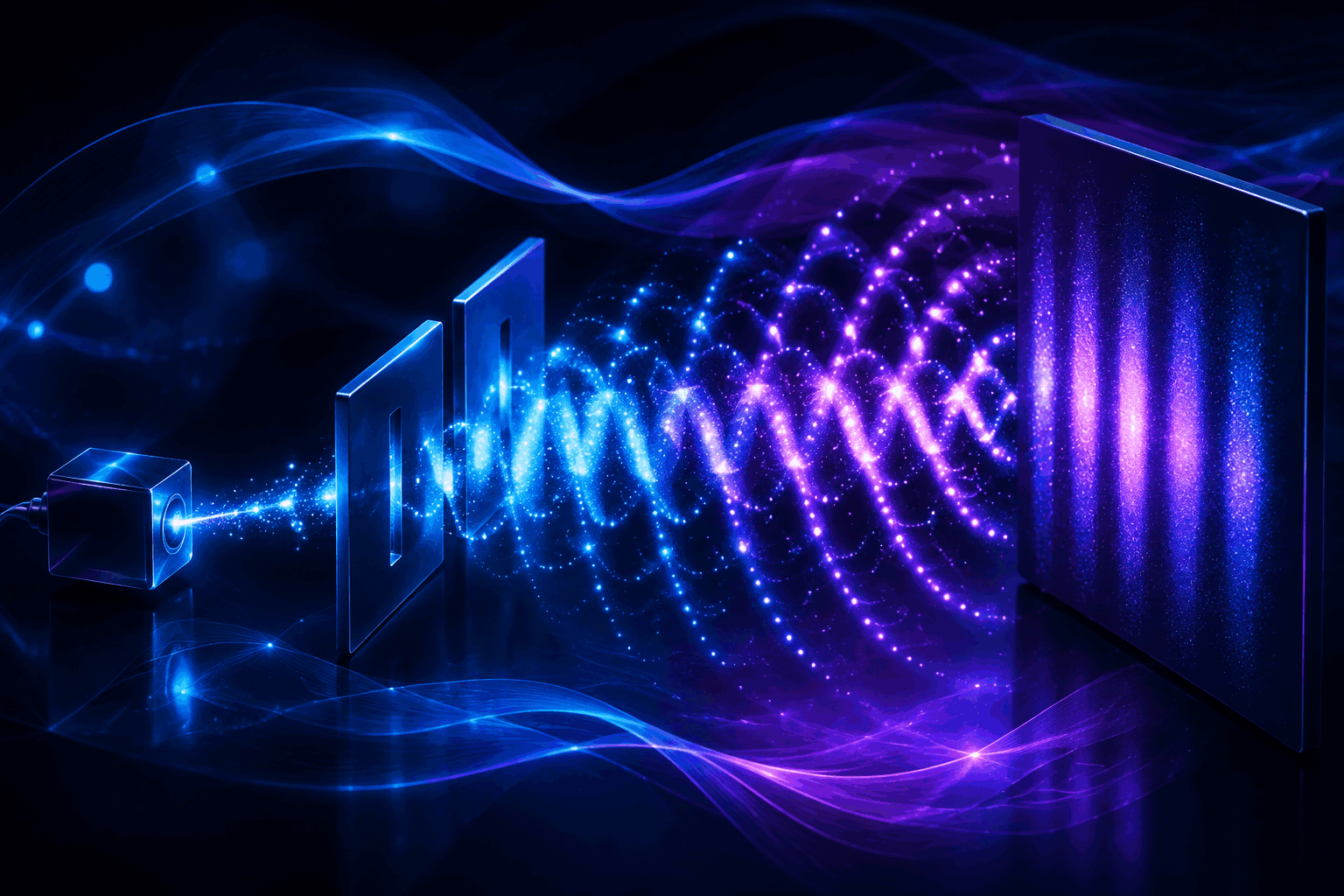
Here's the setup. You have a source that fires a single electron toward a barrier with two narrow slits. Behind the barrier sits a detection screen. You fire one electron. It hits the screen as a single dot. Fine. You fire another. Another dot. You keep going—hundreds, thousands, tens of thousands of individual electrons, each fired alone, with no other electron anywhere nearby.
And the dots build up a pattern. Not two clumps behind the two slits (which is what you'd expect if electrons were tiny bullets). Instead, they form an interference pattern—alternating bright and dark bands, exactly like waves overlapping.
But each electron was alone. It had no partner to interfere with. So what interfered?
The electron interfered with itself. More precisely, its probability amplitude took both paths simultaneously, and those two amplitudes combined—constructively in some places, destructively in others—before the electron "decided" where to appear.
What Happens When You Watch
Now place a detector at one of the slits to determine which path the electron takes. The moment you gain "which-path" information, the interference pattern vanishes. The dots on the screen rearrange into two simple clumps. Classical behavior returns.
Why? Because measurement decoheres the system. The electron's probability amplitudes were in a delicate superposition—both paths coexisting. The detector entangles with the electron, leaking information into the environment. The phases of the amplitudes become randomized relative to each other. They can no longer interfere. The wave-like behavior collapses into particle-like behavior.
It's not that consciousness causes collapse. It's not that the electron "knows" it's being watched. It's that any physical interaction capable of extracting which-path information destroys the phase coherence required for interference.
Classical Interference vs. Quantum Interference: What's the Real Difference?
Both involve waves combining. Both produce patterns of reinforcement and cancellation. So what actually separates them?
| Feature | Classical Interference | Quantum Interference |
|---|---|---|
| Physical Medium | Requires a medium (water, air, electromagnetic field) | No medium required; occurs in abstract probability amplitude space |
| What Is Interfering | Physical wave quantities (displacement, pressure, electric field) | Probability amplitudes (complex numbers encoding likelihood and phase) |
| Deterministic vs. Probabilistic | Deterministic outcome (wave pattern is fixed and predictable) | Probabilistic outcome (interference shapes likelihood, but individual results are random) |
| Single-Particle Interference | Not possible (need at least two physical waves) | Possible (a single particle interferes with its own probability amplitudes) |
| Effect of Observation | Observation does not alter the interference pattern | Extracting which-path information destroys the interference pattern |
Real-World Applications Powered by Quantum Interference
Quantum Computing: Amplifying Right Answers, Canceling Wrong Ones
A quantum computer doesn't just try every answer simultaneously (that's a common oversimplification). Instead, quantum algorithms are carefully designed so that the probability amplitudes of wrong answers destructively interfere—canceling each other out—while the amplitudes of correct answers constructively interfere, building up a high probability of measuring the right result.
Grover's search algorithm does exactly this. You have an unsorted database of N items. Classically, you'd need ~N/2 checks on average. Grover's algorithm uses quantum interference to amplify the amplitude of the correct item while suppressing all others, finding the answer in roughly √N steps. The interference is the engine.
Shor's algorithm for factoring large numbers works similarly. It uses the quantum Fourier transform to create interference patterns that reveal the periodic structure hidden in a number's factors. Without interference, the algorithm is just random noise. With it, exponential speedup becomes real.
Ultra-Sensitive Quantum Sensors and Metrology
Atom interferometers split a cloud of ultracold atoms into two paths, let them travel along slightly different routes, and then recombine them. The interference pattern that emerges is exquisitely sensitive to tiny differences in gravitational acceleration, rotation, or magnetic fields between the two paths.
These devices can detect gravitational variations caused by underground cavities, monitor volcanic activity, and even test general relativity with unprecedented precision. The interference fringes shift by fractions of a wavelength in response to forces a billionth of a billionth the strength of Earth's gravity.
3 Common Misconceptions About Quantum Interference
Misconception 1: "Particles Physically Smash Into Each Other to Make Patterns"
No. Quantum interference doesn't require two particles colliding or interacting. A single particle, completely isolated, produces interference patterns because its probability amplitudes take multiple paths. The "interference" happens between mathematical descriptions of possibility, not between physical objects bouncing off each other.
Misconception 2: "Quantum Interference Only Exists in Theory or in Deep Space"
Quantum interference is happening in laboratories on every continent right now. It's in the chip fab where engineers use electron beam lithography. It's in the atomic clocks that synchronize GPS satellites. The effects are fragile and require isolation from environmental noise, but they are thoroughly, undeniably real and present in everyday technology.
Misconception 3: "Observation Destroys the Particles"
Measurement doesn't annihilate particles. The electron still exists after you detect which slit it passed through. What changes is the coherence of its probability amplitudes. The particle doesn't get destroyed; its wave-like behavior gets disrupted by the physical interaction required to observe it. The particle persists. The interference pattern does not.
Frequently Asked Questions
Can quantum interference happen in macroscopic objects?
In principle, yes. Every object has a wavefunction. In practice, large objects interact constantly with their environment—air molecules, photons, thermal vibrations—and these interactions cause near-instantaneous decoherence. The interference pattern gets washed out before you could ever measure it.
What is the difference between quantum entanglement and quantum interference?
They're related but distinct. Quantum interference involves the combination of probability amplitudes for a single system's possible states. Entanglement involves correlations between two or more systems that cannot be described independently. Entanglement can enhance or modify interference patterns (as in multi-particle interference experiments), but you can have interference without entanglement and entanglement without observable interference. They're different tools in the quantum toolkit.
Does quantum interference violate the conservation of energy?
No. In destructive interference, probability doesn't disappear—it redistributes. Where amplitudes cancel, probability drops to zero. Where they reinforce, probability increases. The total probability across all possible outcomes always sums to exactly one. Energy is conserved. Information is conserved. The interference pattern simply reshapes where things can happen, not whether they happen at all.
Contact Us
 (+86) 177 3001 9472
 market@originqc.com