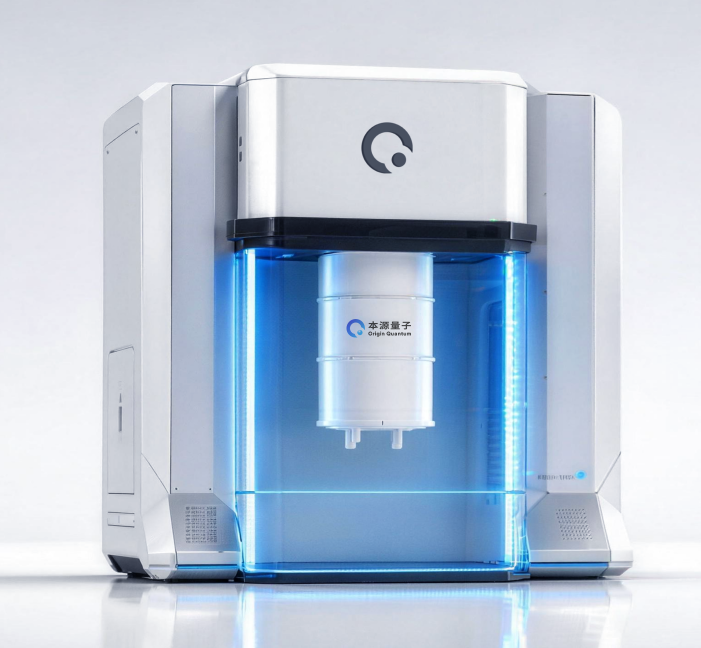
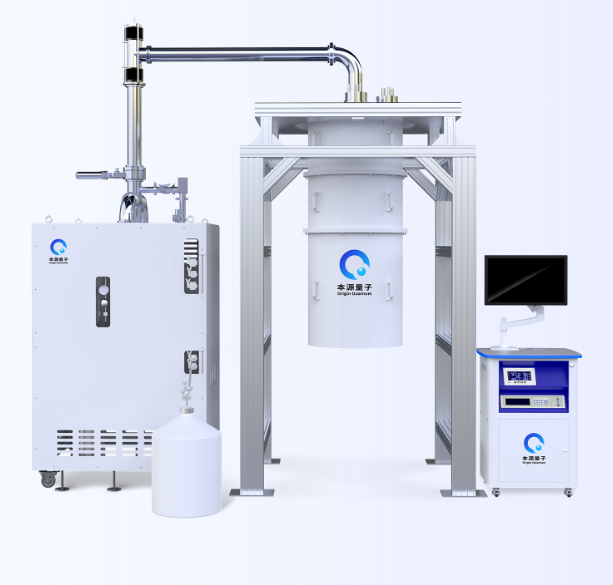
What Does a Quantum Computer Look Like? It's Not a Laptop
Quick Answer: A quantum computer looks like a specialized physics laboratory rather than a single standalone machine. Its physical appearance depends entirely on its architecture:
- Superconducting systems: The famous "golden chandelier" (a dilution refrigerator) sealed inside a tall stainless-steel cylinder alongside racks of RF electronics.
- Trapped-ion systems: Standard black datacenter server cabinets housing high-vacuum cells addressed by internal lasers.
- Photonic & neutral-atom systems: Optical benches covered in precision mirrors, beam splitters, laser arrays, and glass vacuum chambers.
A quantum computer does not look like a sleeker laptop. It does not look like a holographic display from a sci-fi film. In most cases, what you see is one of two things:
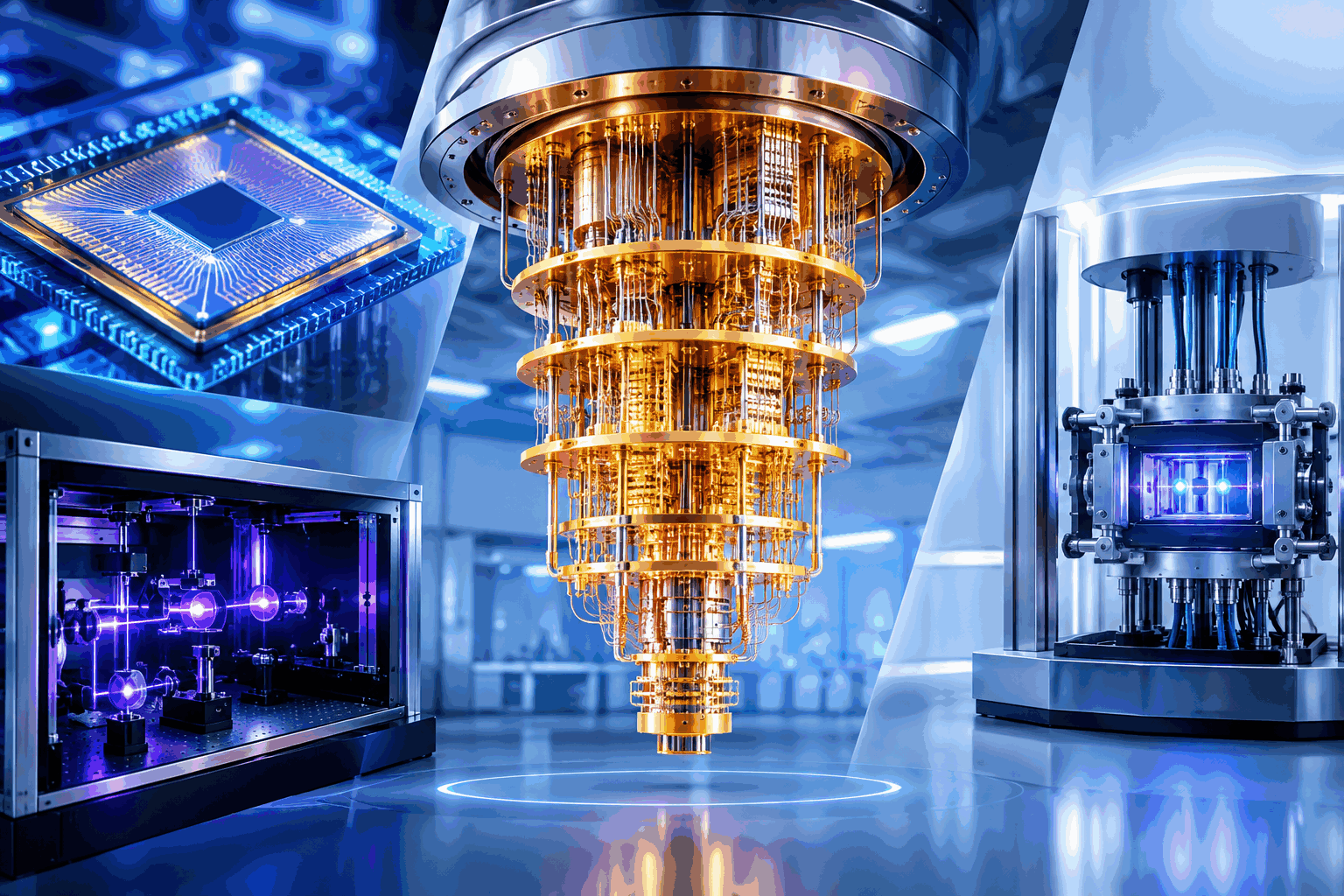
- A golden, inverted chandelier-like structure hanging from a ceiling mount, dripping with copper-colored coaxial cables and stacked disc-shaped platforms. This is the exposed interior of a dilution refrigerator, and it's the image that dominates press photos.
- A plain industrial cylinder or a row of server racks, depending on the technology. The quantum processor is hidden inside, and the exterior looks like something you'd find in a pharmaceutical cold-storage facility or a telecom switching station.
Neither version is glamorous. Both are deeply, stubbornly physical objects made of metal, glass, and wire.
The "Golden Chandelier"
If you've seen a quantum computer in a news article, you've almost certainly seen this: a cascading structure of gold-plated discs connected by thin copper wires, hanging upside down like an ornate light fixture. This is the interior of a dilution refrigerator, and every layer has a job. (Read our detailed breakdown on why a quantum computer looks like a chandelier to see the physics behind this tiered design.)
Top to Bottom: A Layer-by-Layer Walkthrough
Top plate (widest disc): A thick, flat copper disc, roughly 30–40 cm in diameter. This is the 4 Kelvin stage, still "warm" by quantum standards. Thick stainless-steel coaxial cables enter here from the outside world, carrying microwave control signals. The metal has a dull, brushed finish at this level.
Middle stages (3–5 intermediate discs): Each disc is slightly smaller than the one above it. They're connected by thin, rigid stainless-steel rods. The cables running between them get thinner and more numerous as you go down. The gold plating becomes more prominent here—it's not decorative. Gold is an excellent thermal conductor and resists oxidation, which matters when you're cycling between room temperature and near absolute zero repeatedly.
Bottom plate (smallest disc, the mixing chamber): This is the coldest point, sitting at roughly 10–15 millikelvin. That's colder than the void between galaxies. The disc here is maybe 10 cm across. And mounted directly on its underside, barely visible unless you crouch and look up, is the quantum chip.
The Chip Itself
Here's the part that surprises people. The actual quantum processor—the thing doing the "quantum computing"—is a square of silicon or sapphire, typically 5 to 10 millimeters on each side. About the size of a fingernail. Sometimes smaller than a postage stamp. It's flat, dark, and etched with tiny superconducting circuits that look like a miniature city grid under magnification. To the naked eye, it's just a dark, unremarkable square. You could mistake it for a broken piece of a phone screen.
All that golden scaffolding, all those cables, the entire refrigerator—everything exists to keep that one tiny chip cold enough and isolated enough to function.
The Hidden Shell
The golden chandelier photos are misleading in one important way: they show the machine open, with its thermal shielding removed. In operation, you never see the gold.
What you see instead is a dilution refrigerator—a large, smooth, cylindrical vessel made of polished or matte stainless steel. Picture a giant Thermos bottle, maybe 1.5 to 2 meters tall and 1 meter in diameter. Some are silver. Some are painted white or black.
Around this cylinder, the scene gets industrial:
- Flexible stainless-steel hoses (some as thick as a garden hose) snake from the cryostat to external compressor units. These carry helium gas in a closed-loop cooling cycle.
- Compressor units sit on the floor nearby—boxy, gray, roughly the size of a large air conditioning condenser. They produce a constant, low mechanical hum, around 60–70 decibels. Not loud, but persistent.
- Control electronics racks line the adjacent wall. These are standard 19-inch server racks filled with microwave signal generators, arbitrary waveform generators, and data acquisition cards. They look identical to equipment in any RF engineering lab. Cables—hundreds of them, color-coded and labeled—run from these racks into the top of the cryostat.
Not All Quantum Computers Look Like Chandeliers
The golden chandelier is specific to superconducting qubit systems. Other approaches like trapped-ion quantum computing look completely different.
Trapped-Ion Systems
Walk into an IonQ facility and you'll see something that looks like a standard data center rack: a tall, rectangular cabinet made of black or dark-gray sheet metal, maybe 2 meters high. Inside, the core is a vacuum chamber—a small glass or metal enclosure, roughly the size of a coffee mug, where individual ions float in empty space. Laser beams enter through tiny windows in the chamber, and if you could see them (most are infrared, so you can't), they'd appear as faint red or violet dots on the chamber walls. The overall aesthetic is "clean laboratory equipment," not "golden art installation."
Photonic Systems
These look like an optics bench from a university physics lab. Imagine a flat, vibration-isolated table (usually a thick slab of granite or honeycomb steel, about 1.5 meters square) covered with small mirrors, beam splitters, lenses, and coiled fiber-optic cables. Everything is mounted on tiny posts with adjustment knobs. The color palette is silver, black, and the occasional green or red laser dot.
Neutral Atom Systems
These feature a high-vacuum glass cell (a small transparent chamber, maybe 10 cm across) surrounded by a complex array of laser heads and optical components. The lasers are often visible as bright red or blue beams crossing in the chamber. The overall setup sits on an optical table and looks like a particularly dense physics experiment.
Visual Comparison: Quantum Computer Architectures at a Glance
| Architecture | Key Players | Iconic Visual Look | Approximate Footprint | Processor (Naked Eye) |
|---|---|---|---|---|
| Superconducting | IBM, Google, Origin Quantum | Golden chandelier inside a steel cylinder; external compressor racks | ~2 m tall cylinder + 2–4 server racks + floor compressors (total ~4–6 m²) | Dark silicon/sapphire square, 5–10 mm per side, flat and featureless |
| Trapped Ion | IonQ, Quantinuum | Black server-style cabinet; small vacuum chamber with laser ports inside | ~1–2 standard 19-inch racks (~1 m² floor space) | No visible "chip"; individual atoms floating in a glass/metal vacuum cell |
| Photonic | Xanadu, PsiQuantum | Optical table with mirrors, lenses, fiber coils; photonic chip on a substrate | ~1.5 × 1.5 m optical table + electronics rack (~3–4 m²) | Small chip (few mm) with waveguide circuits etched on surface; looks like a tiny greenish glass rectangle |
| Neutral Atom | QuEra, Pasqal | Laser array surrounding a glass vacuum cell on an optical table | ~2 × 2 m optical table + laser modules (~4–5 m²) | No solid chip; atoms suspended in free space inside a glass cell |
What Does the User Interface Look Like?
Here's where the last bit of sci-fi fantasy dies. When a programmer actually uses a quantum computer, they see:
- A web browser open to a cloud platform (IBM Quantum Lab, Origin Quantum Cloud).
- A Jupyter Notebook with Python code cells. The code uses libraries like Qiskit, Cirq, or QPanda. It looks exactly like any other data science notebook.
- After running a circuit, the output is a bar chart—a probability distribution showing measurement results. It looks like a histogram you'd generate in any intro statistics class.
There is no 3D visualization of qubits spinning. There is no holographic interface. There is no special "quantum screen." The human-machine boundary is a text editor and a matplotlib plot. Full stop.
Frequently Asked Questions
Can you put a quantum computer on a desk?
Not today. The smallest superconducting systems require a dilution refrigerator, which alone is the size of a large appliance, plus control electronics that fill multiple racks. Trapped-ion systems are the most compact—Quantinuum has demonstrated systems that fit in a single rack—but even those need dedicated vibration isolation and laser cooling infrastructure.
Why is the chandelier gold?
It's not for aesthetics. Gold is used because it has excellent thermal conductivity (critical for pulling heat away from the chip) and does not oxidize. Copper would oxidize over repeated thermal cycles, forming an insulating layer that degrades performance. Gold plating on copper gives you the thermal performance of copper with the chemical stability of gold. The visual result—that striking warm metallic glow—is a happy accident of physics requirements.
Can you touch a quantum computer while it's running?
You can touch the outside of the cryostat shell. It will feel cool to the touch, maybe slightly cold, like a metal surface in an air-conditioned room. The outer shell is at or near room temperature. What you absolutely cannot touch is anything inside. The interior stages are at temperatures where exposed skin would instantly freeze and bond to the metal. The system is also under vacuum, so opening it would destroy the operating conditions and require days of re-cooling. In practice, the machine is sealed shut during operation, and there's nothing to touch anyway.
Contact Us
 (+86) 177 3001 9472
 market@originqc.com