Fault-Tolerant Quantum Computing: The Full Architecture Guide
Fault-tolerant quantum computing (FTQC) is not a feature. It is a design philosophy enforced by physics itself. At its core, FTQC demands that every component of a quantum processor—gate operations, state preparation, measurement, and idle storage—be engineered so that a single physical failure cannot propagate into an uncorrectable logical catastrophe.
This definition immediately separates FTQC from quantum error correction (QEC). QEC is a subroutine: detect an error, identify its location, apply a correction. FTQC is the overarching architectural contract that guarantees the correction machinery itself does not become a new error source. A QEC protocol that introduces more errors during syndrome extraction than it removes is useless. FTQC closes that loophole by imposing strict constraints on how every operation couples to the encoded logical state.
The distinction matters because quantum errors behave nothing like classical bit flips. A single faulty two-qubit gate can spread a local Pauli error across an entire entangled block. Without fault-tolerant design, correction circuits become amplifiers—each round of "fixing" injects fresh corruption faster than it removes old corruption. The system enters a cascading failure regime where adding more qubits makes things worse.
So the first architectural question is brutal: how do you build a correction mechanism that never touches the quantum information it protects, never clones it, and never lets a single hardware defect metastasize?
Topological Surface Codes
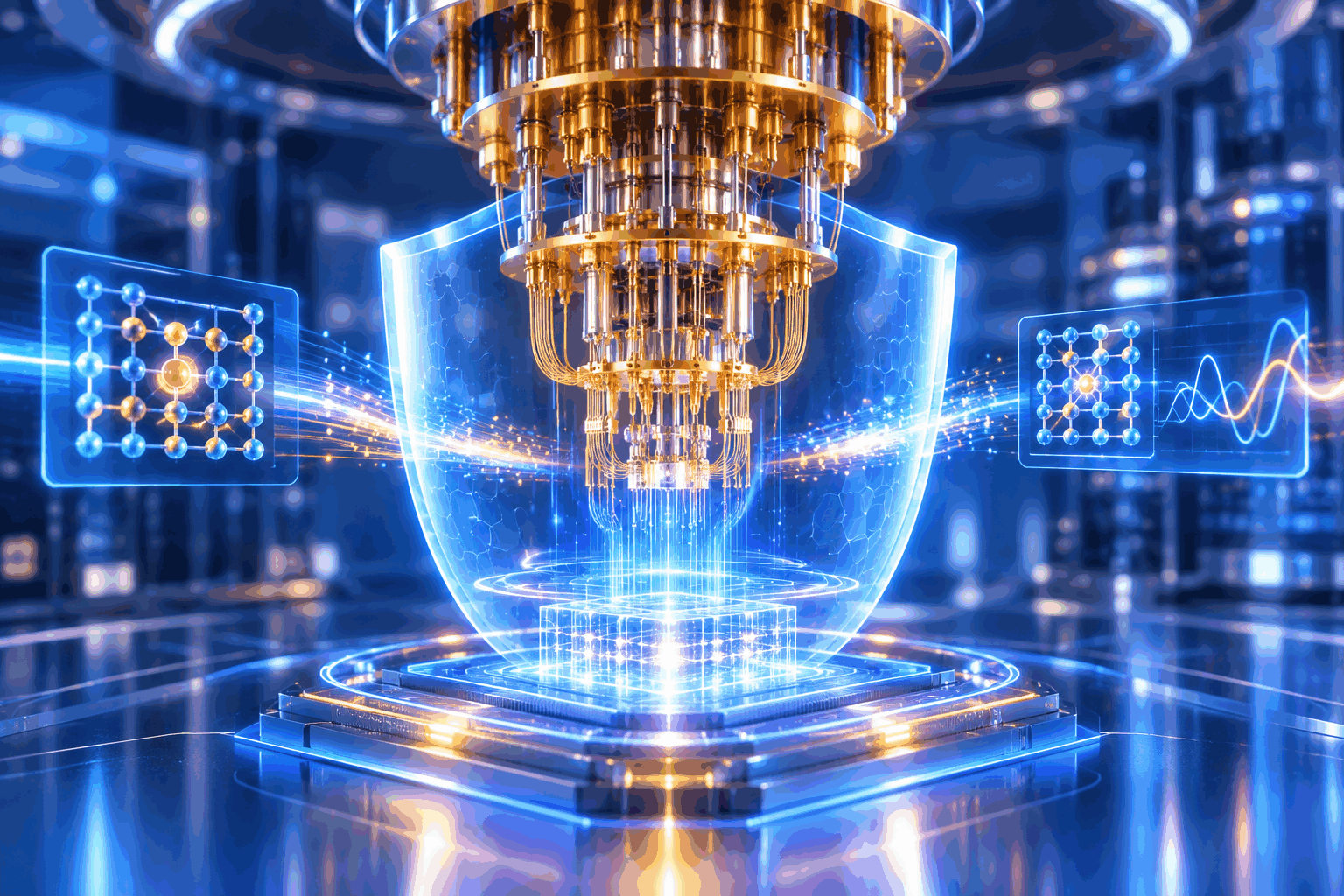
The no-cloning theorem forbids redundancy through duplication. You cannot copy an unknown quantum state onto backup qubits. The solution, developed over two decades of theoretical work, is to encode information using the principles of surface code quantum computing—storing quantum states not in fragile individual physical qubits, but within the global topological properties of a two-dimensional lattice of entangled physical qubits.
The Stabilizer Formalism
The surface code arranges data qubits on a planar grid. Interspersed among them are ancilla (syndrome) qubits, each coupled to a small neighborhood of four data qubits. These ancillas perform parity measurements—checking whether the product of neighboring qubit states is +1 or −1—without ever reading the individual qubit values. The quantum information lives in the collective pattern of correlations across the entire lattice, invisible to any local measurement.
When a physical error flips a data qubit, it disturbs the parity checks of adjacent syndrome qubits. The resulting syndrome pattern—a constellation of "defects" on the lattice—encodes the error's geometric location. A classical decoder then infers the most likely error chain and applies a correction. Critically, the parity measurement extracts only error information; the encoded logical superposition remains untouched.
Why Topology Provides Protection
An error becomes logically dangerous only when it forms a connected chain spanning the entire lattice from one boundary to the opposite boundary. For a code of distance d, this requires at least ⌈d/2⌉ physical errors aligned along a non-trivial path. Random, independent errors at rate p produce such a chain with probability scaling as ~(p/pth)⌈d/2⌉—exponentially suppressed as d grows. The lattice geometry itself acts as a firewall against error propagation.
But this exponential suppression holds only under a precise mathematical condition. That condition is the threshold theorem, and it draws the sharpest line in all of quantum computing.
The Fault-Tolerant Threshold Theorem
The threshold theorem states: if the physical error rate per operation, pphys, falls below a critical value pth, then increasing the code distance d drives the logical error rate pL toward zero exponentially. Above pth, the opposite occurs—larger codes perform worse because the syndrome extraction hardware introduces errors faster than the code can suppress them.
For the standard rotated surface code under realistic circuit-level noise models, pth sits between ~0.57% and 1% depending on the specific decoder used. This number sounds generous. It is not. The theorem guarantees asymptotic suppression; at finite code distances relevant to near-term hardware, the pseudo-threshold—the physical error rate at which a specific small code outperforms an unencoded qubit—sits significantly lower, often near 0.1% or below. Engineering a system that operates reliably at 0.1% per gate, per high-fidelity quantum measurement, per idle cycle, across thousands of qubits simultaneously, remains an open challenge.
NISQ vs. FTQC: A Structural Comparison
| Dimension | NISQ Regime | FTQC Regime |
|---|---|---|
| Error Propagation | Uncontrolled; errors accumulate freely | Bounded by code distance; cascades suppressed |
| Qubit Hierarchy | Flat; all qubits are physical | Layered; physical → logical via encoding |
| Circuit Depth Limit | ~10²–10³ gates before noise dominates | Arbitrarily deep (in principle) |
| Fidelity Scaling | Degrades with circuit size | Improves exponentially with code distance |
| Operational Reliability | Probabilistic; no guarantee of correct output | Deterministic to arbitrary precision (given sufficient resources) |
Crossing the threshold grants one capability: the ability to store quantum information indefinitely. But a computer must compute. Executing gates on protected logical qubits without breaking the topological shield introduces a deeper theoretical obstruction—one rooted in a no-go theorem.
The Eastin-Knill Theorem and Magic State Distillation
The Eastin-Knill theorem (2009) delivers a stark verdict: no quantum error-correcting code can implement a universal gate set using only transversal gates. Transversal gates—operations applied independently, qubit-by-qubit, across a code block—are the gold standard of fault tolerance because they prevent errors from spreading between qubits within the block. Yet the theorem proves they can never be sufficient for universality.
For the surface code, the Clifford group (Hadamard, Phase, CNOT) is implementable transversally or via lattice surgery. The missing piece is the non-Clifford T gate (π/8 rotation), essential for universal computation. Implementing T fault-tolerantly requires stepping outside the transversal paradigm entirely.
Lattice Surgery
Lattice surgery performs logical operations by temporarily merging and splitting surface code patches. Two logical qubits encoded on adjacent patches can be entangled by measuring a joint parity operator along their shared boundary—effectively "stitching" the codes together, extracting the syndrome, then "cutting" them apart. This process is fully fault-tolerant: every intermediate measurement is itself protected by the code structure.
Magic State Distillation
For the T gate, the standard approach is magic state distillation. Noisy, low-fidelity copies of the magic state |T⟩ = T|+⟩ are prepared using physical hardware. These raw states are then fed through a sequence of Clifford operations and measurements inside a dedicated distillation factory. Each round probabilistically outputs fewer but higher-fidelity magic states. After sufficient rounds, the distilled state exceeds the fidelity threshold required for a logical T gate via state injection.
The cost is staggering. A single high-fidelity T gate may consume hundreds or thousands of physical qubits operating in parallel inside the distillation pipeline. This is the fault-tolerance tax—and it dominates the resource budget of any large-scale FTQC architecture.
Deconstructing the "Fault-Tolerance Tax"
The ratio of physical qubits to logical qubits in a surface-code architecture is not a modest constant. It is a function of code distance, target logical error rate, and the fraction of operations requiring magic states.
- Code distance scaling: A standard rotated surface code patch of code distance d requires d² data qubits and d² − 1 syndrome ancillas, scaling physical footprint as ~2d² total qubits. Moving from d = 17 (~577 qubits) to d = 27 (~1,457 qubits) nearly triples the footprint per logical qubit.
- Distillation dominance: In algorithms with high T-gate counts (factoring, quantum chemistry), 80–95% of all physical qubits reside inside magic state factories, not in the computational register.
- Total overhead: Estimates for a single logical qubit capable of executing arbitrary gates at a logical error rate of 10−15 range from 1,000 to over 10,000 physical qubits, depending on physical error rates and architectural choices.
While emerging architectures like quantum low-density parity-check (qLDPC) codes aim to shrink this footprint, a traditional surface-code machine running Shor's algorithm for factoring may still require 107 to 109 physical qubits. The engineering challenge is not merely building that many qubits; it is wiring, controlling, and reading them out with the timing precision that fault tolerance demands. Which brings us to the hidden bottleneck that no qubit count alone can solve.
Fast Classical Decoders and Latency
Surface code error correction is not autonomous. Every syndrome extraction cycle produces a stream of binary measurement outcomes that must be processed by a classical decoder to determine which corrections to apply. The decoder solves a combinatorial optimization problem—most commonly, minimum-weight perfect matching (MWPM) on a graph whose nodes are syndrome defects and whose edges represent possible error chains.
The constraint is temporal. Syndrome data arrives at the physical cycle rate—typically sub-microsecond to 1–2 microseconds for superconducting circuits, or tens of milliseconds for trapped-ion architectures. If the decoder cannot return a correction decision before the next cycle completes, errors accumulate uncorrected. A backlog of even a few cycles can push the effective error rate above threshold, collapsing the entire fault-tolerant guarantee.
Current approaches span a spectrum:
- MWPM solvers (e.g., Blossom algorithm): optimal but computationally expensive; difficult to parallelize at scale.
- Union-Find decoders: near-linear complexity, highly parallelizable, slightly suboptimal in accuracy.
- Neural network decoders: trained on noise models; promise constant-latency inference but require careful calibration to distribution shifts.
- FPGA/ASIC implementations: hardware-accelerated decoders targeting sub-microsecond latency for real-time feedback.
The decoder is not an afterthought. It is a first-class component of the fault-tolerant architecture, as critical as the qubits themselves. A system with perfect qubits but a slow decoder is not fault-tolerant.
How to Quantifiably Prove True Fault Tolerance
Claims of "fault tolerance" require a specific, falsifiable metric. The community has converged on the error suppression factor:
Λ = Plogical(d) / Plogical(d + 2)
If Λ > 1, increasing code distance reduces the logical error rate—the system is operating below threshold and exhibiting genuine fault-tolerant behavior. If Λ ≤ 1, the system is above threshold or dominated by correlated noise, and scaling up will not help.
Demonstrating true FTQC proceeds through three escalating milestones:
- Logical break-even: A single logical qubit retains coherence longer than the best physical qubit composing it. This proves the code suppresses errors faster than it introduces them.
- Fault-tolerant multi-qubit gates: Two or more logical qubits execute an entangling gate with a logical error rate below the physical gate error rate, confirming that the gate protocol itself does not break the code's protection.
- Sustained algorithmic execution: A non-trivial quantum algorithm runs to completion on logical qubits with a success probability that improves as code distance increases—the definitive signature of scalable fault tolerance.
Recent experimental milestones have achieved logical break-even and early multi-qubit logical operations across superconducting, neutral-atom, and trapped-ion hardware architectures. The gap between these results and milestone three remains vast—not a gap of principle, but of engineering scale, control fidelity, and classical processing speed.
FTQC is not an upgrade path for quantum computing. It is the phase transition that separates a laboratory curiosity from a computational technology. Every element—topological encoding, threshold physics, magic state factories, real-time decoding—exists because quantum mechanics permits no shortcut around the fragility of coherent superposition. Mastering fault tolerance means mastering the interface between quantum coherence and classical control at a scale and precision that has no historical precedent. That is the actual engineering frontier. Nothing less suffices.
Frequently Asked Questions About Fault-Tolerant Quantum Computing
What is the difference between QEC and FTQC?
Quantum Error Correction (QEC) is the algorithmic mechanism used to detect and correct physical errors. Fault-Tolerant Quantum Computing (FTQC) is the end-to-end system architecture that prevents the error-correction circuits themselves from spreading and cascading uncorrectable errors across logical states.
Why does the Eastin-Knill theorem matter in quantum architectures?
The Eastin-Knill theorem proves that no quantum error-correcting code can achieve universal computation using only transversal gates. This creates a fundamental hardware overhead, forcing architectures to run dedicated magic state distillation routines to perform universal non-Clifford operations (like the T-gate).
What does the fault-tolerant threshold mean in practice?
The threshold represents a critical tipping point in hardware quality. When physical gate and measurement error rates fall below this critical value, grouping more physical qubits together into a protected logical qubit exponentially suppresses logical errors. Operating above this threshold produces the opposite effect, where scaling the system only amplifies errors.
Contact Us
 (+86) 177 3001 9472
 market@originqc.com