What Is Quantum Tunneling? The Physics Explained Simply
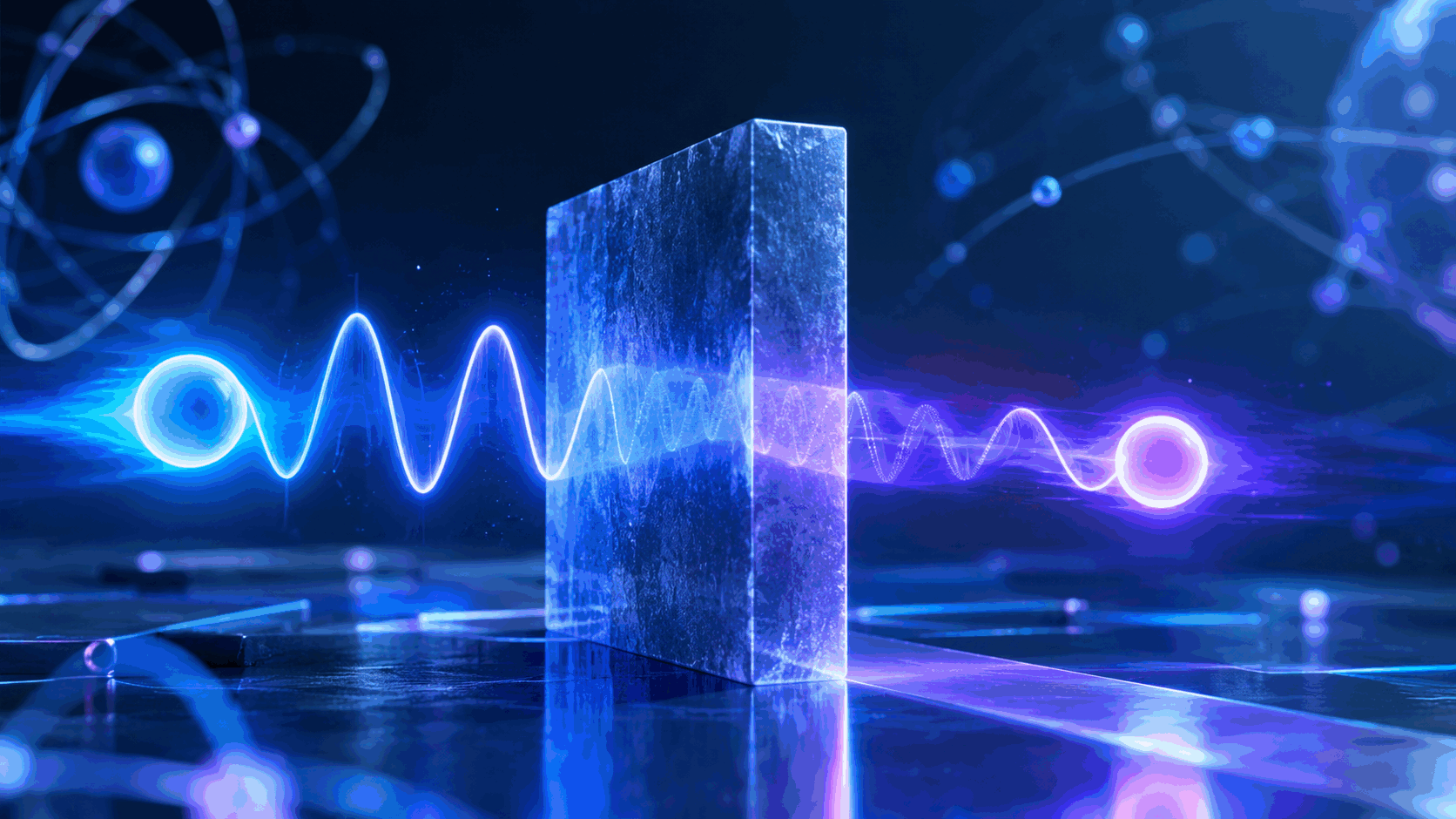
Quantum tunneling is a quantum mechanical phenomenon where subatomic particles (such as electrons or protons) have a non-zero probability of passing directly through a potential energy barrier—even when their kinetic energy is lower than the barrier's potential energy. It occurs because matter exhibits wave-particle duality, where particles are described by a probabilistic wavefunction rather than localized points.
Throw a tennis ball at a concrete wall. It bounces back. Every single time. No exceptions, no ambiguity. Classical mechanics guarantees this outcome with the cold certainty of a mathematical proof.
Now shrink that tennis ball down to the size of an electron. Aim it at an energy barrier it does not have enough kinetic energy to cross. Fire.
Sometimes, it appears on the other side.
Not because it broke through. Not because it found a crack. It simply was there, as though the barrier never existed. This is quantum tunneling, and it is not a metaphor. It is a measurable, repeatable, engineering-critical phenomenon that keeps the Sun burning and simultaneously threatens to render your smartphone obsolete.
The Wave Mechanics: Why Particles Can "Pass" Through Barriers
Here is where classical intuition fails us. We picture subatomic particles as microscopic billiard balls—hard, localized, and possessing definite coordinates. That classical picture was shattered in 1924 when Louis de Broglie introduced the concept of wave-particle duality, proposing that all matter possesses an intrinsic matter wave with a de Broglie wavelength defined by λ = h/p (where h is Planck's constant and p is momentum).
An electron is therefore not a localized point particle; it is described mathematically as a localized wave packet—a perturbation in a probability field governed by the uncertainty principle. The time-independent Schrödinger equation does not plot deterministic paths; it calculates the likelihood of detection. The wavefunction ψ(x) encodes this probability amplitude, while Born's rule dictates that |ψ(x)|² represents the probability density at position x.
What Happens at the Barrier
When this probability wave encounters a potential barrier—a region of space where the particle's kinetic energy is less than the potential energy—classical physics says "stop." The particle reflects. Full stop.
Quantum mechanics says something stranger. The wavefunction does not abruptly hit zero at the barrier's edge. Instead, it decays exponentially inside the barrier region. The mathematical form is roughly ψ(x) ∝ e−κx, where κ depends on the barrier height and the particle's mass. If the barrier is thin enough, the wavefunction has not decayed to zero by the time it reaches the far side. A nonzero amplitude exists beyond the wall.
Nonzero amplitude means nonzero probability. The particle can be detected on the other side. Think of it not as magic, but as a statistical inevitability written into the geometry of wave mechanics.
The tunneling probability drops exponentially with barrier width and with the square root of particle mass. This is why electrons tunnel readily through nanometer-scale barriers, while a tennis ball would need to wait longer than the heat death of the universe to tunnel through a wall.
Classical vs. Quantum Reality: A Direct Comparison
| Dimension | Classical Mechanics | Quantum Mechanics |
|---|---|---|
| Particle nature | Point-like object with definite position and velocity | Wavefunction (probability amplitude) spread over space |
| Barrier encounter (E < V₀) | Total reflection; zero transmission | Exponential decay inside barrier; nonzero transmission probability |
| Energy requirement to cross | Must have E ≥ V₀ | Can cross with E < V₀ if barrier is sufficiently thin |
| Transmission probability | Exactly 0% | T ≈ e−2κd (depends on width d and decay constant κ) |
| Macroscopic relevance | Accurate for everyday objects | Effects negligible at macro scale due to large mass |
Two Real-World Proofs You Experience Daily
Case 1: The Sun's Gentle Burn
The core of the Sun sits at roughly 15 million kelvin. Hot by any human standard. But for nuclear fusion? Not even close.
Two protons repel each other via the Coulomb force. To fuse, they must approach within about 1 femtometer (10−15 m), where the strong nuclear force takes over. The kinetic energy required to classically overcome that electrostatic repulsion corresponds to a temperature of roughly 10 billion kelvin—nearly a thousand times hotter than the Sun's actual core.
So why does the Sun shine?
Because protons are quantum objects. First calculated by physicist George Gamow in 1928, their wavefunctions extend into and penetrate the Coulomb barrier via what is now known as the Gamow factor. A tiny fraction of proton-proton collisions result in tunneling events close enough for the strong force to bind them. The probability per collision is absurdly small—on the order of 10−28—but the Sun contains roughly 1056 protons colliding billions of times per second. Statistics does the rest.
Without quantum tunneling, the Sun would be a cold, dark sphere of hydrogen. Life on Earth would not exist.
Case 2: The Ghost in Silicon Chips
Modern smartphone processors use transistors manufactured at the 3-nanometer class and below, where critical barrier dimensions are only a few atoms thick (roughly 1 to 2 nanometers across).
At this sub-nanometer scale, electrons bypass the classical barriers inside the chip. When the channel length between the source and drain becomes too short, electrons tunnel straight through the barrier via source-to-drain direct tunneling, while others tunnel through the insulating dielectric (gate leakage). The transistor is designed to be a digital switch: on or off, 1 or 0. Quantum tunneling turns it into a leaky dimmer switch that never fully closes, generating parasitic current, draining battery life, and releasing excess heat.
This is not a theoretical concern. It is the primary physical reason why simply shrinking transistors further becomes exponentially harder. Power consumption rises. Heat builds. The chip throttles or fails. Quantum tunneling, the same effect that ignites stars, is now the fundamental wall standing between us and smaller, faster electronics.
Modern Technologies Powered by Tunneling
- Scanning Tunneling Microscope (STM): A sharp metallic tip is brought within ~1 nm of a conductive surface. Electrons tunnel across the vacuum gap, producing a current exquisitely sensitive to distance (changing by a factor of ~10 for every 0.1 nm). By scanning the tip and recording current variations, STM produces real-space images of individual atoms. Invented in 1981 by Binnig and Rohrer, it earned them the Nobel Prize in 1986.
- Flash Memory: The floating gate in a flash memory cell stores charge by trapping electrons behind an insulating oxide layer. Writing data means forcing electrons to tunnel through that oxide (Fowler-Nordheim tunneling). Erasing means tunneling them back out. Every photo on your phone exists because of controlled quantum tunneling.
- Tunnel Diodes and Josephson Junctions: Exploited in ultrafast switching circuits and superconducting quantum computers, respectively.
FAQ: Quantum Tunneling
Does quantum tunneling violate energy conservation?
No. The particle's total energy remains constant throughout the process. Inside the barrier, the kinetic energy term in the Schrödinger equation becomes negative (which is why the wavefunction becomes evanescent rather than oscillatory), but this does not mean the particle "borrows" energy. The energy-time uncertainty relation is sometimes invoked loosely here, but the rigorous statement is simpler: the Hamiltonian is time-independent, so energy is conserved exactly. Tunneling is a redistribution of probability, not a violation of thermodynamics.
Could a human ever tunnel through a wall?
In theory, quantum physics does not forbid it. In reality, it is impossible. A human body consists of roughly seven octillion atoms. For a person to pass through a wall, every single electron, proton, and neutron would have to tunnel simultaneously, in the exact same direction, and reconstruct with biological precision on the other side. Because tunneling probability collapses exponentially with mass, the odds of this happening are so close to zero that waiting for it would require a timeframe vastly longer than trillions of lifetimes of the universe.
Why don't we see tunneling in everyday life?
Because tunneling probability scales as e−2κd, where κ is proportional to the square root of particle mass. Double the mass, and the exponent grows dramatically. Macroscopic objects have enormous mass relative to electrons or protons, making their tunneling probabilities indistinguishable from zero on any timescale shorter than the Poincaré recurrence time of the universe. Quantum effects do not disappear at large scales—they simply become immeasurably suppressed.
Contact Us
 (+86) 177 3001 9472
 market@originqc.com