What Is a Wave Function? Explained in Plain English
Quick Answer: In quantum mechanics, a wave function (Ψ) is a mathematical function that completely describes the quantum state of an isolated physical system. It does not describe a physical wave, but rather a probability amplitude. By applying Born's Rule (|Ψ|²), physicists calculate the probability density of finding a particle at a specific point in space and time.
In everyday life, your coffee mug sits at a specific spot on your desk. It has a fixed address. You can point at it. A baseball in flight traces a clean arc you can calculate with high-school physics. But zoom down to the scale of electrons, photons, and atoms, and that tidy picture falls apart completely. An electron orbiting a hydrogen atom does not trace a neat little circle like a planet around the sun. It doesn't have a fixed address. Instead, it exists in a smeared-out cloud of possibilities, and the wave function is the mathematical object that maps that cloud in full detail.
Physicists write it as the Greek letter Ψ (psi). It encodes not just where a particle might be, but also how its probability of being in various places changes over time. It is the single most important object in quantum mechanics. Without it, you cannot predict anything about the microscopic world.
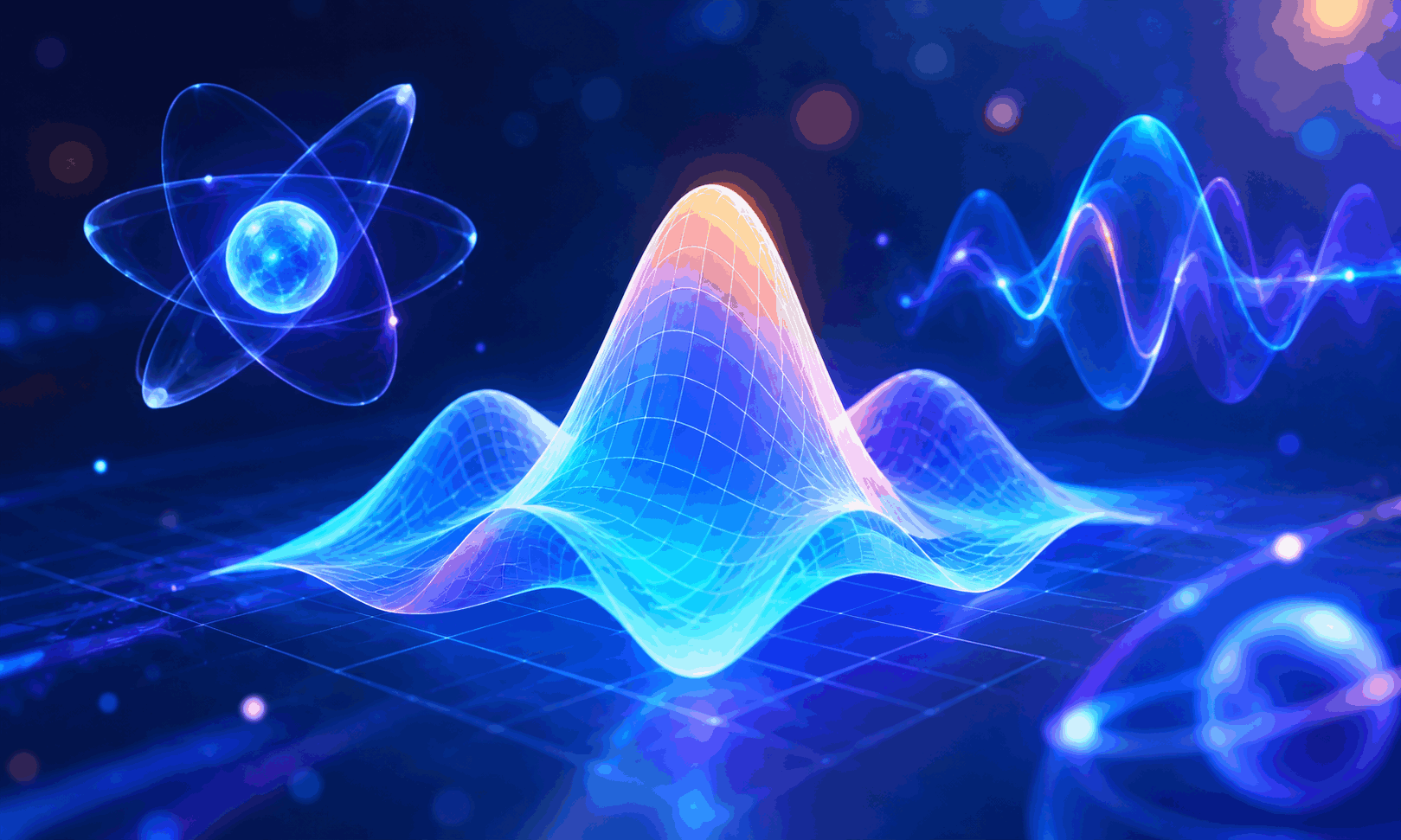
Wave Function is Not a Physical Wave
The moment people hear "wave function," their brain pictures ocean swells, ripples in a pond, or maybe the vibration of a guitar string. I need you to delete that image right now. The wave function is not a physical wave. You cannot touch it. You cannot see it. It does not carry energy through space the way a sound wave carries energy through air.
So what is it, then? It is an abstract mathematical wave. Specifically, it is a complex-valued function, meaning its values involve imaginary numbers (numbers built from the square root of negative one). This already tells you something crucial: you will never directly observe the wave function itself in an experiment. No detector clicks and prints out "Ψ = 0.3 + 0.7i." What you observe are probabilities, and those come from a specific mathematical operation applied to Ψ.
Here's a metaphor that I think works better than anything I've seen in textbooks. Imagine a weather radar screen showing the probability of rainfall across a city. The radar displays a colorful blob hovering over downtown. That blob is not rain. It is not water. It is a mathematical representation of where rain is likely to fall. The wave function works the same way. It is the "radar image" for a quantum particle. The particle is not smeared out like peanut butter across space. Rather, the wave function tells you the likelihood of finding the particle at any given point if you were to go look.
The "amplitude" of the wave function at a particular location is not a physical displacement. It is a probability amplitude, a complex number whose magnitude squared gives you the actual probability. This distinction trips up nearly everyone the first time they encounter it, so let's spend the next section making it crystal clear.
How Born's Rule Turns Math into Reality
In 1926, a German physicist named Max Born proposed an interpretation that changed everything. He said: take the wave function Ψ, multiply it by its own complex conjugate (which, for the non-mathematically inclined, basically means "square its magnitude"), and what you get is the probability density. In symbols: |Ψ(x)|² represents the probability density (integrate it over a region to get the actual probability of finding the particle there).
Why square it? Because the wave function can be negative, or even imaginary. Probabilities cannot be negative. Squaring (or more precisely, taking the absolute value squared) guarantees you always get a non-negative real number between zero and one. It is nature's way of translating abstract mathematical amplitudes into concrete, measurable odds.
Let me give you a grounded analogy. Suppose you have a scratch-off lottery ticket that hasn't been scratched yet. Before you scratch it, the ticket contains a hidden outcome. The wave function is like the complete mathematical description of all possible outcomes printed on that ticket, weighted by their odds. The act of scratching is the measurement. Once you scratch, you get one definite result. The probability distribution collapses to a single outcome. Born's Rule is the formula that tells you, before scratching, exactly how likely each hidden outcome is.
This is not a philosophical aside. This is how every single quantum prediction works. The energy levels of hydrogen, the tunneling of electrons through barriers, the interference patterns in the double-slit experiment—all of it flows from computing |Ψ|² and comparing the result to experimental data. And it works. Spectacularly well. Quantum electrodynamics, built on this foundation, predicts the magnetic moment of the electron to twelve decimal places. No other theory in the history of science comes close to that precision.
What Does the Wave Function Actually "Do"?
When nobody is measuring a quantum system, the wave function evolves smoothly and deterministically according to the Schrödinger equation. This equation is the quantum equivalent of Newton's second law. It tells you exactly how Ψ changes from one moment to the next. During this unobserved evolution, the wave function can spread out, interfere with itself, and exist in what physicists call a superposition—a combination of multiple possible states simultaneously.
Superposition does not mean the particle is "in two places at once" in the way a macroscopic object could be. It means the wave function has non-zero amplitude at multiple locations, and those amplitudes can add or cancel each other like overlapping ripples. The particle's fate is genuinely undecided until a measurement forces a definite outcome.
Now, here is where things get weird. The moment you perform a measurement—say, you fire a detector at the electron—the wave function appears to "collapse." The smooth, spread-out probability distribution instantaneously snaps to a single point. The electron is found here, not there. The other possibilities vanish.
What causes this collapse? Nobody knows for certain. The Schrödinger equation does not predict collapse. It predicts smooth, continuous evolution forever. Collapse is an additional postulate bolted onto the theory, and it is arguably the deepest unresolved puzzle in all of physics. Some physicists treat it as a real physical process. Others deny it happens at all. We will touch on that debate in a moment.
Is the Wave Function "Real" or Just a Tool?
Here is a question that has kept physicists arguing for nearly a century: does the wave function correspond to something physically real out in the world, or is it merely a bookkeeping device that encodes our incomplete knowledge?
The first camp is called psi-ontic. These physicists argue that Ψ is as real as an electromagnetic field. It exists out there in the world, independent of whether anyone is looking. The Many-Worlds Interpretation falls in this camp. In that view, the wave function never collapses. Instead, every possible outcome actually occurs, but in separate, non-communicating branches of reality. The wave function is the whole show.
The second camp is called psi-epistemic. These physicists argue that Ψ is more like a weather forecast. It reflects our state of knowledge about the system, not the system itself. The Copenhagen Interpretation, historically associated with Niels Bohr, leans in this direction. In Copenhagen, it is meaningless to ask what the electron is "really doing" between measurements. The wave function is a tool for computing probabilities, full stop.
Neither side has won. Experiments have placed constraints on certain psi-epistemic models, but the debate is far from settled. What everyone agrees on is this: regardless of your philosophical preference, the wave function gives you the correct numbers. It works. The argument is about what it means, not whether it predicts correctly.
Comparison Table: Classical Object vs. Quantum Wave Function
| Property | Classical Object (e.g., a baseball) | Quantum Wave Function (e.g., an electron's Ψ) |
|---|---|---|
| Position | Definite, single location at any given time | Spread out over many possible locations simultaneously |
| Trajectory | Well-defined path (parabola, orbit, etc.) | No trajectory exists; only probability distributions |
| Measurement | Reveals a pre-existing property without disturbing it significantly | Forces a definite outcome from a range of possibilities; fundamentally disturbs the system |
| Mathematical nature | Real-valued coordinates (x, y, z) | Complex-valued function in abstract space (Hilbert space) |
| Evolution rule | Newton's laws or Hamilton's equations | Schrödinger equation (unitary, deterministic) |
| Observability | Directly observable (you can see the baseball) | Never directly observed; only |Ψ|² (probabilities) are measured |
Wave Function Collapse: What Actually Happens When You Look
Let's get specific about collapse, because this is where most people's understanding goes off the rails.
Before measurement, the wave function is a smooth, spread-out distribution of possibilities. An electron's Ψ might have significant amplitude in a region spanning several nanometers. Then you fire a detector. The detector clicks at one specific location. The wave function, which was spread across that entire region, suddenly has all its probability concentrated at a single point. Everywhere else, it drops to zero. That instantaneous snap from "spread out" to "right here" is what physicists call wave function collapse.
Here's the analogy I keep coming back to. Imagine you're watching a live sports broadcast, and the camera is showing a wide aerial shot of the entire stadium. Every seat is visible. Every fan is in frame. Then the director cuts to a tight close-up of one specific person eating a hot dog. The wide shot didn't "collapse" in any physical sense. The stadium didn't shrink. But your information went from "all possibilities visible" to "one definite outcome selected." Collapse is a bit like that cut—except in quantum mechanics, nobody fully agrees on whether the "director" is a real physical process or just an update in our description.
The mathematical problem is this. The Schrödinger equation, which governs how Ψ evolves over time, is perfectly smooth and deterministic. It never produces a sudden jump. It never produces collapse. If you apply the Schrödinger equation to the electron plus the detector plus the lab plus the air molecules in the room, you get a giant, ever-spreading superposition that includes "detector clicked left" and "detector clicked right" simultaneously. The equation does not pick a winner. And yet, in every experiment ever performed, you get one winner. One click. One outcome.
So where does the single outcome come from?
The most widely accepted practical answer is decoherence. When a quantum system interacts with its environment—even a single stray photon bouncing off the apparatus—the different branches of the superposition become entangled with trillions of environmental degrees of freedom. Those branches stop interfering with each other. For all practical purposes, they behave as if only one branch exists. The wave function hasn't literally collapsed in the mathematical sense, but it has become impossible to detect the other branches. The system looks collapsed. It acts collapsed. Every experiment you could ever run will confirm it is collapsed. Whether it "really" collapsed or merely appears to is a question that depends on your interpretation.
In the Copenhagen view, collapse is a fundamental postulate. You simply add it to the rules: when a measurement occurs, Ψ jumps. Don't ask why. Don't ask what counts as a measurement. Just use the rule and move on. This is pragmatic, and it works, but it leaves a conceptual gap that has bothered physicists for decades.
In the Many-Worlds view, collapse never happens. The wave function keeps evolving smoothly forever. Every outcome occurs, but in separate, non-interacting branches. You experience one branch because you are part of it. The "appearance" of collapse is just your subjective experience of being stuck in one branch.
In objective collapse theories (like the GRW model or Penrose's gravitational collapse proposal), collapse is a real physical process that happens spontaneously, without any observer. The wave function genuinely, physically shrinks. These theories make slightly different predictions from standard quantum mechanics, and experiments are currently trying to test them.
Frequently Asked Questions About the Wave Function
Can we ever directly observe a wave function?
No. The wave function itself is not an observable quantity. You cannot build a device that outputs Ψ. What you can measure are probabilities, which correspond to |Ψ|². There is a technique called quantum state tomography that lets you reconstruct the wave function from many repeated measurements on identically prepared systems, but that is a statistical reconstruction, not a single-shot observation. You never see Ψ directly in one experiment.
What happens to the wave function after collapse?
After a measurement yields a definite result, the wave function is said to be "reset" to a new state corresponding to that result. From that point forward, it begins evolving again according to the Schrödinger equation, spreading out once more until the next measurement. So collapse is not a one-time event at the beginning of the universe. It happens (or appears to happen) every time a measurement is performed.
Why do physicists use complex numbers in the wave function instead of just real numbers?
Because complex numbers are necessary to capture interference. When two probability amplitudes overlap, they can cancel each other out (destructive interference) or reinforce each other (constructive interference). Real numbers alone cannot fully describe this behavior. The complex phase of Ψ carries information about how different paths or states interfere, and that phase information is essential for predicting phenomena like the double-slit interference pattern. Strip away the complex numbers, and the theory stops working.
Contact Us
 (+86) 177 3001 9472
 market@originqc.com