What Is Grover's Algorithm? Quantum Search & Limits Explained
Grover's algorithm is a quantum search algorithm proposed by Lov Grover in 1996. Its job is deceptively simple: find a specific item in an unsorted database faster than any classical computer possibly can.
Here's the headline number. A classical computer searching through N unsorted entries needs, on average, N/2 attempts. Grover's algorithm needs roughly √N attempts. That's a quadratic speedup—not exponential, but genuinely powerful at scale.
Picture this: someone shuffles one million face-down playing cards and asks you to find the Ace of Spades. Classically, you flip cards one by one. On average, you'll check 500,000 cards before hitting it. With Grover's algorithm? You'd need around 785 operations. That's the difference between spending a lifetime flipping cards and finishing before your coffee gets cold.
Now let's unpack why this matters, how it actually works under the hood, and where the hype collides with reality.
The Problem It Solves: The Classical Brute Force Bottleneck
Unsorted search sounds trivial until you realize how many hard problems secretly reduce to it.
Cracking a password hash? That's searching through all possible inputs to find one that produces a specific output. Solving a Boolean satisfiability (SAT) problem? You're searching through all variable assignments to find one that makes the formula true. Inverting a cryptographic hash function in a cryptographic hash function? Same structure—search an enormous space for a needle that satisfies a condition.
The classical approach is brute force. Check one candidate. Check the next. Check the next. There's no shortcut when the data carries no structure, no ordering, no index. You must examine each possibility individually, and the cost scales linearly: O(N).
For small N, this is fine. For N = 2128 (the key space of AES-128), "linear" means the heat death of the universe arrives before your search finishes. This is precisely why symmetric cryptography has been considered safe for decades. Grover's algorithm doesn't eliminate the search. It compresses it.
The Quantum Advantage: Understanding Quadratic Speedup
Let's make the speedup visceral. The table below compares classical worst-case steps against Grover's iteration count for various database sizes:
| Database Size (N) | Classical Average Steps (N/2) | Grover Optimal Steps (≈ π/4·√N) | Speedup Factor |
|---|---|---|---|
| 100 | ~50 | ~8 | ~6× |
| 10,000 | ~5,000 | ~79 | ~63× |
| 1,000,000 | ~500,000 | ~785 | ~637× |
| 1016 | ~5 × 10¹⁵ | ~78,500,000 | ~63,700,000× |
Notice something: the speedup grows with N. For small databases, Grover's algorithm barely helps. For astronomically large search spaces—the kind that appear in cryptography and combinatorial optimization—the advantage becomes staggering.
One critical nuance people miss: quadratic speedup is proven optimal. Bennett, Brassard, and colleagues proved in 1997 that no quantum algorithm can search an unstructured database faster than O(√N). Grover's algorithm is not just good. It is the best quantum mechanics allows for this problem class.
How Grover's Algorithm Actually Works
Forget the unitary matrices for a moment. The algorithm has four conceptual moves, and each one maps to a physical intuition you already carry.
Step 1: Uniform Superposition — Put Every Answer on the Table Simultaneously
The algorithm begins by placing all N possible answers into an equal quantum superposition. Think of it as laying every card face-up on an infinite table, each with exactly the same "weight" or probability amplitude. No card is favored. The quantum computer now holds all candidates at once, each with amplitude 1/√N.
This alone doesn't help—you'd measure a random answer with equal probability. The magic comes next.
Step 2: The Oracle — Mark the Correct Answer with a Phase Flip
The oracle is a black-box function that recognizes the correct answer. When it encounters the target item, it flips that item's phase by 180 degrees. In our card analogy, imagine secretly painting the back of the Ace of Spades with invisible UV ink. The card looks identical to every other card when you glance at it, but it now carries a hidden negative sign in its amplitude.
The oracle doesn't tell you which card is correct. It only marks it. This distinction matters enormously.
Step 3: Amplitude Amplification — Inversion About the Mean
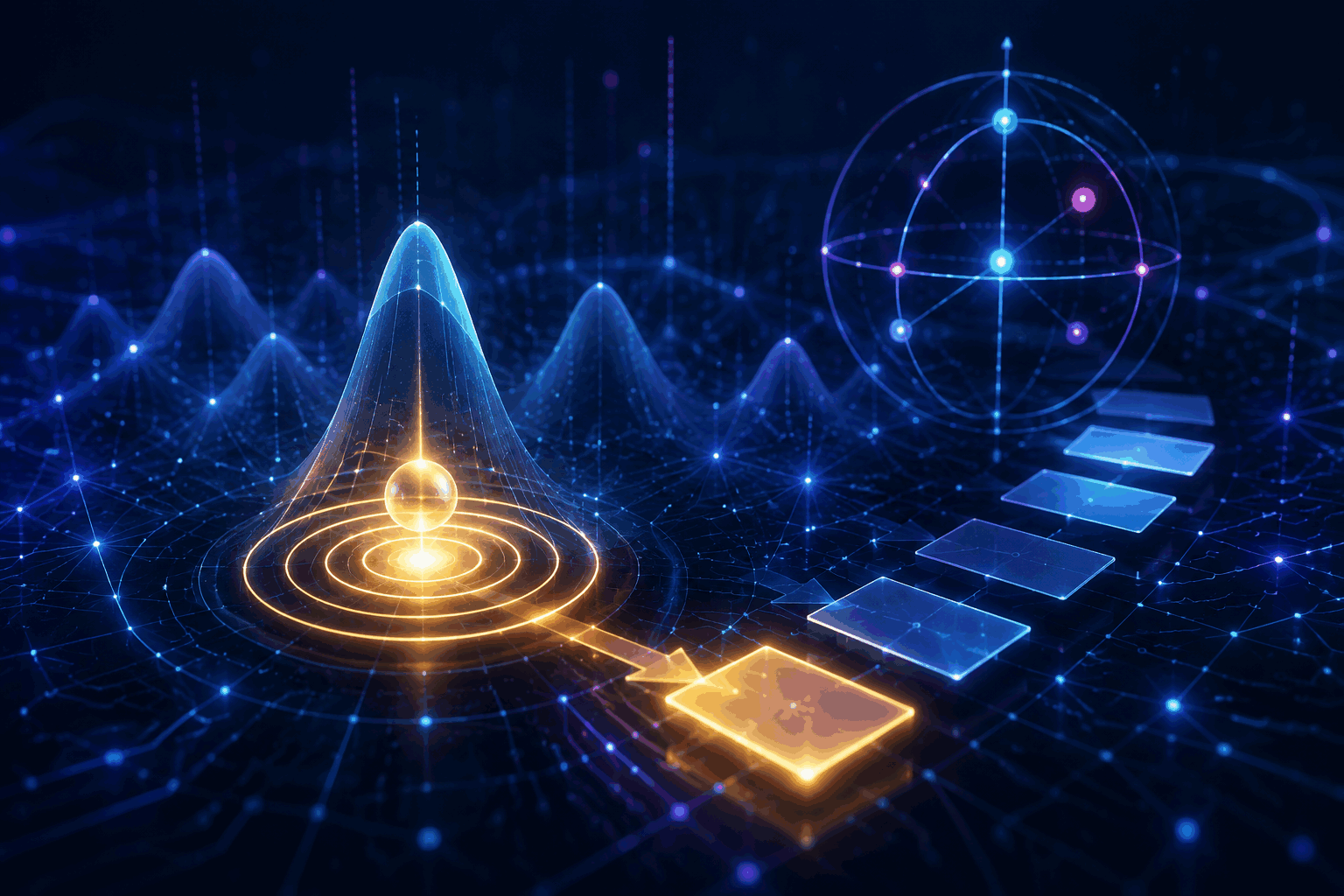
Here's where the real physics kicks in. The algorithm computes the average amplitude of all items, then reflects every amplitude across that average. The marked item (which was slightly below average due to its negative phase) gets pushed above average. Every unmarked item gets pushed slightly below average.
Repeat steps 2 and 3 together, and the marked item's amplitude grows with each iteration while all others shrink. It's constructive and destructive interference, weaponized.
Step 4: Measurement — Collapse to the Answer
After the correct number of iterations, you measure the quantum state. The probability of observing the marked item is now overwhelmingly close to 1. You've found your Ace of Spades.
Why Exactly π/4 · √N Iterations? (And Why More Hurts)
The amplitude of the target state grows sinusoidally with each iteration. It rises, peaks, then falls back down. The optimal stopping point is approximately (π/4)√N iterations. Go past that peak and the amplitude starts decreasing—a phenomenon called over-rotation.
Think of pushing a child on a swing. Push at the right moment and the swing goes higher. Push too many times past the apex and you start slowing it down. Grover's algorithm has a sweet spot, and overshooting it is worse than doing nothing.
A Physical Analogy
Put on a pair of active noise-cancelling headphones. The microphone picks up ambient noise, the processor generates an inverted waveform, and the two signals interfere destructively—silence emerges from chaos.
Grover's amplitude amplification does the same thing to probability amplitudes. The "noise" is the collective amplitude of all wrong answers. The algorithm generates an inverted version of that collective signal and superimposes it. Wrong answers cancel each other out through destructive interference. The correct answer, carrying its flipped phase, experiences constructive interference instead—its amplitude builds up iteration after iteration.
Alternatively, imagine dropping a pebble into a still pond. Now drop a second pebble at precisely the right distance and timing. Where the two wave crests meet, you get a tall spike (constructive interference). Where a crest meets a trough, the water goes flat (destructive interference). Grover's algorithm engineers the quantum equivalent: it arranges for all wrong answers to be troughs meeting crests, and the right answer to be crest meeting crest.
What Grover's Algorithm Actually Changes
Symmetric Cryptography Gets Halved. This is the headline consequence. AES-128 has a key space of 2128. A classical brute-force attack needs ~2127 operations. Grover's algorithm reduces that to ~264—which is computationally feasible for a sufficiently large quantum computer. The fix? Migrate to AES-256, which Grover reduces to ~2128 effective security.
It does NOT break RSA or elliptic curve cryptography. That's Shor's algorithm's territory. Grover provides only a quadratic speedup; Shor provides an exponential one for integer factorization and discrete logarithms. Conflating the two is one of the most common errors in quantum computing discourse.
Combinatorial Optimization. Problems like the Traveling Salesman Problem, graph coloring, and SAT solving can be framed as searches over solution spaces. Grover's algorithm offers a quadratic reduction in the search component, which can be meaningful when nested inside larger algorithmic frameworks.
Common Myths & The QRAM Bottleneck
Here's the question that trips up nearly everyone: "If Grover's algorithm searches databases faster, why can't I use it to speed up Google or my SQL queries?"
Because of the QRAM bottleneck.
Grover's algorithm assumes the database is already loaded into quantum superposition. For a classical database with N entries, loading that data into a quantum-accessible memory (QRAM) takes O(N) time by itself. You've just spent as long loading the data as a classical search would take to scan it. The quadratic speedup evaporates before the algorithm even starts.
QRAM hardware that could load classical data efficiently into quantum states does not exist at scale and faces fundamental engineering challenges. This isn't a "give it five years" problem. It's a structural architectural gap.
Grover's algorithm shines when the "database" is generated on the fly by a quantum circuit—like evaluating a hash function or checking a constraint—rather than stored in a classical hard drive. That's the cryptographic and optimization use case. Not web search.
Add to this the current NISQ-era reality: today's quantum processors have anywhere from a few hundred to ~1,000 noisy qubits with limited coherence times. Running Grover's algorithm on a search space large enough to matter (say, 2128) would require thousands of fault-tolerant logical qubits.
Frequently Asked Questions
Is Grover's algorithm exponential or quadratic?
Quadratic. It reduces O(N) to O(√N). This is a polynomial speedup, not an exponential one. It's powerful but fundamentally different in character from Shor's algorithm, which achieves exponential speedup for factoring.
Why can't we use Grover's algorithm for web search engines?
Three reasons: (1) the QRAM loading bottleneck negates the speedup, (2) web search relies on structured indexes and ranking heuristics, not brute-force unsorted search, and (3) current quantum hardware cannot interface with classical databases at the required scale. Grover's algorithm solves a different problem than what search engines actually do.
What happens if Grover's algorithm iterates too many times?
The success probability decreases. The target amplitude follows a sinusoidal trajectory—it rises to a peak near (π/4)√N iterations, then falls. Over-rotating past the peak means you're more likely to measure a wrong answer than if you'd stopped at the optimum. Precision in iteration count is not optional; it's baked into the algorithm's design.
Contact Us
 (+86) 177 3001 9472
 market@originqc.com