Why Quantum Computers Look Like Chandeliers: Explained Simply
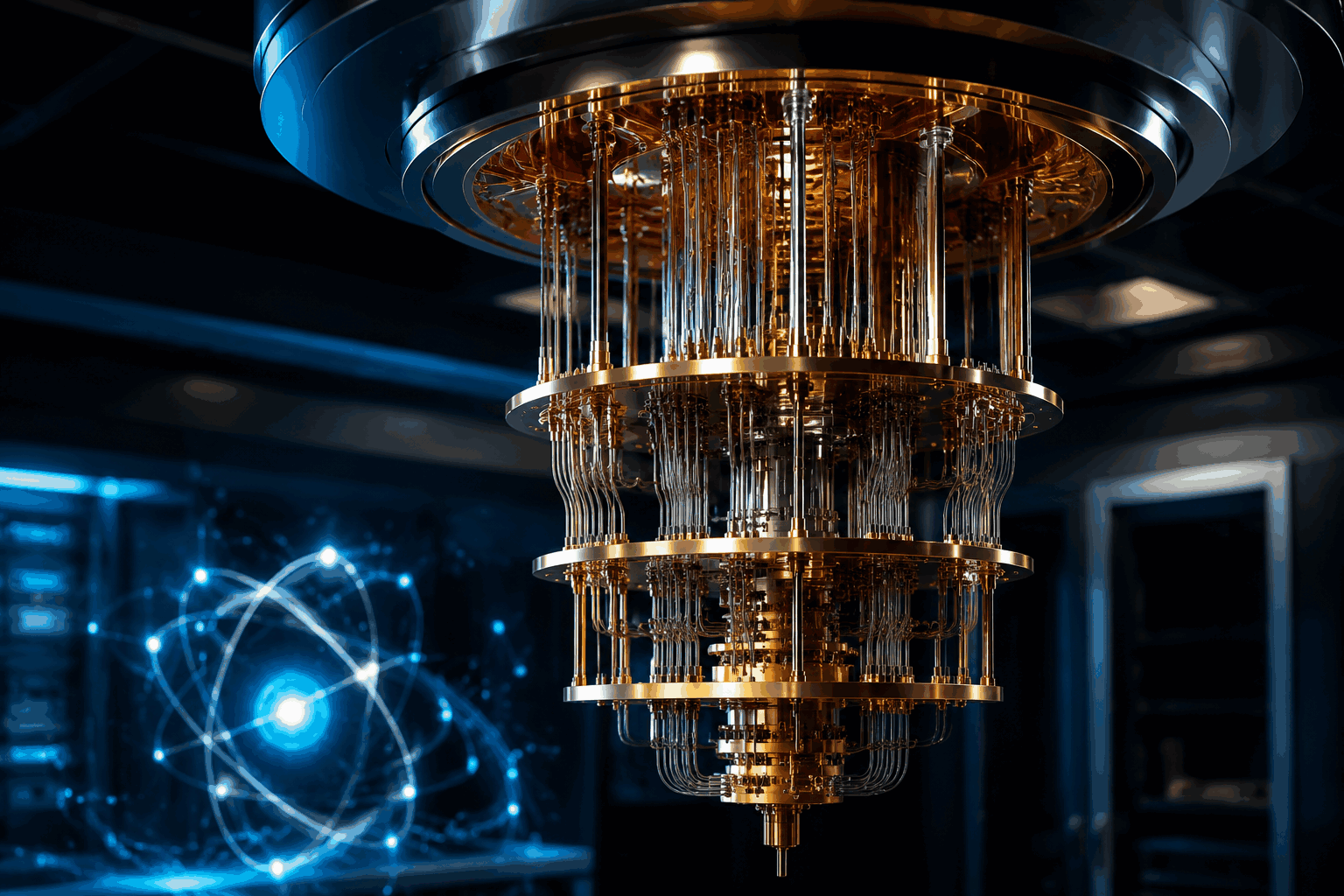
If you've seen a picture of an IBM or Google quantum machine, you know the image: a cascading structure of gleaming gold discs, tangled silver wires, and concentric plates that look like something ripped from a steampunk cathedral. Social media calls it a "quantum chandelier." The press loves it.
Here's the thing nobody tells you: that chandelier isn't the quantum computer. Not even close.
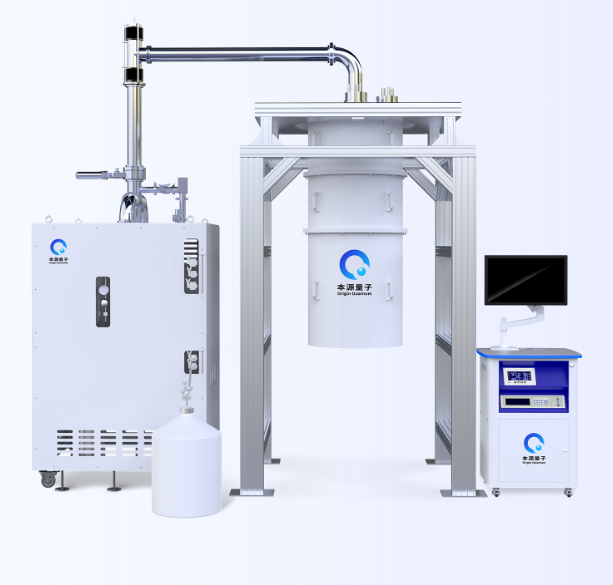
What you're actually looking at is a dilution refrigerator—a cryostat, in the lab's shorthand—a machine whose sole purpose is to keep a processor smaller than a postage stamp colder than the void between galaxies. The quantum processing unit itself, the thing doing the actual computation, is a chip no bigger than a fingernail, bolted to the very bottom plate of that golden cascade. Everything else—the discs, the wires, the gold—is life support.
What That Chandelier Actually Is
Let's kill the biggest misconception right now. When journalists photograph a "quantum computer," they're photographing the refrigerator. The quantum processor—the superconducting qubits etched onto a chip—sits at the lowest temperature stage, buried under meters of cabling and multiple thermal shields. You could hold the actual quantum computer in your palm. The chandelier around it weighs over a ton.
Why such extreme insulation? Because superconducting qubits are absurdly fragile. They exist in a quantum superposition—simultaneously zero and one—but that state collapses the instant the qubit absorbs even a whisper of thermal energy. We call this thermal decoherence. At room temperature, the ambient thermal radiation carries roughly 25 millielectronvolts of energy per photon. A superconducting qubit's transition energy is around 20 microelectronvolts. That's a mismatch of three orders of magnitude. The qubit doesn't just get disturbed; it gets obliterated.
So the chandelier's entire reason for existing is to build a thermal fortress around that tiny chip. Every disc, every wire, every gold-plated surface serves that single brutal engineering constraint.
A Descent to Absolute Zero
The best way to understand the structure is to follow the cold downward. Imagine you're shrinking yourself and descending through the chandelier from top to bottom, like diving into progressively colder ocean layers.
The Top Plate: Room Temperature (~300 K)
The topmost disc sits at ambient temperature. This is where the coaxial cables enter the system, carrying microwave control signals from room-temperature electronics. You'll also find the vacuum can sealed here—a high-vacuum enclosure that wraps the entire interior, eliminating convective heat transfer. Think of it as a thermos flask the size of a washing machine.
The 50 K Stage: The First Real Cold
Dropping down, you hit the first cryogenic stage, cooled by a pulse-tube refrigerator (a mechanical compressor that uses helium gas cycles). At 50 Kelvin—about minus 223 degrees Celsius—the thermal radiation load drops dramatically. The plates here are typically aluminum, and they act as a radiation shield, intercepting infrared photons before they can reach deeper stages.
The 4 K Stage: Liquid Helium Territory
The pulse tube's second stage brings you to roughly 4 Kelvin. This is where helium-4 becomes a liquid, and where the first coaxial attenuators are bolted. These attenuators are critical: they absorb thermal noise riding down the cables from warmer stages, dissipating it as heat into the 4 K plate before it can contaminate the qubit signal below.
The Still and the 800 mK Plate
Now we enter the dilution refrigerator's domain. At around 800 millikelvin, you encounter the "still"—a chamber where helium-3 is preferentially evaporated from a helium-3/helium-4 mixture, pulling heat away in the process. The plates here are gold-plated copper, and the cabling starts looking like a frozen silver waterfall.
The Mixing Chamber: The Bottom of the Abyss (~10–15 mK)
At the very bottom sits the mixing chamber plate. This is the coldest point in the entire system: roughly 10 to 15 millikelvin. That's 0.010 to 0.015 Kelvin above absolute zero. For reference, the Cosmic Microwave Background (CMB)—the residual glow of the Big Bang filling all of space—sits at 2.725 Kelvin. The bottom of this chandelier is over 200 times colder than deep space.
The quantum chip lives here. Bolted with tiny screws to a copper mount, wire-bonded to a printed circuit board, surrounded by the final set of attenuators and filters. This is where superconductivity reigns, where Josephson junctions behave as artificial atoms, and where quantum computation actually happens.
Why the Chandelier Shape? The Pure Engineering Logic
Now the real question: why this shape specifically? Why not a box? Why not a sphere? Why hanging discs connected by rods?
Gravity as a Design Tool
The dilution refrigerator relies on the phase separation of helium-3 and helium-4 isotopes at ultra-low temperatures. Below about 870 millikelvin, the mixture spontaneously separates into a helium-3-rich phase (lighter, floating on top) and a helium-4-rich phase (denser, sinking below). The cooling happens at the interface where helium-3 atoms cross from the concentrated phase into the dilute phase—an endothermic process analogous to evaporation.
Gravity is essential for maintaining this phase boundary. The system must be oriented vertically. Hang it upside down, and the phases mix, the cooling stops, and your qubits decohere in microseconds. The chandelier shape is, in part, a gravitational architecture.
Suspension Against Vibration
The pulse-tube compressor that pre-cools the system generates mechanical vibrations. If those vibrations reached the mixing chamber, they'd shake the qubit chip and introduce noise. The hanging-disc design, connected by thin support rods with low thermal conductivity, acts as a mechanical low-pass filter. Vibrations attenuate as they travel downward through the structure. By the time they reach the bottom plate, they're negligible.
The Coaxial Cable Maze
Look closely at any chandelier photo and you'll notice the cables don't run straight. They loop, curve, and cascade between stages like metallic vines. This isn't aesthetic. Two reasons:
- Thermal contraction absorption. Copper shrinks as it cools. From 300 K to 10 mK, a straight copper cable would contract enough to snap or pull components off their mounts. The loops provide slack—mechanical compliance that absorbs differential contraction between stages.
- Thermal anchoring. Each cable is clamped to the plate at every temperature stage. This forces the cable to equilibrate thermally at each level, preventing heat from "short-circuiting" down from warmer regions. The curves ensure sufficient contact length with each plate's thermal clamp.
At each stage, attenuators (typically 10 dB or 20 dB) are inserted in-line on the control cables. These resistive elements thermalize the microwave signal, stripping away thermal photons from above while allowing the intentional control pulses to pass (albeit weakened). By the time a signal reaches the qubit, it's been filtered through 60 or more decibels of attenuation, ensuring the qubit sees only the deliberate microwave pulse and not the 300 K thermal bath above.
Why Gold? It's Not for Show
Every copper surface in the chandelier is plated with gold. This confuses people. They assume it's decorative, or a flex by well-funded labs. It's neither.
The base material is oxygen-free high-conductivity (OFHC) copper, chosen for its exceptional thermal conductivity at cryogenic temperatures. But bare copper oxidizes. Copper oxide is a thermal insulator at millikelvin temperatures. Even a nanometer-thick oxide layer on a mating surface can increase thermal contact resistance by orders of magnitude.
Gold doesn't oxidize. Ever. A gold-plated surface maintains pristine metal-to-metal contact indefinitely, ensuring maximum thermal conductance across bolted joints. Additionally, gold has low emissivity in the infrared, meaning gold-plated radiation shields emit less thermal radiation toward colder stages than bare metal would.
So the gold is doing real thermodynamic work. Every single gleaming surface is a heat management decision.
How Dilution Cooling Actually Works
Here's the simplified version. Helium-3 and helium-4 are isotopes of helium. At temperatures below about 870 millikelvin, a mixture of the two separates into two phases: a concentrated phase (mostly helium-3) on top, and a dilute phase (mostly helium-4 with about 6.6% helium-3 dissolved in it) on the bottom.
When a helium-3 atom crosses from the concentrated phase into the dilute phase, it absorbs energy from its surroundings—an endothermic process. It's thermodynamically identical to how sweat evaporating from your skin carries heat away, except instead of water molecules escaping into air, helium-3 atoms dissolve into a quantum fluid.
The "still" (a heated chamber higher up in the system) selectively evaporates helium-3 from the dilute phase, because helium-3 has a lower boiling point than helium-4. This maintains the concentration gradient that drives helium-3 atoms across the phase boundary at the mixing chamber, continuously pulling heat away from the bottom plate.
The entire cycle is a closed loop. Helium-3 is pumped out of the still, compressed, pre-cooled through the heat exchangers, and reinjected into the concentrated phase. The cooling power at the mixing chamber is tiny—typically 200 to 400 microwatts—but that's all you need when your only heat load is a few dozen qubits and their wiring.
The Temperature Hierarchy at a Glance
| Stage / Tier | Temperature | Primary Hardware | Core Engineering Function |
|---|---|---|---|
| Top Plate | ~300 K (Room Temp) | Cable feedthroughs, vacuum seal, electronics interface | Signal entry point; vacuum boundary |
| First Stage (Pulse Tube) | ~50 K | Aluminum radiation shield, thermal anchors | Intercept infrared radiation; pre-cool helium gas lines |
| Second Stage (Pulse Tube) | ~4 K | Superconducting magnets (if used), first attenuators | Liquid helium temperature; initial signal thermalization |
| Still Plate | ~700–800 mK | Still heater, heat exchangers | Evaporate He-3 to drive dilution cycle |
| Intermediate Plates | ~100–200 mK | Additional attenuators, filtered DC lines | Progressive thermal anchoring of all cables |
| Mixing Chamber | ~10–15 mK | QPU chip, final attenuators, superconducting packaging | Qubit operation; quantum coherence preservation |
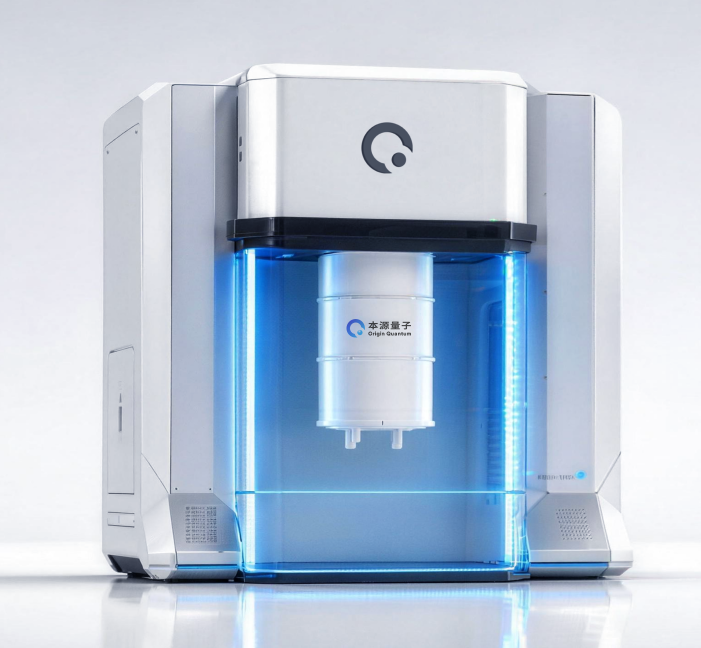
Click to see what other quantum computers look like.
Frequently Asked Questions
How cold is the bottom of the quantum chandelier?
The mixing chamber plate typically reaches 10 to 15 millikelvin (0.010–0.015 K). Some research-grade systems have achieved below 5 millikelvin. This is colder than the cosmic microwave background by a factor of over 200.
What happens if the chandelier heats up even by one millikelvin?
Qubit coherence times degrade rapidly with temperature. At 15 mK, a transmon qubit might maintain coherence for 100 microseconds. Raise the temperature to 50 mK, and thermal population of the qubit's excited state increases, causing errors and reducing coherence. At a few hundred millikelvin, superconductivity in the aluminum Josephson junctions breaks down entirely (aluminum's critical temperature is about 1.2 K), and the qubit ceases to function. The system isn't binary—it degrades continuously with temperature, which is why thermal stability at the mixing chamber is monitored to microkelvin precision.
Where is the actual quantum chip located?
At the very bottom of the chandelier, bolted to the mixing chamber plate. It's connected to the cabling above via wire bonds and a printed circuit board, and it's often enclosed in a superconducting enclosure made of niobium or aluminum to provide magnetic shielding.
Contact Us
 (+86) 177 3001 9472
 market@originqc.com