Single-Qubit vs Two-Qubit Gates: Key Differences & Roles
Single-qubit gates manipulate the state vector of an individual qubit on the Bloch sphere, controlling local superposition and phase. In contrast, two-qubit gates couple two distinct qubits to generate quantum entanglement. Together, they constitute a universal quantum gate set: single-qubit gates steer individual states, while two-qubit gates unlock multi-body correlations essential for exponential quantum speedup.
Classical computers think in switches. A transistor is either on or off, a bit is either 0 or 1, and logic gates—AND, OR, NOT—simply reroute these binary signals into new configurations. It's brutal in its simplicity, and it built the entire digital world.
Quantum computers don't work that way.
A qubit isn't a switch. It's a vector living in a two-dimensional complex Hilbert space, and a quantum gate doesn't flip it between two states—it rotates it through a continuous landscape of possibilities. This single distinction changes everything about how we think about computation at the hardware level.
So what exactly are single-qubit gates and two-qubit gates? Here's the short version:
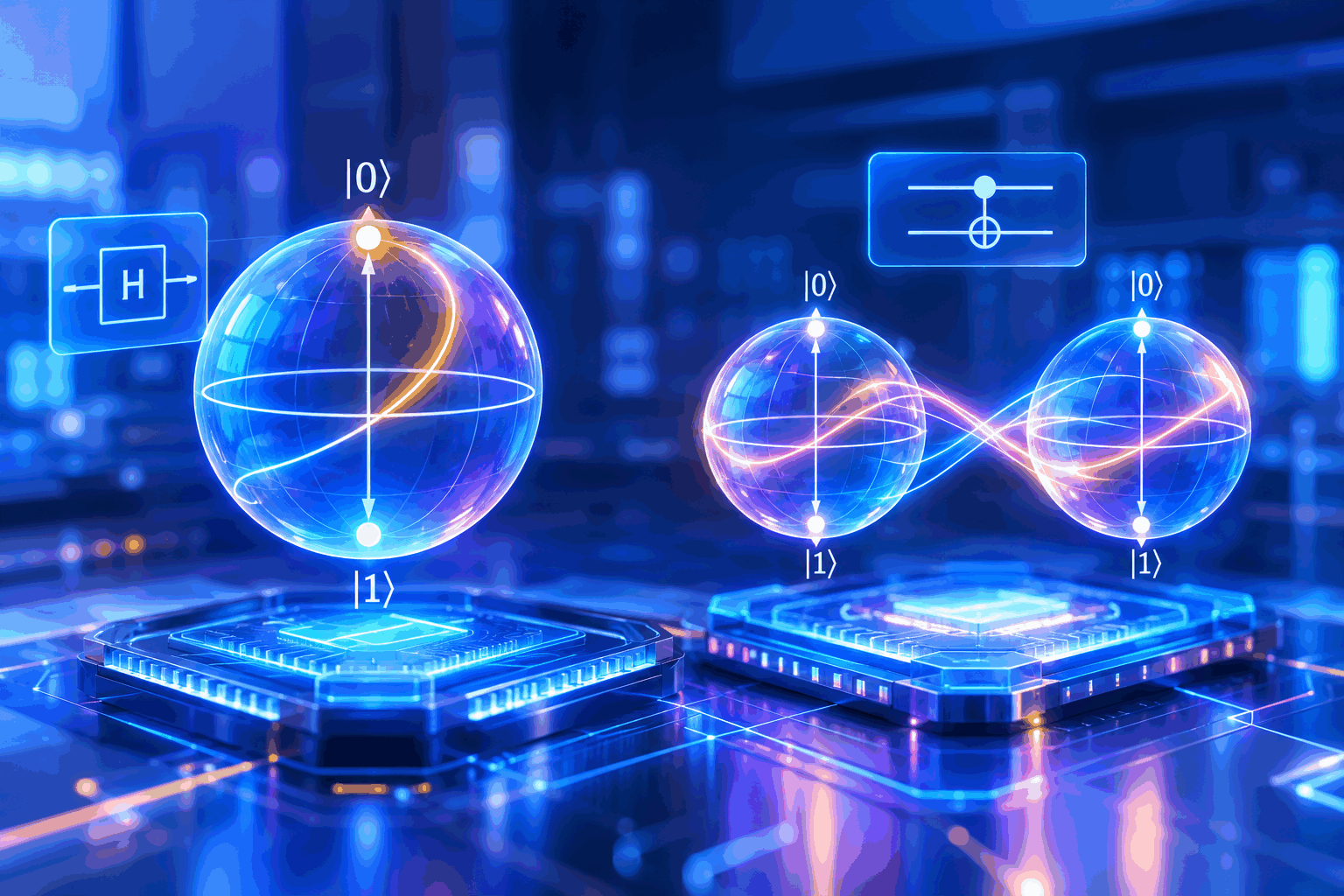
- A single-qubit gate is a 2×2 unitary matrix operation that transforms the quantum state of an individual qubit by rotating its state vector on the Bloch sphere. Think of it as adjusting the latitude and longitude of a single point on a globe.
- A two-qubit gate (Two-Qubit gate) is a 4×4 unitary matrix operation that acts on two coupled qubits simultaneously, generating quantum entanglement and non-classical correlations. Think of it as linking two globes so that spinning one instantly constrains the state of the other.
That's the elevator pitch. Now let's unpack why this matters, why the distinction is so fundamental, and why building the second type is one of the hardest engineering problems in modern physics.
Single-Qubit Gates: Steering the Quantum Compass
A single qubit's state can be written as |ψ⟩ = α|0⟩ + β|1⟩, where α and β are complex probability amplitudes satisfying |α|² + |β|² = 1. A single-qubit gate is any 2×2 unitary matrix U that transforms this state: |ψ'⟩ = U|ψ⟩.
Unitary means reversible. Apply the gate, then apply its conjugate transpose, and you're back where you started. No information is lost. This is not a design choice—it's a consequence of quantum mechanics itself. The Schrödinger equation is time-reversible, and any physical evolution of a closed quantum system must preserve the inner product structure of the state space.
The Core Gates
Pauli-X Gate — The quantum NOT. It swaps |0⟩ and |1⟩. On the Bloch sphere, this is a 180° rotation around the X-axis. If your qubit is pointing "north," X flips it to "south."
Pauli-Y and Pauli-Z Gates — Y rotates 180° around the Y-axis (flipping both the bit and the phase). Z rotates 180° around the Z-axis, leaving |0⟩ unchanged but multiplying |1⟩ by −1. This phase flip has no classical counterpart. You can't see it if you measure immediately, but it changes interference patterns downstream.
Hadamard (H) Gate — This is the workhorse. H maps |0⟩ to (|0⟩ + |1⟩)/√2 and |1⟩ to (|0⟩ − |1⟩)/√2. It creates an equal superposition from a definite state. Geometrically, it's a 180° rotation around an axis halfway between X and Z on the Bloch sphere. Every quantum algorithm you've heard of—Shor's, Grover's, and VQE start with a layer of Hadamards.
Phase Gates (S and T) — S applies a 90° phase rotation (|1⟩ → i|1⟩), and T applies a 45° phase rotation (|1⟩ → e^(iπ/4)|1⟩). These are finer adjustments. They don't change measurement probabilities on their own, but they control how probability amplitudes interfere when combined with other gates.
The Bloch Sphere Intuition
Here's where the geometry clicks. Every pure single-qubit state corresponds to a point on the surface of a unit sphere. The north pole is |0⟩, the south pole is |1⟩, and the equator holds all equal superpositions with varying relative phase.
A single-qubit gate is simply a rotation of this sphere. Any 2×2 unitary (up to a global phase) can be decomposed into rotations around two axes—say, Rz(θ) followed by Rx(φ). This is the Euler angle decomposition, and it's exactly how quantum hardware compilers break down arbitrary single-qubit operations into native pulse sequences.
One qubit. One sphere. One rotation at a time. Powerful, but limited.
Two-Qubit Gates: Where Entanglement Begins
Let's be honest about something. If you only had single-qubit gates, you could never build a quantum computer that outperforms a classical one. Not even close.
Why? Because N independent qubits, each undergoing their own local rotations, are mathematically equivalent to N independent coins being spun on separate tables. The joint state is always a product state: |ψ⟩ = |ψ₁⟩ ⊗ |ψ₂⟩ ⊗ ... ⊗ |ψₙ⟩. You can simulate this on a laptop in polynomial time. No speedup. No quantum advantage.
The magic—the actual, provable, exponential-separation-from-classical magic—requires quantum entanglement. And entanglement requires a gate that acts on two or more qubits jointly.
The Control Mechanism
Two-Qubit gates typically follow a control-target structure. One qubit (the control) determines whether an operation is applied to the other (the target). The most famous example:
CNOT (Controlled-NOT Gate) — The canonical two-qubit gate. In the computational basis (|00⟩, |01⟩, |10⟩, |11⟩), it conditionally flips the target bit if and only if the control bit is |1⟩:
-
|00⟩ → |00⟩ -
|01⟩ → |01⟩ -
|10⟩ → |11⟩ -
|11⟩ → |10⟩
If the control qubit is |1⟩, the target gets flipped. If the control is |0⟩, nothing happens. Looks simple, right? But feed in a superposition on the control—say (|0⟩ + |1⟩)/√2 with the target in |0⟩—and the output is (|00⟩ + |11⟩)/√2. That's a Bell state. Two qubits, maximally entangled. Measure one, and the other's outcome is instantly determined, regardless of distance.
This is not a correlation you can manufacture with classical gates. CNOT is the entanglement factory.
CZ (Controlled-Z) applies a phase flip to the target only when the control is |1⟩. It's symmetric—control and target are interchangeable—which makes it natural for certain hardware architectures like superconducting transmon qubits.
SWAP exchanges the states of two qubits. It's less glamorous but essential for routing information across a quantum processor where not all qubit pairs are physically connected.
Why Two-Qubit Gates Are the Only Path to Multi-Body Correlations
Entanglement is a property of the joint state that cannot be factored into individual descriptions. No sequence of single-qubit gates, no matter how long or clever, can take a product state and produce an entangled state. This is a theorem, not an engineering limitation. The mathematical structure of tensor products simply doesn't allow it.
Two-Qubit gates are the only bridge between "a collection of independent qubits" and "a correlated quantum system." They are the sole mechanism through which quantum parallelism becomes computationally exploitable.
Single vs. Double Qubit Gates: Key Differences at a Glance
| Dimension | Single-Qubit Gate | Two-Qubit Gate |
|---|---|---|
| Qubits acted upon | 1 | 2 |
| Matrix dimension | 2 × 2 | 4 × 4 |
| Physical action | Rotates one qubit's state vector on its Bloch sphere | Couples two qubits, creating or manipulating entanglement |
| Classical analogue | NOT gate (loosely) | No direct analogue (XOR is irreversible; CNOT is reversible) |
| Reversibility | Yes (unitary) | Yes (unitary) |
| Can create entanglement? | No | Yes |
| Typical gate time (superconducting) | ~20–50 ns | ~100–300 ns |
| Typical physical gate fidelity (State-of-the-Art) | 99.9% – 99.99% | 99.0% – 99.8% |
| Hardware requirement | Single microwave/laser pulse on one qubit | Controlled interaction between two qubits (tunable coupler, shared bus, or joint laser addressing) |
That fidelity gap—99.9% versus 99%—might look small. It isn't. We'll get to why in a moment.
Universal Quantum Computing: The Power of Mixing Both
Here's a result that still surprises people when they first encounter it: you don't need an infinite library of gates to build a universal quantum computer. You need just two ingredients:
- Any single-qubit gate that can approximate arbitrary rotations (in practice, the combination of H and T suffices).
- Any entangling two-qubit gate (CNOT, CZ, or even the iSWAP family).
That's it. As proven by the Barenco et al. universality theorem, single-qubit gates combined with CNOT form a universal quantum gate set. Furthermore, the Solovay-Kitaev theorem guarantees that any desired unitary operation can be efficiently approximated using a discrete set (such as Clifford + T) with only polylogarithmic overhead.
Think of it this way: single-qubit gates give you full local control over each qubit's orientation. The two-qubit gate gives you the ability to correlate qubits. Together, they let you navigate the full 2N-dimensional Hilbert space of an N-qubit system. That space is where quantum algorithms live, and universality means you can reach any point in it.
This is directly analogous to classical computation, where NAND alone is universal. But the quantum version is richer because the state space is continuous and exponentially large.
The Engineering Reality: Why Are two-qubit Gates So Hard to Build?
Single-qubit gates are, relatively speaking, easy. You shine a microwave pulse (superconducting qubits) or a laser beam (trapped ions) at one qubit, tuned to its transition frequency. The qubit rotates. Done. The pulse doesn't need to know about any other qubit in the system.
Two-Qubit gates are a different beast entirely.
To entangle two qubits, you need them to interact—to feel each other's quantum state—in a controlled, tunable way. In superconducting circuits, this means engineering a coupler element (a tunable inductor, a bus resonator, or a direct capacitive link) that can be turned on and off precisely. In trapped-ion systems, it means using shared motional modes of the ion chain as a quantum bus, requiring laser pulses that address two ions simultaneously without disturbing their neighbors.
Every one of these interaction mechanisms introduces failure modes that simply don't exist for single-qubit gates:
- Crosstalk: The pulse meant to couple qubits A and B inadvertently nudges qubit C sitting nearby.
-
Leakage: The interaction pushes population out of the computational subspace (
|0⟩,|1⟩) into higher energy levels that were never meant to be occupied. - Decoherence during the longer gate time: two-qubit gates take 3–10× longer than single-qubit gates. During that extra time, both qubits are exposed to environmental noise—thermal photons, flux fluctuations, charge noise—that degrades the very entanglement you're trying to create.
- Calibration drift: The interaction strength between two specific qubits depends on physical parameters (coupling capacitance, detuning) that drift over hours and days, requiring constant recalibration.
This is why the fidelity numbers matter so much. Surface code quantum error correction—the leading candidate for fault-tolerant quantum computing—requires physical gate error rates below a threshold of roughly 1% (and in practice, well below 0.1% for reasonable overhead). Single-qubit gates already clear this bar comfortably.two-qubit gates are right at the edge, and every 0.1% improvement in two-qubit fidelity translates directly into fewer physical qubits needed per logical qubit.
The entire race toward useful quantum computing is, in large part, a race to push two-qubit gate fidelity higher while scaling qubit counts.
Frequently Asked Questions
Can you build a quantum computer using only single-qubit gates?
No. A system of N qubits acted upon exclusively by single-qubit gates remains in a product state at all times. Such a system can be efficiently simulated classically (you just track N independent 2D vectors instead of one 2N-dimensional vector). You gain no computational advantage. Entanglement, which requires at least one two-qubit gate, is a necessary resource for quantum speedup.
How many qubits does a gate actually affect during calculation?
A single-qubit gate mathematically acts on a 2-dimensional subspace, but because of entanglement, its effect can propagate through the entire multi-qubit state. If qubit 3 is entangled with qubits 1, 7, and 12, then rotating qubit 3 changes the joint probability amplitudes of all four. The gate is "local" in the circuit diagram but "global" in its informational consequences.
What happens to a two-qubit gate if one qubit decoheres mid-operation?
The entangling operation fails partially or completely. If the control qubit loses coherence before the gate finishes, the target qubit ends up in a mixed state rather than a clean entangled partner. The resulting two-qubit state has reduced entanglement fidelity, and any downstream computation that depended on that Bell pair will produce incorrect results with elevated probability. This is precisely why gate time relative to coherence time (T₁, T₂) is a critical hardware metric.
Contact Us
 (+86) 177 3001 9472
 market@originqc.com