What is Quantum Machine Learning? The Complete Guide
Quantum Machine Learning (QML) is an interdisciplinary field that integrates quantum computing principles—primarily superposition, entanglement, and quantum interference—with machine learning algorithms. Its goal is to solve computationally intractable problems in optimization, high-dimensional data classification, and molecular simulation exponentially faster than classical computers.
Quantum machine learning (QML) sits at the frontier of computational intelligence. In short, it borrows the strangeness of subatomic physics and points it directly at the core challenge of classical ML: how do we discover hidden mathematical structures within complex, high-dimensional data?
Here's the problem that keeps researchers up at night. Classical machine learning is hitting walls. Not everywhere—but in specific, brutal corners. Drug discovery demands simulating molecular interactions that scale exponentially. Financial risk models drown in combinatorial explosions. Certain optimization landscapes are so rugged that gradient descent gets stuck in valleys that look nothing like the true minimum.
Think of it like this. You're lost in a maze with ten thousand corridors. A classical algorithm walks each path one by one, backtracking when it hits a dead end. A quantum-enhanced approach? It's as if you could briefly explore many corridors simultaneously, then collapse all that exploration into a single, confident direction.
Merging Two Revolutionary Worlds
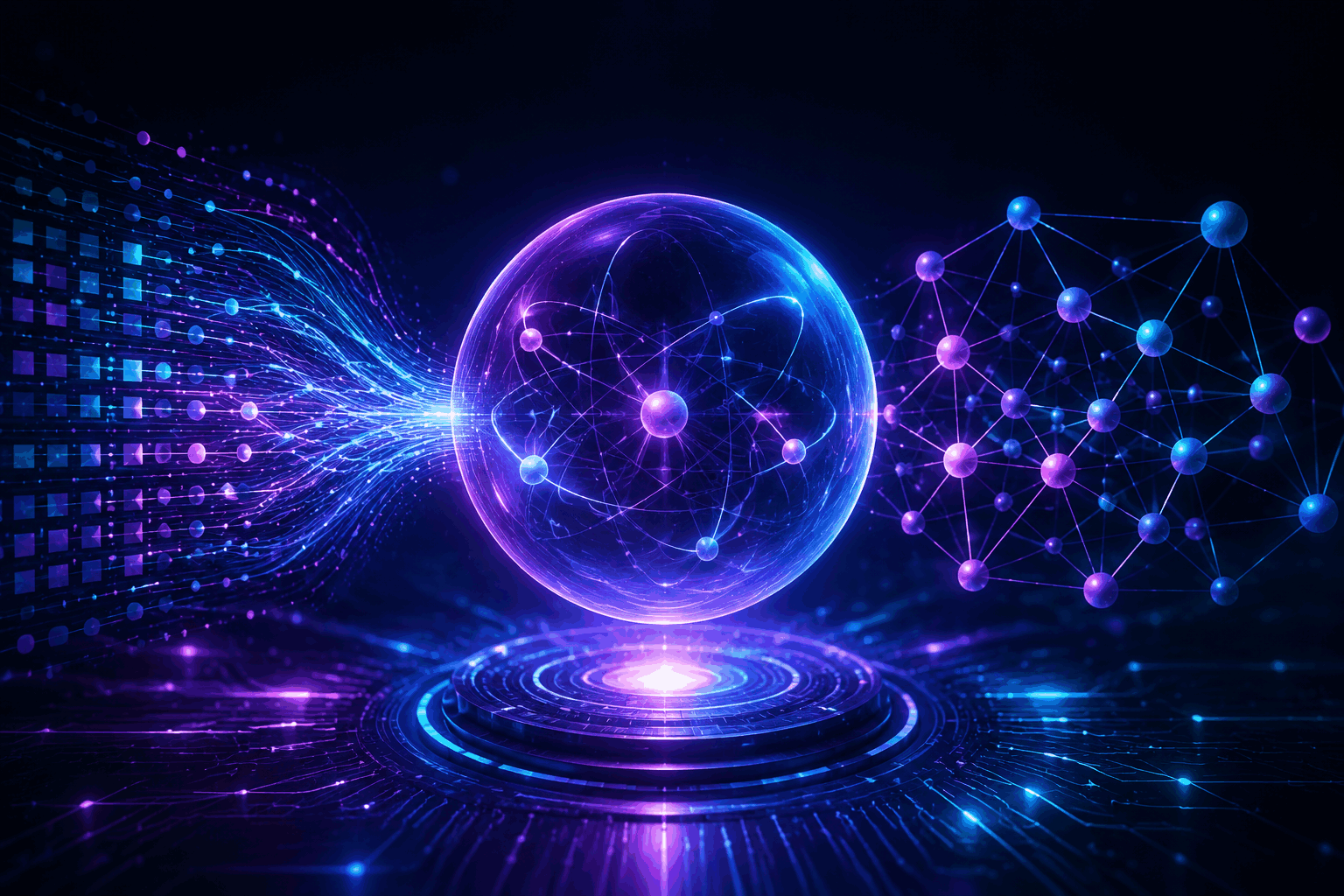
QML sits at the intersection of two fields that each took decades to mature. On one side: classical machine learning—algorithms that learn patterns from data, adjust internal parameters, and make predictions. On the other: quantum computing—machines that manipulate matter at the subatomic level to process information in ways no silicon transistor ever could.
Three quantum properties power the whole enterprise:
Quantum Superposition
A classical bit is a coin lying flat on the table. Heads or tails. Zero or one. A qubit (quantum bit) is that same coin spinning in the air. While it spins, it isn't heads or tails—it holds a probability amplitude for both simultaneously. This means a system of n qubits can represent 2n states at once. Fifty qubits? That's over a quadrillion states coexisting in one register. Classical ML would need to process those states sequentially. QML algorithms can, in principle, operate on all of them in parallel.
Quantum Entanglement: Spooky Correlation as a Feature
When two qubits become entangled, measuring one instantly determines the state of the other, regardless of distance. Einstein called it "spooky action at a distance." For QML, entanglement is a superpower. It lets algorithms encode correlations between data points that would require an astronomical number of classical parameters to represent. You get a compressed, high-fidelity description of complex relationships for free—well, for the price of maintaining fragile quantum states.
Quantum Interference: Amplifying the Right Answer
Here's where the analogy shifts from coins to waves. Quantum states behave like ripples on a pond. When two ripples meet, they can reinforce each other (constructive interference) or cancel out (destructive interference). QML algorithms are engineered so that wrong answers interfere destructively—washing themselves out—while correct answers reinforce and grow louder. It's nature's own noise-canceling headphone, applied to computation.
How Does Quantum Machine Learning Actually Work?
First, a myth to kill: QML does not mean uploading your PyTorch model onto a quantum chip and watching it run faster. That's not how any of this works.
The most widely referenced framework for understanding QML comes from a 2014 taxonomy by Maria Schuld and colleagues, often called the four-quadrant model. It classifies QML approaches based on two axes: whether the data is classical or quantum, and whether the algorithm runs on a classical or quantum processor.
- Classical data + Classical algorithm (CC): Standard ML. Nothing quantum here.
- Classical data + Quantum algorithm (CQ): Encode classical data into quantum states, then run a quantum circuit. This is where most near-term QML research lives.
- Quantum data + Classical algorithm (QC): Use a classical optimizer to learn from outputs of quantum experiments.
- Quantum data + Quantum algorithm (QQ): Fully quantum pipeline. Theoretically powerful, practically years away from broad utility.
Right now, the dominant paradigm is the Hybrid Classical-Quantum Approach. Here's the mental model that clicks for most people:
Picture a restaurant kitchen. The head chef (the quantum processor) handles one specific, extraordinarily complex task—say, reducing a sauce that requires precise molecular-level control. The sous chef (your classical CPU or GPU) does everything else: chopping, timing, plating, adjusting seasoning based on taste. The head chef doesn't run the whole kitchen. But for that one critical step, nothing else works.
In practice, a Parameterized Quantum Circuit (PQC) acts as the "head chef." It encodes data into qubit states, applies a sequence of quantum gates with tunable parameters, and produces a measurement outcome. The classical optimizer then tweaks those parameters—much like gradient descent adjusts weights in a neural network—based on a cost function. The loop repeats until the model converges. Libraries like PennyLane and Qiskit make this hybrid loop surprisingly accessible.
Quantum Machine Learning vs. Classical Machine Learning
At a philosophical level, classical ML searches for patterns using mathematical structures that scale linearly or polynomially with problem size. QML searches those same patterns inside Hilbert spaces—mathematical spaces whose dimensionality grows exponentially with the number of qubits. That exponential growth is either your best friend (more representational power) or your worst enemy (impossible to verify on classical hardware). Often, it's both.
| Dimension | Classical Machine Learning | Quantum Machine Learning |
|---|---|---|
| Underlying Physics | Transistor-based bits (0 or 1) | Qubits exploiting superposition and entanglement |
| Optimization Mechanism | Gradient descent, backpropagation on differentiable loss surfaces | Hybrid loops: classical optimizer tunes parameters of quantum circuits (PQCs); quantum landscapes can be flatter or more structured |
| Problem Scaling | State space grows polynomially; limited by memory and compute budget | State space grows as 2n with n qubits; exponential representational capacity in principle |
| Hardware Readiness (2025) | Mature. GPUs, TPUs, and custom ASICs handle billions of parameters reliably. | NISQ era. 50–1,000+ noisy qubits. Error correction not yet fault-tolerant at scale. |
| Best-Suited Problems | Image recognition, NLP, tabular prediction, recommendation systems | Molecular simulation, combinatorial optimization, quantum-native data analysis, kernel methods in exotic feature spaces |
Where Can Quantum Machine Learning Make a Difference?
Not every ML problem benefits from going quantum. QML earns its keep in domains where the underlying structure is already quantum or combinatorially explosive.
Molecular Simulation and Drug Discovery
Molecules are quantum systems. Simulating the electronic structure of even a modest protein on classical hardware requires approximations that sacrifice accuracy. A quantum processor, in principle, speaks the same language as the molecule it's modeling. QML algorithms can learn potential energy surfaces or predict molecular properties with fewer samples than classical counterparts—because the feature space they operate in mirrors the physics directly.
Portfolio Optimization and Risk Modeling
Selecting an optimal portfolio from thousands of assets under dozens of constraints is a combinatorial nightmare. The number of possible combinations grows faster than any classical brute-force method can chew through. Quantum approximate optimization algorithms (QAOA) and variational QML models can explore these landscapes in superposition, potentially finding better solutions faster. The keyword is potentially.
Quantum Kernel Methods and High-Dimensional Pattern Recognition
Kernel methods (like Support Vector Machines) work by mapping data into a higher-dimensional space where separation becomes easier. Quantum kernels map data into Hilbert spaces of exponential dimension—spaces so vast that no classical computer can even write down the full feature vector. For certain structured datasets, this gives QML a theoretical edge in classification tasks that classical kernels simply cannot replicate.
The Reality Check: What QML Is NOT
Time for honesty.
Myth 1: QML will replace deep learning and Transformers overnight.
No. Large language models, diffusion models, and convolutional networks run on hardware that is mature, cheap, and absurdly fast. QML targets a narrow slice of problems where classical methods hit fundamental scaling walls. For 99% of applied ML tasks today, classical methods remain the right tool.
Myth 2: Current quantum computers already outperform classical machines on practical ML tasks.
They don't. We are deep in the NISQ era (Noisy Intermediate-Scale Quantum). Today's processors have between roughly 50 and 1,000+ qubits, but those qubits are noisy, prone to decoherence (losing their quantum state due to environmental interference), and lack full error correction. Any claimed "quantum advantage" in ML so far has been on contrived benchmarks, not production workloads.
How Developers and Curious Minds Can Explore QML Today
You don't need a physics PhD or access to a cryogenic lab. The open-source ecosystem has matured significantly:
- PennyLane (by Xanadu): A Python library built specifically for differentiable quantum programming. It integrates with PyTorch and TensorFlow, letting you treat quantum circuits as trainable layers in a neural network.
- IBM Qiskit: IBM's open-source SDK. Includes simulators, real hardware access via IBM Quantum, and a growing library of QML algorithms.
- Google Cirq: Focused on near-term quantum circuits. Pairs well with TensorFlow Quantum for hybrid model building.
- VQNet: It integrates quantum computing for efficient simulation and QPanda for real quantum computer training and inference..
A practical starting path: Learn basic linear algebra and probability. Work through a short quantum computing primer. Then pick a small dataset, encode it into a parameterized quantum circuit using VQNet, and train it with a classical optimizer. You'll hit limitations fast—and that's the point. You'll understand exactly where the boundary between promise and reality sits.
Frequently Asked Questions About Quantum Machine Learning
Do I need a PhD in physics to learn QML?
No. A solid grasp of linear algebra, basic probability, and Python is enough to start. The quantum mechanics you need is a thin slice—state vectors, unitary operations, measurement—not the full machinery of quantum field theory.
Will QML replace GPUs?
Not in any foreseeable timeframe. GPUs are optimized for the matrix multiplications that dominate modern deep learning. Quantum processors solve a fundamentally different class of problems. They're complementary, not competitive.
Contact Us
 (+86) 177 3001 9472
 market@originqc.com