Quantum Superposition Explained: How It Works, Why It Matters
If you're here because you've heard the term "quantum superposition" and want to actually understand what it means—you're in the right place. I'll walk you through what superposition is, where it comes from, why it matters for quantum computing, and what the latest research actually says. No hype. Just the physics.
The Basics: What Quantum Superposition Actually Is
Let's start with something familiar. The device you're reading this on runs on classical bits—tiny electrical switches that are either 0 or 1. Every app, every video, every website you've ever used boils down to billions of these 0s and 1s flipping in sequence. Simple. Predictable. Comfortable.
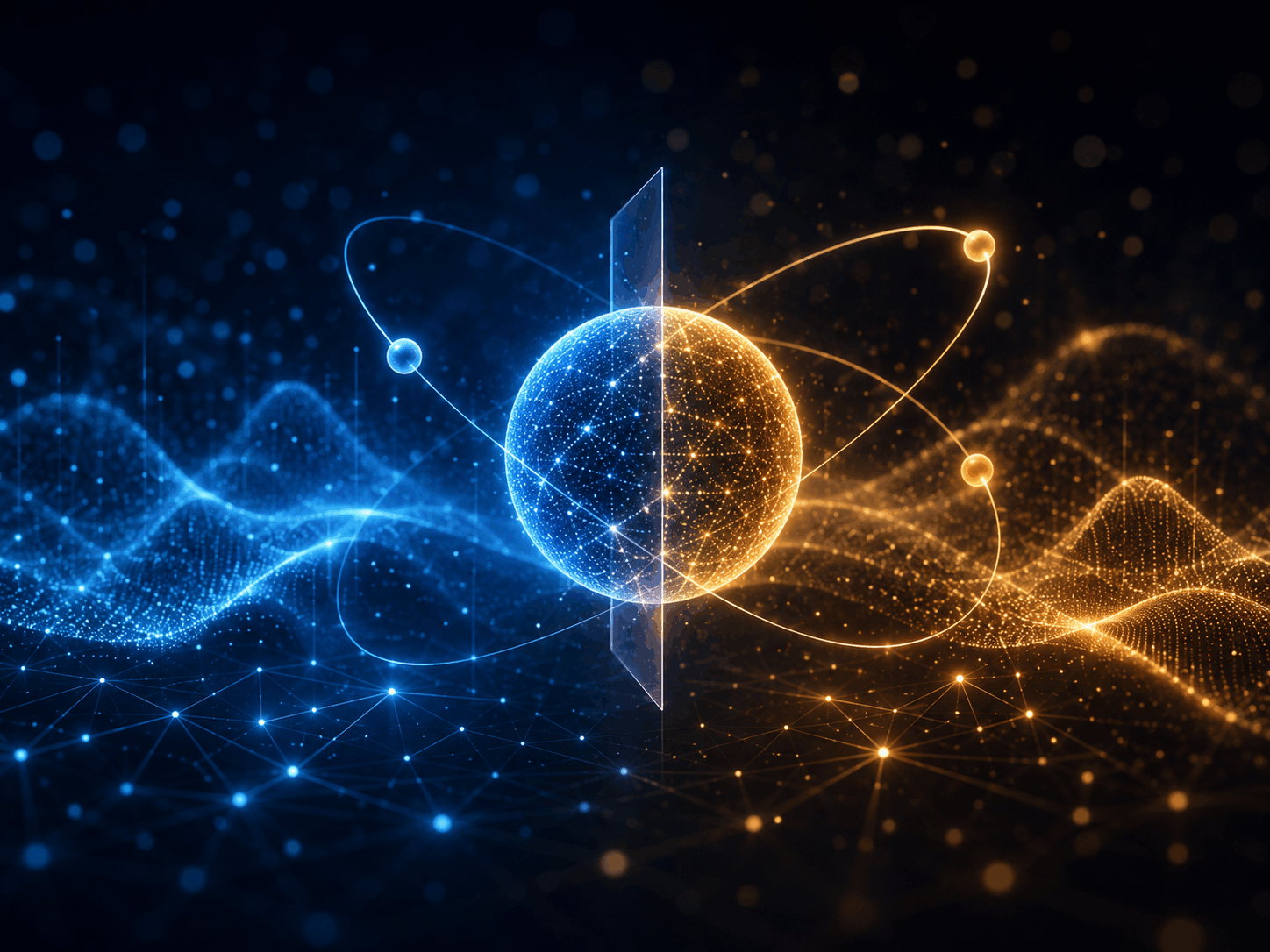
Quantum particles don't play by those rules. An electron's spin, a photon's polarization—these properties don't have to "pick" a single value until someone measures them. Before measurement, the particle exists in what physicists call a superposition: a combination of all possible states, each with its own probability amplitude.
The mathematical tool we use to describe this is the wave function, usually written as the Greek letter ψ (psi). The wave function doesn't tell you "the electron is spin-up." It tells you "the electron has a 70% chance of being measured as spin-up and a 30% chance of spin-down." Both possibilities are real, simultaneously, until observation forces a single outcome.
The Double-Slit Experiment: Where It All Started
You can't really understand superposition without the double-slit experiment. It's the cleanest, most direct demonstration we have, and it's been reproduced in labs worldwide since Thomas Young first ran a version of it with light in 1801.
Here's the setup: fire particles (electrons, photons, whatever) at a barrier with two narrow slits. Behind the barrier is a detector screen that records where each particle lands. Common sense says each particle goes through one slit or the other, building up two clusters on the screen.
That's not what happens.
When you don't measure which slit the particle passes through, an interference pattern emerges on the screen—alternating bands of high and low particle density, exactly like ripples in water overlapping. This pattern only makes sense if each particle is somehow going through both slits simultaneously and interfering with itself.
Put a detector at the slits to figure out which one the particle uses, and the interference pattern disappears. The particle suddenly behaves like a classical object, picking one path. The act of measurement—of gaining information about the system—destroys the superposition.
The Math Behind Superposition
I know—when people say "here's the math," most readers close the tab. But this part is genuinely useful, and I'll keep it to the essentials. You don't need a physics degree to follow along.
In quantum mechanics, we represent states as vectors. A classical bit has two states: 0 or 1. A qubit (quantum bit) can be in any linear combination of those two states:
|ψ⟩ = α|0⟩ + β|1⟩
The symbols α and β are complex numbers called probability amplitudes. The probability of measuring the qubit as 0 is |α|², and the probability of measuring it as 1 is |β|². These probabilities always add up to 1.
Here's what makes superposition powerful: a system of n qubits doesn't just hold n bits of information. It exists in a superposition of all 2n possible states simultaneously. Three qubits give you 8 simultaneous states. Ten qubits give you 1,024. Three hundred qubits give you more states than there are atoms in the observable universe.
This exponential scaling is why quantum computers, if we can build them at sufficient scale, would outperform classical machines on certain problems. It's not that they're "faster" in the usual sense—it's that they explore a vastly larger solution space in parallel.
Schrödinger's Cat: What It Really Means
Erwin Schrödinger came up with his famous cat scenario in 1935, and it's probably the most misunderstood thought experiment in physics history. So let's set the record straight.
The setup: a cat in a sealed box with a radioactive atom, a Geiger counter, a vial of poison, and a mechanism. If the atom decays, the Geiger counter triggers the mechanism, the vial breaks, and the cat dies. If the atom doesn't decay, the cat lives. Since the atom is in a superposition of decayed and not decayed, quantum mechanics says the cat—in the formalism—is in a superposition of alive and dead.
So why don't we see superposition in large objects? The answer is decoherence. Any interaction with the environment—air molecules bouncing off the object, thermal radiation, even stray photons—acts as a kind of "measurement." The superposition collapses almost instantly. For an isolated electron in a vacuum chamber at near absolute zero, it can persist long enough to do useful work.
That's why quantum computers need to operate at temperatures colder than deep space—typically around 15 millikelvin. Any warmth, and thermal noise destroys the delicate superposition states before calculations can complete.
Quantum Superposition vs. Quantum Entanglement: Don't Confuse Them
These two concepts get mixed up constantly, even in articles that should know better. They're related but distinct.
| Property | Quantum Superposition | Quantum Entanglement |
| Definition | A single system existing in multiple states simultaneously | Two or more systems whose states are correlated, regardless of distance |
| Requires multiple particles? | No—one particle is sufficient | Yes—at least two particles required |
| Classical analogy | A spinning coin (both heads and tails until it lands) | Two coins that always land the same way, no matter how far apart |
| Role in quantum computing | Provides parallel computation paths | Enables qubits to work together as a unified system |
| Destroyed by | Measurement or decoherence | Measurement of either particle, or decoherence |
In practice, quantum algorithms use both. Superposition gives you the computational space; entanglement lets you manipulate that space in ways classical systems can't replicate. Neither alone is sufficient for quantum advantage—you need both working together.
Common Misconceptions About Quantum Superposition
| Misconception | What Is Actually True |
|---|---|
| "A particle in superposition is in two places at once" | Before measurement, the particle does not have a single definite position. Its wavefunction is distributed across space, and the concept of "being at one place" does not apply until a position measurement is made. |
| "Schrödinger believed his cat was both dead and alive" | Schrödinger introduced the cat thought experiment in 1935 as a critique. He wanted to show that applying quantum formalism uncritically to everyday objects leads to conclusions that seem absurd. |
| "Superposition means we just do not know which state the system is in" | That would be classical uncertainty. Quantum superposition produces interference effects that are impossible if the system had a definite but unknown state. Bell test experiments have ruled out this "hidden variable" explanation. |
| "Superposition and entanglement are the same thing" | Superposition applies to a single system. Entanglement describes correlations between two or more systems. Entanglement involves superposition (of joint states), but a single system can be in a superposition without being entangled with anything. |
| "A quantum computer evaluates every possible answer simultaneously" | Quantum algorithms do not work by brute-force parallel evaluation. They work by setting up interference patterns among probability amplitudes so that correct answers are reinforced and incorrect answers are suppressed. The art of quantum algorithm design lies in engineering the right interference. |
| "Observation requires a conscious observer" | In standard quantum mechanics, "observation" or "measurement" means any interaction that correlates the quantum system with a macroscopic degree of freedom. A photon hitting a detector, an atom colliding with a gas molecule—these are measurements. Consciousness plays no role in the formalism. |
How Superposition Powers Quantum Computing
This is where quantum superposition moves from "interesting physics" to "potentially transformative technology."
Classical computers process information sequentially. Even with multiple cores, each core handles one instruction at a time. A quantum computer leverages superposition to effectively evaluate many possibilities in parallel. This doesn't mean it's faster at everything—your laptop will still beat a quantum machine at streaming video or running spreadsheets. But for specific problem classes, the difference is staggering.
Shor's algorithm, which uses superposition and entanglement to factor large numbers, could theoretically break RSA encryption—the system that secures most of today's internet communications. A sufficiently powerful quantum computer running Shor's algorithm could crack a 2048-bit RSA key in hours. A classical supercomputer would need billions of years.
Grover's algorithm provides a quadratic speedup for unstructured search problems. Looking through a database of N entries takes roughly √N steps on a quantum computer instead of N. For a million-entry database, that's the difference between 1,000 operations and 1,000,000.
Modeling molecular interactions on classical computers is brutally expensive because the quantum state space grows exponentially with each added particle. A quantum computer, operating natively in that space, could simulate drug molecules, battery materials, or catalysts with accuracy that's simply impossible today.
One piece of advice: don't get too caught up in the "meaning" of superposition. The Copenhagen interpretation, Many-Worlds, de Broglie-Bohm—these are frameworks for thinking about what the math implies. The math itself works regardless. Calculate the wave function, predict the probabilities, run the experiment, check the results. The interpretation is philosophy. The prediction is physics.
Frequently Asked Questions
What is quantum superposition in simple terms?
Quantum superposition is the ability of a particle or system to exist in multiple states at the same time. Unlike a coin that is secretly heads or tails while hidden under your hand, a quantum system in superposition is genuinely in all of its states together until a measurement forces it to choose one.
How is quantum superposition different from classical wave superposition?
Classical wave superposition involves physical quantities like water height or air pressure adding together. Quantum superposition involves probability amplitudes—complex numbers whose squared magnitudes give measurement probabilities. The key difference is that quantum superposition describes a single particle in multiple states, not multiple waves in the same space.
What is the mathematical formula for quantum superposition?
A superposition of two basis states is written as |ψ⟩ = α|0⟩ + β|1⟩, where α and β are complex probability amplitudes satisfying |α|² + |β|² = 1. For n basis states, the generalization is |ψ⟩ = Σᵢ cᵢ|i⟩, where each cᵢ is a complex amplitude.
Does superposition mean a particle is everywhere at once?
No. A particle's wavefunction may be spread over a large region, but it typically has regions of higher and lower amplitude. The particle is more likely to be found where the amplitude is large. Superposition means the particle does not have a single definite position before measurement—not that it is uniformly distributed everywhere.
What causes superposition to collapse?
Any interaction that correlates the quantum system with an uncontrolled external degree of freedom—a process called decoherence—effectively collapses the superposition. This can be a deliberate measurement by a detector or an accidental collision with a stray particle. The distinction between "measurement" and "environmental interaction" is largely semantic; both involve entanglement with degrees of freedom outside the system.
How long does a quantum superposition last?
It depends entirely on the system and its environment. Superconducting qubits maintain coherence for tens to hundreds of microseconds. Trapped ions can hold superposition for seconds or minutes. In carefully isolated laboratory conditions, coherence times continue to improve with better vacuum systems, lower temperatures, and improved control techniques.
Can humans or everyday objects be in a superposition?
In principle, quantum mechanics applies to all matter regardless of size. In practice, the interactions between a macroscopic object and its environment cause decoherence so rapidly that any superposition becomes undetectable almost instantly. A human body at room temperature decoheres on timescales far shorter than any physical process could resolve.
If you'd like a simple explanation of quantum superposition using the coin analogy, please check out:Quantum Superposition: A Simple Explanation (With the Spinning Coin Analogy)
Contact Us
 (+86) 177 3001 9472
 market@originqc.com