What Is Quantum Teleportation? Explained Simply (Step-by-Step)
TL;DR / Quick Summary:
- What it is: Quantum teleportation transfers the quantum state (information) of a particle to another distant particle, not physical matter.
- How it works: It relies on quantum entanglement and a classical communication channel.
- Key Rule: The original quantum state is always destroyed during the process (governed by the No-Cloning Theorem).
- Speed Limit: It cannot exceed the speed of light because classical measurement results must be transmitted to complete the transfer.
You've seen it a hundred times. Captain Kirk steps onto a glowing platform, there's a shimmer, a hum, and suddenly he's standing on the surface of an alien planet. Star Trek made teleportation feel almost inevitable—like it was just a few centuries of engineering away.
So when physicists started using the word "teleportation" in the 1990s, headlines went wild. People imagined beaming themselves to work, skipping traffic forever.
Here's the truth: quantum teleportation is real. Scientists have done it. But it has almost nothing in common with what you saw on the Enterprise. No one is dissolving your body into light and reassembling it across town. What's actually being teleported is something far more subtle—and honestly, far more interesting. It's quantum information encoded in qubits: the state of a particle, the recipe, not the cake.
If you've been searching for quantum teleportation explained simply, you're in the right place. Ready? Let's go.
What Is Quantum Teleportation?
Let's get the biggest misconception out of the way first. Quantum teleportation does not move matter from point A to point B. Not a single atom travels across space during the process. What moves is the quantum state—the complete description of a particle's properties like spin, polarization, or energy level.
Think of it this way. Imagine you have an original painting in New York. Quantum teleportation doesn't ship the canvas to London. Instead, it transfers the exact arrangement of every brushstroke, every color, every texture onto a blank canvas that's already sitting in London. The original? It gets destroyed in the process. You can never have both copies at once. That last part is critical, and we'll come back to it.
Now, could you do this with a human being? In principle, the laws of physics don't explicitly forbid it. In practice, you'd need to measure and transmit the quantum state of roughly 7 × 1027 atoms that make up your body, all while maintaining quantum coherence. That's not just a technology bottleneck—it's a fundamental physical barrier. So no, you're not beaming to Paris for lunch anytime soon.
| Feature | Sci-Fi Teleportation | Quantum Teleportation |
|---|---|---|
| What gets moved? | Physical matter (your body) | Quantum state (information/qubits) |
| Does original survive? | Sometimes (depends on the sci-fi canon) | Never. The original state is destroyed. |
| Speed | Instantaneous | Speed of light (requires classical data transfer) |
| Scale | Macroscopic objects, humans | Individual subatomic particles (photons, atoms, ions) |
| Receiver required? | No | Yes—a particle must already exist at destination |
| Is it real? | Science Fiction | Science Fact (Demonstrated experimentally since 1997) |
The Building Blocks of Quantum Teleportation
Before we walk through the teleportation process itself, you need two fundamental concepts in your back pocket. Without them, the mechanics won't make sense. I promise both are easier to grasp than they sound.
1. Quantum Superposition: Being in Multiple States at Once
In the everyday world you live in, an object exists in only one state at a time. A light switch is either on or off. A cat is either alive or dead. A coin sitting on the table shows heads or tails. Period.
Now shrink down to the quantum scale—electrons, photons, and ions. Down there, the rules change completely. A particle doesn't have to pick a single definitive state. It can exist in a superposition—a genuine, physical blend of multiple states simultaneously. It is not a matter of "we don't know which one it is." It is, in a measurable sense, both at once.
Think of it like a coin spinning in the air. While it's rotating, it's not strictly heads and it's not strictly tails. It's a blur of both possibilities coexisting. Only when it lands—when you measure it—does it collapse into one definite outcome. Quantum superposition works the same way, except the "coin" never lands until an observation forces it to collapse.
Why does this matter for quantum teleportation? Because the "thing" being teleported is precisely this delicate superposition state. It's not a basic binary 0 or 1; it's the exact, fragile ratio of how those quantum states are blended.
2. Quantum Entanglement: The Ultimate Cosmic Connection
Here's where quantum physics gets counterintuitive. Take two particles and cause them to interact in a specific way. Now, no matter how far apart you separate them—even across light-years—they become entangled. Measure one, and you instantly gain precise information about the other.
The classic analogy: imagine you have a pair of shoes. You put the left shoe in Box A and the right shoe in Box B, then ship them to opposite sides of the globe. The moment you open Box A and see the left shoe, you instantly know Box B contains the right shoe. No physical signal traveled between the boxes; you simply resolved the system's state.
Quantum entanglement is similar, but far more profound. Before you open the box, the quantum particles don't have predetermined identity. The act of measuring one forces both to instantly collapse into correlated states. Einstein famously questioned this phenomenon, referring to it as "spooky action at a distance." Yet, countless experiments have proven its reality.
Quantum Teleportation Explained Simply: Step-by-Step
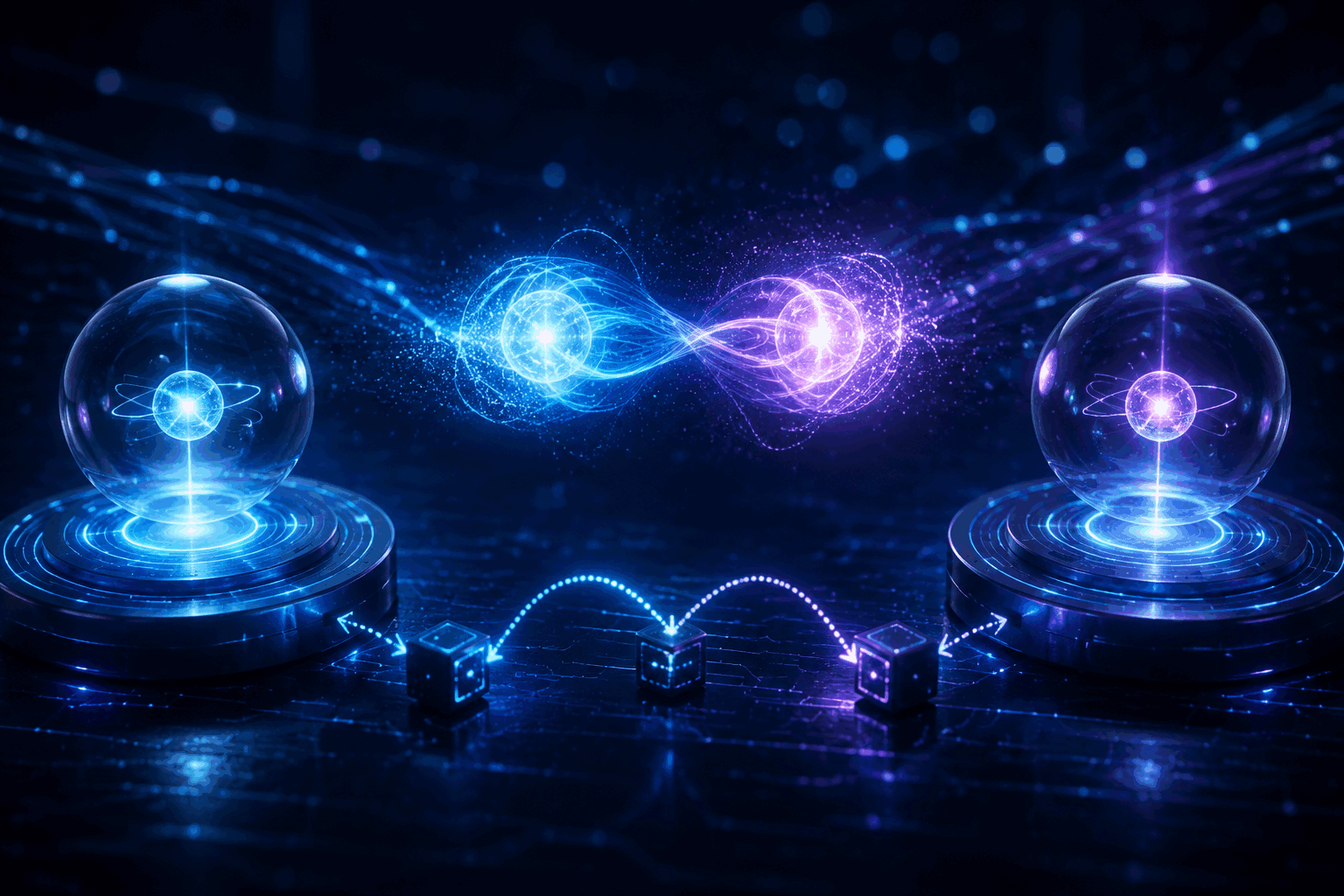
Alright, let's look at the core execution. We'll use the traditional thought-experiment protocol featuring Alice (the sender) and Bob (the receiver). Imagine them in labs on opposite sides of a city. Alice wants to teleport the quantum state of a photon to Bob. Here is how it happens across four distinct steps:
-
Step 1: Establishing Entanglement (The Setup)
Alice and Bob first share a pair of entangled photons: Photon A (in Alice's lab) and Photon B (in Bob's lab). They are connected by an invisible quantum link. -
Step 2: The Message Photon Arrives
Alice receives a third particle—Photon M (the message). She wants to transfer Photon M's unknown quantum state to Bob without directly measuring it (since measuring it would destroy its superposition). -
Step 3: Joint Measurement & The No-Cloning Theorem
Alice performs a joint measurement on Photon M and Photon A together (known as a Bell-state measurement). Crucially, this action destroys the quantum state of Photon M. According to the physics principle known as the No-Cloning Theorem, you can never create a perfect copy of an unknown quantum state. To transfer it, the original state must be erased. -
Step 4: Classical Data Transfer & Reconstruction
Alice's measurement generates a classical outcome (one of four possibilities). She transmits this binary result to Bob via standard channels (fiber-optic cables, internet, or radio waves). Upon receiving the key, Bob applies a corresponding transformation matrix to Photon B. Instantly, Photon B takes on the exact quantum state Photon M originally held. Teleportation is complete.
Why Doesn't It Break the Speed of Light?
A common question naturally arises: If entanglement correlations occur instantly across space, does this protocol violate Einstein's theory of special relativity by enabling faster-than-light (FTL) communication?
The short answer is: No, relativity remains entirely intact.
Refer back to Step 4. Bob holds an entangled photon, but it contains purely random noise until he receives Alice's measurement data. That data must travel through a standard classical channel—which is strictly bounded by the speed of light.
Entanglement by itself carries zero usable data. Think of Bob's photon as a locked safe. The instant entanglement tells him the safe exists, but he cannot extract the secret inside until Alice transmits the combination by mail. The "mail truck" still abides by universal speed limits.
Real-World Applications of Quantum Teleportation
-
The Quantum Internet & Cyber Security:
Quantum teleportation forms the foundation for building a next-generation Quantum Internet. Using Quantum Key Distribution (QKD), communications become immune to silent interception. Any attempt to eavesdrop collapses the quantum state, immediately notifying both parties of a security breach. -
Distributed Quantum Computing Networks:
Individual quantum processors (like those developed by IBM or Google) are limited by physical chip size. Quantum teleportation allows researchers to link separate quantum processors using quantum repeaters, creating a modular, distributed quantum supercomputer without disturbing fragile qubits. -
Long-Distance Space Communication:
In recent years, groundbreaking milestones—such as China's Micius satellite teleporting photon states from Earth to orbit over 1,400 km away—have proven that long-distance quantum networks across space are practical realities.
Frequently Asked Questions
Can humans ever be teleported using quantum mechanics?
Almost certainly not. A human body contains roughly 7 octillion (7 × 1027) atoms. Measuring, processing, and reconstructing the exact quantum states of that many particles without decoherence is practically impossible. Furthermore, due to the No-Cloning Theorem, the process would permanently destroy the original body. Philosophers have a field day with that one: even if reconstructed, would it truly be you?
Does quantum teleportation allow faster-than-light communication?
No. As outlined above, decoding the teleported state requires classical communication (limited by the speed of light). Quantum entanglement shows instant correlation, but correlation alone cannot convey controllable messages without classical data.
Is quantum teleportation the same as quantum computing?
Not quite. Quantum computing focuses on processing complex information using qubits. Quantum teleportation is a communication protocol used to transmit qubit states from one physical location to another. However, teleportation is essential for connecting multiple quantum computers into a unified network.
Contact Us
 (+86) 177 3001 9472
 market@originqc.com