Quantum Computing vs GPU: Will Quantum Replace GPUs?
TL;DR / Key Takeaways:
- GPUs are parallel execution engines designed for massive linear algebra (deep learning, 3D rendering, matrix math).
- Quantum Computers (QPUs) leverage superposition and quantum entanglement for complex problems (molecular biology, cryptography, combinatorial optimization).
- The Verdict: Quantum computers will not replace GPUs. The future of data centers is hybrid—GPUs for deep learning and heavy classical compute, QPUs for specialized quantum algorithms.
Picture this. You're scrolling through tech news, and a headline screams: "Quantum Computer Solves in Minutes What Would Take Supercomputers 10,000 Years." Your first thought? Maybe it'll finally run Cyberpunk 2077 at 400,000 FPS. Or perhaps it'll train GPT-6 over a lunch break.
Here's the uncomfortable truth: quantum computers will never render your video game. They won't replace your RTX 5090. They won't make your AI model train faster in any straightforward sense. The reason is simple but often overlooked—quantum computers and GPUs aren't competing in the same race. They aren't even running on the same track. They're playing entirely different sports with entirely different rules.
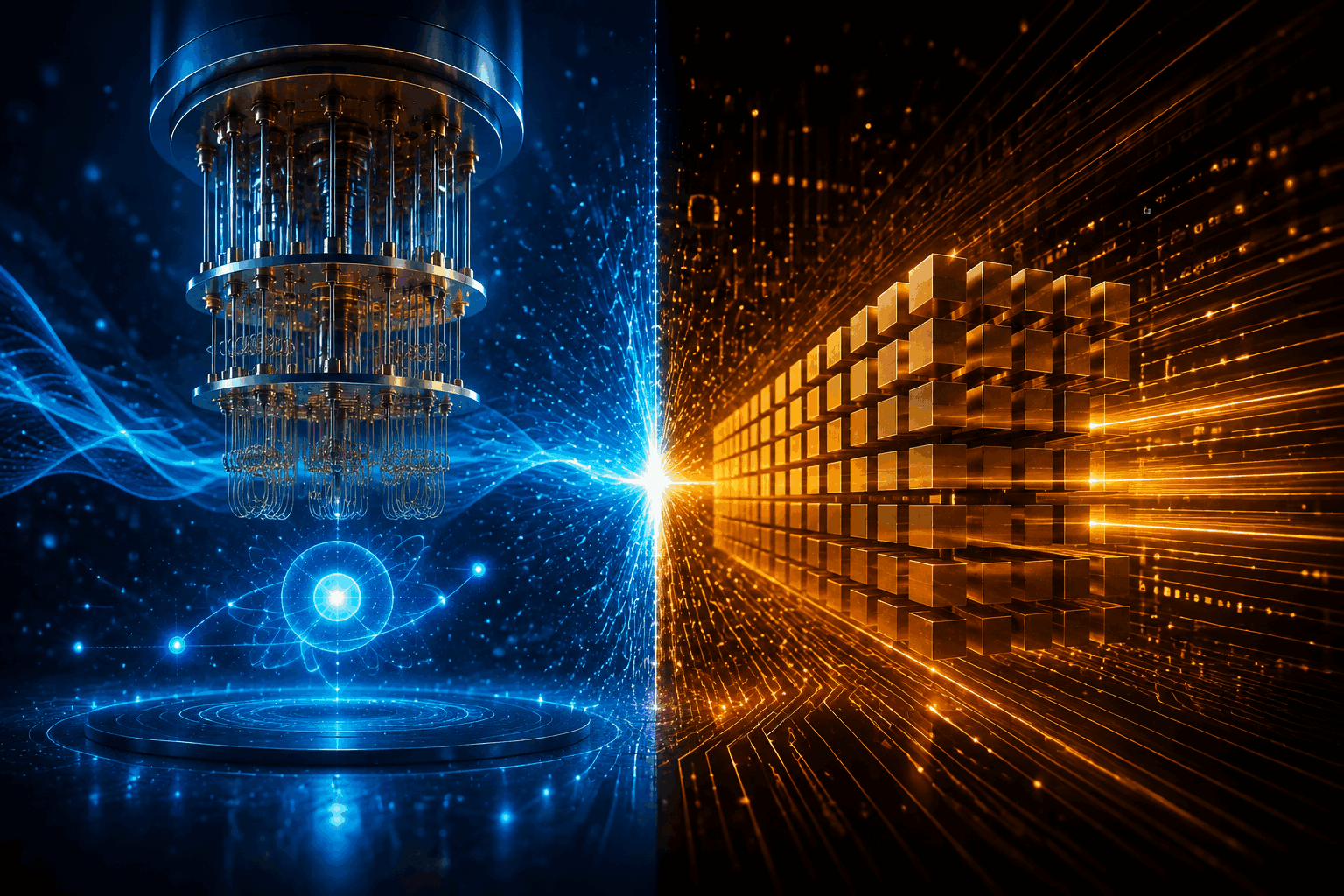
Think of it this way. A GPU is like hiring ten thousand accountants who can each add and subtract at lightning speed, all working simultaneously. A quantum computer is more like a mysterious oracle that can hold every possible answer in its hand at once, then collapse down to the right one through a process that feels almost like cheating physics. One is brute-force elegance. The other is probabilistic sorcery.
How GPUs Rule the Modern Computing World
A modern GPU is a monument to one idea: do the same simple operation on enormous amounts of data, all at the same time. NVIDIA's H100, for instance, packs over 16,000 CUDA cores and 528 Tensor cores onto a single die. Each core is individually quite weak—far slower than a CPU core at complex branching logic. But that's the point. You don't need one genius. You need an army of diligent workers performing identical arithmetic in lockstep.
This architecture is called SIMT—Single Instruction, Multiple Threads. Every core receives the same command and applies it to a different chunk of data. Multiply matrix A by matrix B? Split it into millions of tiny dot products, hand each one to a separate core, and watch them all finish nearly simultaneously.
Why does this matter? Because modern deep learning is, at its core, a mountain of matrix multiplications stacked on top of each other. A transformer model doing a forward pass is essentially performing billions of multiply-accumulate operations. GPUs were practically born for this. Graphics rendering works the same way—every pixel on your screen needs the same shading calculation applied independently. Thousands of cores, same instruction, different pixels. Done.
GPUs dominate AI training, scientific simulation, video encoding, and real-time rendering. They are the workhorses of the 21st-century data center, and no other classical architecture comes close to their throughput on these tasks.
How Quantum Computers Work
Now let's step into genuinely strange territory.
A classical bit is either 0 or 1. A qubit—the quantum equivalent—can exist in a superposition of both states simultaneously. Imagine a coin spinning in the air. While it spins, it isn't heads or tails. It's a blur of both possibilities. A qubit behaves similarly until you measure it, at which point it "collapses" into a definite 0 or 1.
Here's where it gets wild. If you have two qubits in superposition, they represent four states at once. Three qubits represent eight. Ten qubits represent 1,024 states simultaneously. Scale that to 300 qubits, and you're representing more states than there are atoms in the observable universe. This exponential scaling is the source of quantum computing's theoretical power.
Then there's entanglement. When two qubits become entangled, measuring one instantly determines the state of the other, regardless of distance. This isn't just spooky—it's a computational resource. Entangled qubits allow quantum algorithms to create interference patterns, amplifying correct answers and canceling wrong ones, much like how noise-canceling headphones use destructive interference to eliminate sound waves.
So a quantum computer doesn't "try every answer at once" in the naive sense people imagine. Instead, it choreographs probability amplitudes so that wrong answers interfere destructively and the right answer emerges with high probability. It's less like checking every path in a maze simultaneously and more like flooding the maze with water—the water finds the exit by physics, not by choice.
Quantum Computing vs GPU:Key Architectural Differences
Let's lay it all out. The table below captures the fundamental architectural and practical differences between these two technologies across the dimensions that matter most.
| Dimension | GPU (Classical Parallel Processor) | Quantum Computer (QPU) |
|---|---|---|
| Basic Unit of Data | Bits (0 or 1) | Qubits (superposition of 0 and 1) |
| Mathematical Strength | Matrix linear algebra, floating-point arithmetic | Probability amplitude manipulation, quantum interference |
| Parallelism Type | Thousands of cores executing identical operations on different data | N qubits encode 2^n states simultaneously |
| Main Limiters | Memory bandwidth, thermal throttling, power consumption | Quantum decoherence, gate noise, cryogenic requirements (~15 mK for superconducting qubits) |
| Error Rate | Negligible (ECC memory, deterministic logic) | High (10⁻² to 10⁻³ per gate; requires massive error correction overhead) |
| Current Maturity | Enterprise gold standard; deployed at scale in every major cloud | Experimental / NISQ era; limited to research labs and early cloud access |
| Best Used For | Deep learning training/inference, graphics rendering, physics engines, video encoding | Molecular simulation, combinatorial optimization, cryptanalysis, quantum chemistry |
| Scalability Path | Chiplet designs, advanced lithography (3nm, 2nm), HBM stacking | Topological qubits, surface code error correction, modular architectures |
GPU vs QPU Use Cases
Artificial Intelligence and Machine Learning
Let's be blunt: GPUs own AI right now. Every major language model—GPT, Claude—was trained on clusters of GPUs. The math of backpropagation and attention mechanisms maps almost perfectly onto GPU architecture. Tensor cores exist specifically to accelerate the matrix multiplications that transformers live and breathe.
Quantum machine learning (QML) is a real research field, and some papers show theoretical speedups for specific subroutines like quantum kernel estimation or variational circuits. But here's the catch: current quantum hardware has too few qubits, too much noise, and too slow a clock speed to outperform a GPU on any practical ML task.
Cryptography and Security
This is where quantum computing poses a genuine, existential threat—but not to your GPU. GPUs are excellent at brute-force hashing. Bitcoin mining, password cracking, rainbow table generation—these are embarrassingly parallel problems that GPUs chew through with ease.
Quantum computers threaten something entirely different: the mathematical foundations of public-key cryptography. Shor's algorithm, running on a sufficiently large fault-tolerant quantum computer, could factor large integers in polynomial time, completely breaking RSA and elliptic curve cryptography. No amount of GPU horsepower can replicate this, because factoring isn't a parallelism problem—it's a number-theory problem with a quantum shortcut. This is why governments are already racing toward post-quantum cryptography standards. This urgency has forced organizations worldwide to transition toward NIST Post-Quantum Cryptography (PQC) standards.
Complex Optimization and Molecular Simulation
Combinatorial optimization problems—the traveling salesman, supply chain routing, portfolio rebalancing—grow factorially with input size. GPUs can run heuristic solvers, simulated annealing, and genetic algorithms, but they're still searching a vast space one candidate at a time (or in parallel batches). Quantum algorithms like QAOA (Quantum Approximate Optimization Algorithm) theoretically navigate these landscapes more efficiently by exploiting superposition and interference.
Molecular simulation is perhaps the most naturally quantum application. Simulating a molecule's electron interactions is itself a quantum mechanical problem. Classical computers must approximate, and the approximations degrade rapidly with molecular size. A quantum computer, in principle, simulates quantum systems natively—like using a mirror to study reflections instead of painting them by hand. Drug discovery, materials science, and catalyst design could all be transformed, but only once hardware matures enough to handle the required qubit counts and error rates.
Enter the Hybrid Datacenter
The most realistic vision of the next decade isn't "quantum replaces classical." It's "quantum joins classical as a specialized accelerator." Think of it like how GPUs didn't replace CPUs—they offloaded specific workloads that suited their architecture.
In this hybrid model, a quantum processing unit (QPU) sits alongside CPUs and GPUs in a data center. The CPU orchestrates the workflow. The GPU handles the heavy numerical lifting—preprocessing data, running classical neural networks, managing I/O. The QPU gets called upon only for the narrow subroutines where quantum advantage exists: sampling from complex probability distributions, simulating small molecules, solving specific optimization instances.
Platforms like NVIDIA CUDA-Q are building toward this future, providing a unified programming model where developers can write code that seamlessly dispatches tasks between GPUs and QPUs. IBM and Origin Quantum Cloud offer cloud-based quantum access. The software stack is being built now, even while the hardware catches up.
The Bottom Line
A GPU is a massively parallel matrix multiplication engine. It excels when the problem can be decomposed into millions of identical, independent arithmetic operations. Deep learning, rendering, signal processing, scientific simulation on structured grids—these are GPU territory.
A quantum computer is a probability amplitude manipulator. It excels when the problem has inherent quantum structure or when the solution space has a mathematical topology that quantum interference can exploit. Factoring, quantum chemistry, certain optimization landscapes, and sampling from high-dimensional distributions—these are quantum territory, and no classical machine can match them once the hardware is ready.
Neither kills the other. They answer different questions. The GPU asks: "Can I do this same calculation a billion times, faster?" The quantum computer asks: "Can I collapse an exponentially large possibility space into the one answer I need?" Those are fundamentally different questions, and the world needs both answers.
So the next time someone tells you quantum computing will make your GPU obsolete, smile politely. Then ask them what problem they're actually trying to solve. The answer will tell you everything about which machine they need.
Frequently Asked Questions (FAQ)
Will quantum computers ever replace consumer GPUs for gaming?
No. Quantum computers do not process graphics or calculate rasterization and ray tracing efficiently. Video games rely on fast, deterministic arithmetic calculations for millions of pixels, which is an ideal workload for GPUs, not QPUs.
Can quantum computers train Large Language Models (LLMs) faster than GPUs?
Not currently, and likely not in the foreseeable future. Modern LLM training relies on massive matrix multiplication (deep learning), which GPUs handle natively. While Quantum Machine Learning (QML) is an active area of research, current quantum hardware lacks the qubit count, gate speed, and memory bandwidth to handle massive transformer models.
What is the main advantage of a GPU over a Quantum Computer?
GPUs offer massive parallel throughput, extremely low error rates, high memory bandwidth, and high operational reliability at room temperature. Quantum computers, by contrast, require extreme conditions (often near absolute zero) and complex error correction to maintain qubit coherence.
Contact Us
 (+86) 177 3001 9472
 market@originqc.com