Quantum Entanglement Applications: 5 Real-World Uses
Picture this. You and a friend each grab a coin from a mysterious box. You fly to Tokyo. Your friend stays in New York. Now, the instant you flip your coin and it lands heads up, your friend's coin—thousands of miles away, no wires, no signals, no cheating—lands tails. Every single time. No delay. No explanation that classical physics can offer.
That's quantum entanglement. Einstein famously dismissed it as "spooky action at a distance," and honestly, the man wasn't wrong to be unsettled. Two particles become linked in such a way that measuring one instantly determines the state of the other, regardless of the distance separating them. It's as if the universe stitched a hidden thread between them that no pair of scissors can cut.
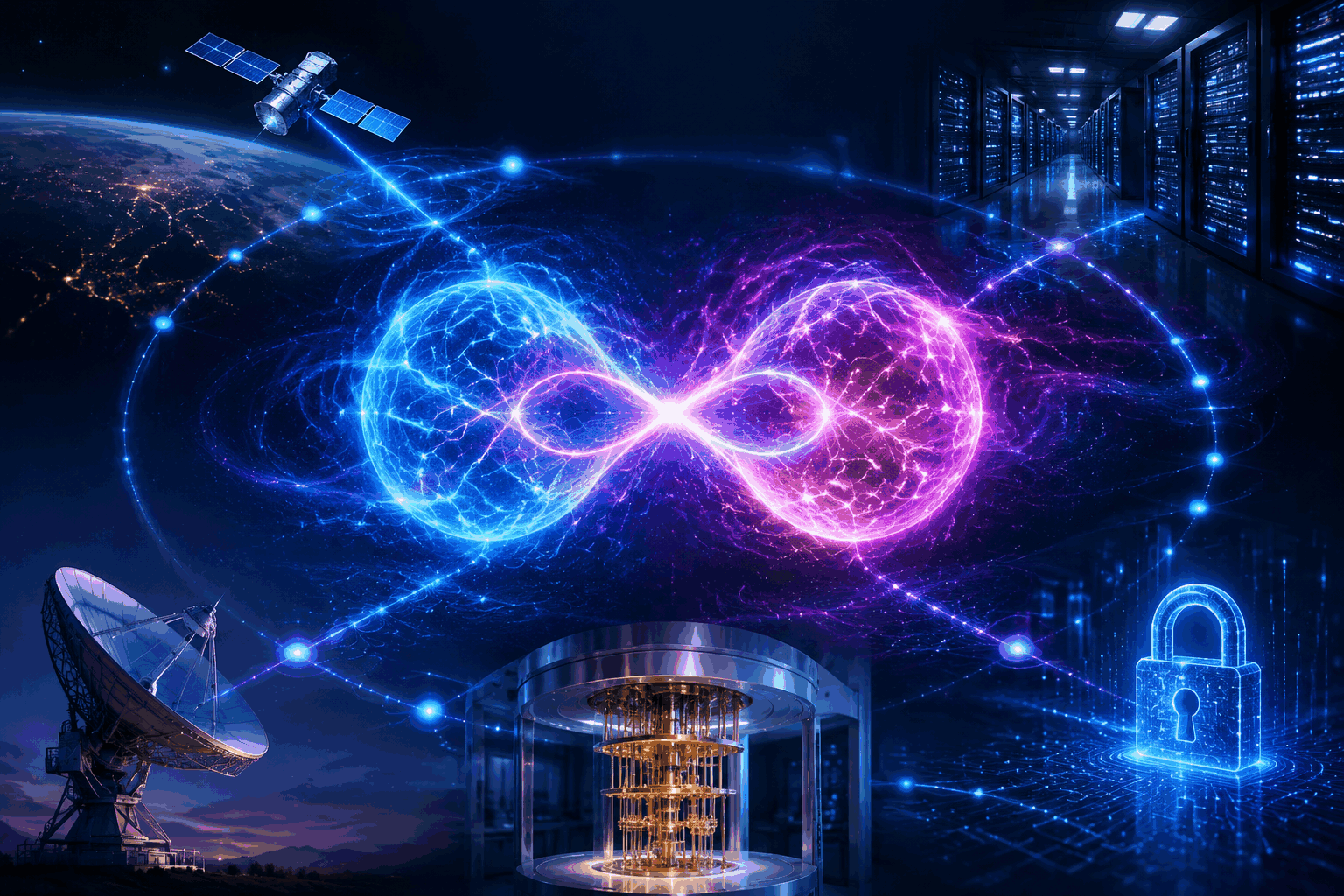
For decades, this phenomenon lived in chalkboard equations and philosophy debates. But here's the thing—quantum entanglement applications have exploded out of the lab and into engineering labs, hospitals. We're talking about unhackable communication networks, computers that solve problems in seconds that would take classical machines millions of years, and sensors so precise they can detect a gravitational whisper from deep underground.
Let's walk through the most exciting quantum entanglement applications that are reshaping technology as we know it.
1. Quantum Cryptography and Unhackable Communications (QKD)
Here's a problem that keeps cybersecurity experts up at night: every encryption method we rely on today—your banking password, classified government files, military communications—rests on mathematical difficulty. RSA encryption, for instance, works because factoring a 600-digit number is computationally brutal. But "brutal" isn't the same as "impossible." A sufficiently powerful quantum computer could crack it. And that day is coming.
Enter Quantum Key Distribution (QKD), arguably the most mature of all quantum entanglement applications in the commercial space.
The principle is elegant. Instead of hiding a message behind a hard math problem, QKD uses entangled photon pairs to generate a shared secret key between two parties. Here's the kicker: if anyone tries to intercept those photons during transmission, the act of observation itself collapses the quantum state. The eavesdropper doesn't just fail to read the key—they irreversibly alter it, leaving a detectable fingerprint. It's physics, not math, guaranteeing security.
Think of it like a sealed envelope made of soap bubbles. You can't peek inside without popping it. And both sender and receiver would instantly know the bubble burst.
Real-world deployments are already underway:
- Financial sector: Banks have piloted QKD links to protect high-value interbank transfers.
- Healthcare data: Patient records transmitted between research hospitals could one day travel over entanglement-secured channels, immune to future quantum computer attacks.
The limitation? Distance. Photons degrade over fiber optic cables.
2. Supercharging Quantum Computing
If QKD is the shield, quantum computing is the sword. And entanglement is the engine that makes the whole thing work.
A classical computer bit is either 0 or 1. A qubit, the quantum equivalent, can exist in a superposition—both 0 and 1 simultaneously. That alone is neat. But the real magic happens when you entangle multiple qubits together. Two entangled qubits don't just hold two states; they encode a correlated relationship between four possible states at once. Scale that up to 50, 100, or 1,000 entangled qubits, and the computational space grows exponentially. We're talking about a state space larger than the number of atoms in the observable universe.
So what does this actually mean for quantum entanglement applications in the real world?
- Drug discovery: Simulating how a protein folds or how a drug molecule binds to a receptor requires modeling electron interactions at the quantum level. Classical supercomputers choke on this. Entangled qubits can natively represent these quantum systems. Companies like Pfizer and Roche are already partnering with quantum hardware firms to explore molecular simulations.
- Logistics and optimization: Routing 10,000 delivery trucks through a city with traffic, weather, and time-window constraints is a combinatorial nightmare. Quantum algorithms like QAOA (Quantum Approximate Optimization Algorithm) leverage entanglement to explore solution spaces far more efficiently than brute-force classical methods.
- Climate modeling: Accurate long-range weather and climate prediction requires solving fluid dynamics equations across billions of variables. Quantum computers, powered by entangled qubit arrays, promise to handle these multi-body interactions with dramatically less energy and time.
We're still in the "noisy intermediate-scale quantum" (NISQ) era. Current machines have error rates that limit practical use. But the trajectory is steep. IBM, Google, Origin Quantum, and dozens of startups are racing toward fault-tolerant systems where entanglement can be maintained long enough to run truly useful algorithms.
3. The Future Unfolds: Building the Quantum Internet
Let's clear up a misconception first. Quantum teleportation does not mean beaming a person from one room to another like in Star Trek. What it actually does is transfer the quantum state of a particle from one location to another, using entanglement as the channel and a classical communication link as the helper.
Imagine you have a delicate glass sculpture (the quantum state) that you want to recreate in another city. You can't ship it—it's too fragile. Instead, you use a pair of entangled particles as a "blueprint link." You perform a measurement on your sculpture and one half of the entangled pair, then send the measurement result via a regular phone call. The person on the other end uses that information to reconstruct the exact state on their half of the entangled pair. The original is destroyed in the process. The state has "teleported."
Now scale this up. A Quantum Internet would connect quantum computers, quantum sensors, and QKD nodes across the globe using entanglement as the fundamental resource. Instead of transmitting classical bits, it distributes entangled states between nodes.
Why does this matter for quantum entanglement applications?
- It enables distributed quantum computing—linking smaller quantum processors into one massive virtual machine.
- It creates blind quantum computing, where a user can run an algorithm on a remote quantum server without the server ever learning what the input or output is.
- It provides the backbone for a global QKD network, making quantum-secured communication as ubiquitous as HTTPS.
4. Ultra-Precise Quantum Sensing and Metrology
Here's where things get weird in a deeply practical way.
Classical sensors hit a wall called the standard quantum limit—a fundamental noise floor imposed by the uncertainty principle. Entangled particles can beat this limit. When you entangle a group of atoms or photons, their collective measurement sensitivity scales better than any classical ensemble. This is sometimes called the Heisenberg limit, and it represents the absolute best precision nature allows.
Quantum entanglement applications in sensing are advancing rapidly:
- Navigation without GPS: Quantum accelerometers and gyroscopes, built from entangled atom clouds (Bose-Einstein condensates), can track position and orientation with extreme precision. Submarines, aircraft, and spacecraft could navigate for months without ever pinging a satellite.
- Geological surveying: Entanglement-enhanced gravimeters can detect tiny variations in gravitational fields caused by underground cavities, mineral deposits, or magma chambers. Imagine mapping an oil reservoir or predicting a volcanic eruption weeks before seismic activity becomes obvious.
- Earthquake early warning: Networks of quantum sensors buried along fault lines could detect the faintest precursor vibrations—signals too subtle for classical seismometers—providing extra seconds or even minutes of warning.
5. Revolutionizing Healthcare and Medical Imaging
Medical imaging has always been a tradeoff: more resolution means more radiation, or more scan time, or more contrast agent injected into a patient's bloodstream. Quantum entanglement applications in imaging aim to break that tradeoff entirely.
Quantum imaging uses entangled photon pairs to illuminate a sample. One photon interacts with the tissue; the other is measured as a reference. Because the pair is correlated, you can extract image information with far fewer photons hitting the patient. Less radiation. Higher signal-to-noise ratio. The potential is enormous.
Specific applications on the horizon:
- Low-dose X-ray and CT alternatives: Entangled-photon sources could produce diagnostic-quality images at a fraction of the radiation dose currently required.
- Enhanced MRI: Quantum sensors based on nitrogen-vacancy (NV) centers in diamond can detect extremely weak magnetic fields. This could enable MRI at the cellular or even molecular level—imagine spotting a cluster of cancerous cells before they form a detectable tumor.
- Quantum radar for biological imaging: Still in early research, quantum illumination protocols (using entangled microwave photons) could image soft tissue with unprecedented contrast, potentially identifying early-stage anomalies invisible to conventional methods.
Researchers demonstrated imaging with entangled photons, producing images of objects that the detected photons never directly touched. It sounds like magic. It's quantum mechanics doing what it does best.
Classic Technologies vs. Quantum Entangled Applications
| Technology Domain | Traditional Approach | Quantum Entanglement Solution | Core Advantage |
|---|---|---|---|
| Data Security | RSA / AES encryption (math-based) | Quantum Key Distribution (QKD) | Physically impossible to eavesdrop undetected |
| Computing | Classical supercomputers (binary logic) | Entangled qubit processors | Exponential speedup for specific problem classes |
| Communication Networks | Fiber optic / satellite (classical bits) | Quantum Internet (entanglement distribution) | Secure, distributed quantum processing |
| Sensing & Navigation | GPS, classical accelerometers | Entangled atom interferometers | Sub-Heisenberg-limit precision, GPS-free operation |
| Medical Imaging | X-ray, MRI, CT (high dose / low resolution) | Entangled-photon imaging, quantum sensors | Lower radiation, higher resolution, earlier detection |
Let's be honest. This technology is not plug-and-play yet. The biggest enemy is decoherence—the tendency of entangled states to collapse when they interact with their environment. Heat, vibration, stray electromagnetic fields—all of it can sever the delicate quantum link. Maintaining entanglement long enough to do useful work requires extreme cooling (millikelvin temperatures), vacuum chambers, and sophisticated error-correction protocols.
Quantum entanglement is no longer just a mind-bending concept in theoretical physics—it is the foundational architecture for the next technological revolution. While challenges like quantum decoherence and signal attenuation remain significant hurdles, the bridge from laboratory physics to commercial engineering has already been crossed. As fault-tolerant quantum systems become a reality, organizations that understand and prepare for these quantum entanglement applications today will lead the digital ecosystem of tomorrow.
Frequently Asked Questions About Quantum Entanglement Applications
Can quantum entanglement be used for faster-than-light communication?
No. Although measuring one entangled particle instantly determines the state of the other regardless of distance, this process cannot transmit actual data faster than light. Because the measurement outcome of the first particle is fundamentally random, classical communication (limited by the speed of light) is still required to decode the transmitted state. This principle is governed by the No-Communication Theorem in quantum physics.
What is the difference between Quantum Key Distribution (QKD) and Post-Quantum Cryptography (PQC)?
Quantum Key Distribution (QKD) is a hardware-based security solution that uses entangled photons and the laws of physics to generate unhackable encryption keys. Post-Quantum Cryptography (PQC), on the other hand, relies on advanced software algorithms designed to run on existing classical computers that are mathematically complex enough to resist attacks from future quantum computers.
What is the biggest roadblock to scaling commercial quantum entanglement applications?
The primary barrier is decoherence—the fragile nature of entangled states. Environmental noise, such as subtle temperature fluctuations, electromagnetic interference, or physical vibration, causes entangled particles to lose their quantum state in microseconds. Maintaining long-lived entanglement requires extreme cryogenic cooling (millikelvin temperatures) and ultra-high vacuum environments, making scaling technically challenging and expensive.
Contact Us
 (+86) 177 3001 9472
 market@originqc.com