Quantum AI vs Classical AI: Key Differences Explained
Most headlines frame quantum AI vs classical AI like a heavyweight boxing match, with shiny quantum processors waiting to knock out the silicon chips running today's chatbots. That framing makes for great clicks. It also gets the physics completely backward.
Classical AI is not an outdated precursor waiting to be retired. On 99% of practical machine learning tasks—from speech translation to video generation and trillion-parameter language models—classical GPUs are dramatically faster, cheaper, and more reliable than any quantum machine in existence.
Quantum AI plays by a different mathematical rulebook altogether. Rather than brute-forcing massive piles of text or images, it targets narrow, brutally hard problems where possibilities multiply exponentially and conventional supercomputers stall. Seeing why these two systems rarely compete head-to-head starts with how each one processes information.
How Do Quantum AI and Classical AI Compute Differently?
Classical AI runs deterministic matrix math across billions of binary bits (0s and 1s) using specialized silicon hardware like GPUs. Quantum AI encodes information into qubits that harness quantum superposition, entanglement, and quantum interference—using wave-like math to cancel wrong answers and amplify correct ones before measurement.
Picture classical AI as an immense, tightly coordinated logistics fleet. When you train a deep neural network, clusters of GPUs dispatch millions of calculations in parallel along fixed, well-mapped routes. Every transistor flips cleanly between 0 and 1, nudging numerical weights layer by layer until the network captures statistical patterns in its training data.
That architecture is astonishingly good at linear algebra. Matrix multiplication scales smoothly when you add more chips, power, and examples. Such predictable throughput is the exact reason classical deep learning built everything from fraud detectors to frontier language models.
Quantum computing throws out that deterministic road map. Through quantum superposition, a qubit holds a complex blend of 0 and 1 described by probability amplitudes. Link multiple qubits through entanglement, and tweaking one immediately reshapes the joint mathematical state of the entire group.
Here is where almost every popular explainer goes off the rails. You have probably heard that superposition lets a quantum computer try every answer at once and simply read out the winner. That sounds neat on paper, until quantum mechanics steps in.
The instant you measure a register of qubits, its rich superposition collapses into one ordinary string of 0s and 1s. If a machine merely calculated every option in parallel and peeked at the output, it would return a random guess—no better than throwing darts blindfolded. Speed never comes from superposition alone.
The real engine is quantum interference. Think of a quantum algorithm less like a fast calculator and more like an acoustic engineer tuning sound waves inside a resonant chamber. Because probability amplitudes carry positive or negative phases, the algorithm choreographs those waves so paths toward wrong answers collide out of phase and flatten into silence.
Meanwhile, paths leading to the right answer stack in phase, building a taller wave. When the hardware measures the qubits, the right outcome is far more likely to appear. Pull off that wave choreography cleanly, and a problem that would stall a classical supercomputer for centuries can shrink to hours.
There is an obvious catch. Keeping delicate wave phases intact requires shielding qubits from heat, radiation, and stray electromagnetic noise; tiny disturbances trigger decoherence, scrambling the waves back into static. Even as engineers tame hardware noise, a second structural constraint decides which AI jobs belong on quantum chips.
Quantum AI vs Classical AI: The Data Bottleneck and Core Trade-Offs
The sharpest divide in quantum AI vs classical AI comes down to data volume versus mathematical complexity. Classical AI thrives on huge, messy datasets—terabytes of text, audio, and pixels—where GPUs excel. Quantum AI struggles to ingest big classical files yet shines on "small data, enormous state space" problems like molecular physics.
Ask a quantum physicist why nobody is training the next large language model on a quantum processor, and they will point straight to two stubborn roadblocks. The first is the data-loading bottleneck. Translating a billion-row customer table or a high-definition video stream into fragile quantum states requires deep, costly sequences of quantum gates.
By the time you finish loading a massive classical dataset into qubits, you have often spent more time and energy than a GPU cluster needed to analyze it directly. Any theoretical quantum speedup vanishes at the front door. Silicon memory bandwidth is simply in another league.
The second hurdle sits inside the training loop of quantum machine learning (QML) itself. Many near-term QML proposals rely on variational quantum circuits—tunable networks trained loosely like neural nets. As those circuits scale up, researchers regularly slam into barren plateaus.
On a barren plateau, the mathematical gradients guiding optimization flatten exponentially close to zero. Imagine hunting for the lowest point in a valley while standing on an almost perfectly level salt pan in thick fog, with no slope hinting which direction goes downhill. Classical neural networks have mature mathematical tricks to keep gradients flowing; variational quantum circuits still wrestle with this barrier at scale.
Flip the problem around, though, and classical AI hits its own wall. Suppose you need to simulate the exact electron interactions inside a next-generation battery electrolyte or an industrial catalyst. Describing the molecule takes only a few dozen numbers—tiny input data—yet the quantum states its electrons occupy explode past the number of atoms in the observable universe.
Classical GPUs must approximate those interactions, often missing subtle behaviors that determine whether a drug binds or a chemical reaction succeeds. A quantum processor fits naturally here because its qubits obey the same quantum math as the electrons under study. Setting both architectures side by side makes these boundaries unmistakable.
Side-by-Side Technical Comparison
| Dimension | Classical AI | Quantum AI |
|---|---|---|
| Core Computing Unit | Binary bits (0 or 1) processed across CPUs, GPUs, and custom AI accelerators | Qubits leveraging superposition, entanglement, and wave interference |
| Mathematical Engine | High-throughput matrix math, backpropagation, and statistical pattern matching | Unitary transformations in exponentially large state spaces with amplitude amplification |
| Problem Sweet Spot | Massive unstructured data: text, images, video, speech, and forecasting | Small-input, high-complexity math: molecular simulation, materials science, and structured search |
| Data Throughput and Bottlenecks | High data bandwidth; limited by power draw and exponential quantum-physics scaling | Severe data-loading bottleneck, qubit decoherence, error overhead, and barren plateaus |
| 2026 Hardware Maturity | Mature global cloud clusters scaling to tens of thousands of networked GPUs | Early fault-tolerant transition: small logical qubit demos; million-qubit scale remains years out |
| Typical Production Role | Powers 99% of commercial enterprise AI workloads today | Experimental cloud co-processing and narrow scientific benchmarks |
Look closely at that maturity row, and a fair question arises. If quantum hardware is still climbing out of its noisy youth while classical AI already runs at global scale, why are major labs investing heavily in pairing the two right now? Because the real story is collaboration, not replacement.
Why Hybrid Quantum-Classical Computing Beats Replacement
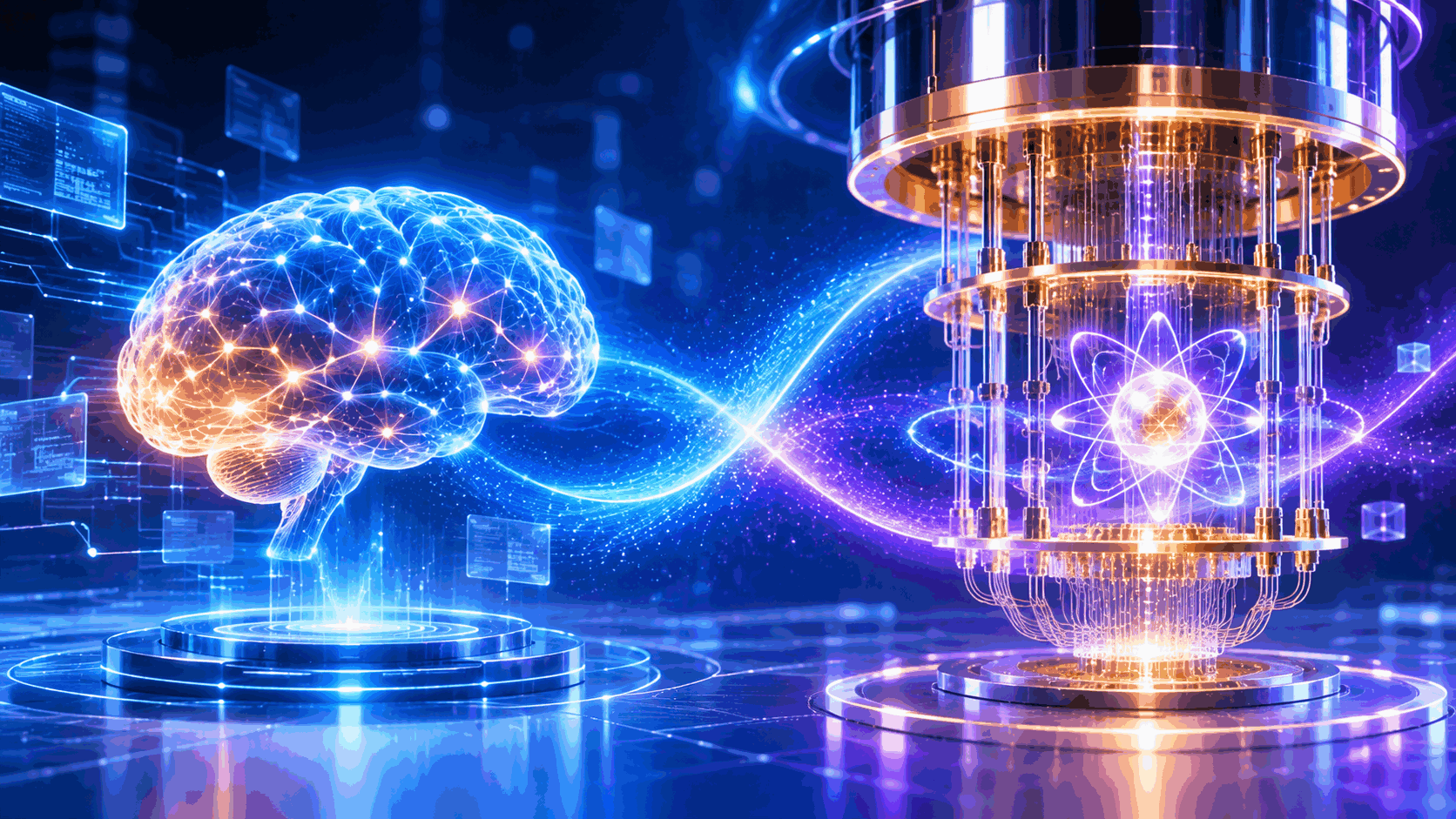
Instead of replacing silicon, hybrid quantum-classical computing pairs classical CPUs and GPUs directly with quantum processing units (QPUs). In this two-way loop, quantum chips tackle specialized mathematical subroutines ("Quantum for AI"), while classical neural networks stabilize fragile quantum processors by decoding errors and calibrating hardware pulses ("AI for Quantum").
Public hype fixates on Quantum for AI—using quantum chips to speed up kernel calculations, structured sampling, or specialized optimization steps inside learning pipelines. Those methods hold genuine long-term promise for scientific datasets. In 2026, however, the most immediate payoff flows in the opposite direction.
AI for Quantum has become a quiet pillar of modern quantum engineering. Running reliable quantum calculations demands quantum error correction (QEC), which weaves dozens or hundreds of noisy physical qubits into a single protected logical qubit. Catching and fixing errors before they corrupt an entire circuit means decoding torrents of error signals in microseconds.
Classical deep learning decoders models thrive on exactly that kind of split-second pattern recognition. Today, neural decoders and reinforcement learning agents sit beside quantum processors to classify errors faster than hand-crafted software and keep microwave or laser control pulses dialed in. Without classical AI babysitting the chips, fault-tolerant quantum computing would progress far more slowly.
This tight partnership reflects a real shift in hardware maturity. For nearly a decade, the field operated in the pure NISQ (Noisy Intermediate-Scale Quantum) stage—chasing larger physical qubit counts while noise wrecked deep circuits. Between late 2024 and 2026, that early phase gave way to an early fault-tolerant transition.
Leading teams pushed error-correcting architectures like surface codes past critical thresholds, proving that adding physical qubits can suppress error rates instead of worsening them. Demonstrations of small logical qubit arrays, paired with cloud hybrid QPU and high-performance computing workflows, are now delivering early verifiable quantum advantage on narrow scientific benchmarks.
Even with that momentum, careful observers must separate three distinct technologies that press releases routinely blur together:
- Gate-based quantum computing: Universal quantum machines executing programmable logic gates on qubits. These systems anchor long-term goals in chemistry, cryptography, and QML, though scaling to millions of fault-tolerant physical qubits remains a 2029–2030s engineering target.
- Quantum annealing: A specialized analog system built to settle into low-energy solutions for select optimization problems. Annealers feature thousands of physical qubits today, yet they cannot run universal gate-based algorithms and face fierce competition from classical solvers.
- Quantum-inspired classical algorithms: Mathematical tools borrowed from quantum physics—most notably tensor networks—that run strictly on classical CPUs and GPUs. They deliver real gains on simulation and optimization today, but they are classical software, not quantum hardware executions.
Keeping those categories straight protects technical leaders from expensive confusion. Once you strip away marketing fog and view hybrid workflows realistically, deciding where to invest money and engineering time becomes much clearer.
Where Does Each Technology Fit in Real-World Decisions Today?
Organizations should run virtually all immediate commercial workloads—language, vision, customer analytics, and forecasting—on classical AI. Quantum AI belongs today in targeted R&D for sectors facing intractable physical or combinatorial math, especially pharmaceuticals, advanced materials, and complex financial modeling, typically accessed through cloud hybrid workflows.
Molecular Simulation and Drug Discovery
Classical deep learning models have transformed structural biology by predicting 3D protein shapes from massive biological archives. Still, calculating exact electronic interactions between a candidate drug molecule and a complex metal-centered enzyme often outstrips classical approximations. In 2026, pharma teams use classical AI to filter millions of compounds down to a shortlist, then explore hybrid quantum-classical routines on the toughest binding-energy physics.
Financial Portfolio and Logistics Optimization
Asset managers and global carriers balance shifting constraints across thousands of positions, routes, and risk rules. Classical heuristic solvers and GPU-accelerated tensor networks remain the clear daily workhorses, beating today's noisy quantum hardware on production deadlines. Forward-looking quant groups nonetheless test gate-based routines and quantum annealing on stripped-down subproblems so their teams are ready if fault-tolerant QPUs win an edge later this decade.
Cryptography and Enterprise Planning
One persistent rumor deserves a blunt correction: quantum computers have not broken current RSA encryption. Breaking RSA at real-world key lengths still requires roughly a million or more noisy physical qubits depending on the hardware architecture—forming over a thousand fault-tolerant logical qubits—which no machine has today. Even so, security architects cannot wait for that hardware because attackers can harvest encrypted traffic now and decrypt it later; adopting NIST-standardized post-quantum cryptography is a practical classical software upgrade right now.
Outside physics-heavy R&D and security planning, the decision rule stays refreshingly grounded. If your bottleneck is messy business data, customer support, or document workflows, put your budget into clean data pipelines and classical GPUs. Reserve quantum spending for small, focused exploration tied to specific mathematical bottlenecks.
Frequently Asked Questions About Quantum AI vs Classical AI
Will quantum AI replace classical AI in the near future?
No. Quantum AI will not replace classical AI. Classical GPUs and neural networks remain vastly faster, cheaper, and more reliable for 99% of commercial tasks—including large language models, computer vision, and enterprise analytics. Quantum processors are emerging as specialized co-processors alongside classical infrastructure rather than replacements.
When will quantum AI achieve widespread commercial advantage?
While early verifiable quantum advantage on narrow physics benchmarks emerged between 2025 and 2026, widespread commercial advantage in fields like drug discovery and materials science depends on scaling to millions of physical qubits for full fault tolerance—an engineering milestone generally targeted for the 2029–2030s horizon.
What is the difference between quantum AI and quantum-inspired AI?
Quantum AI executes calculations on actual quantum hardware (QPUs) using qubits and quantum interference. Quantum-inspired AI—such as tensor network algorithms—borrows mathematical concepts from quantum physics but runs entirely on classical CPUs and GPUs today.
Contact Us
 (+86) 177 3001 9472
 market@originqc.com