What is a Quantum Gate? A Simple Guide (No Physics Degree Required)
If you've spent more than five minutes reading about quantum computing, you've almost certainly hit the term "what is a quantum gate." It sounds like sci-fi hardware, but it's actually the most fundamental instruction in quantum programming. Unlike the transistors and logic gates that run your smartphone, quantum gates don't just flip 0s and 1s. They manipulate probabilities, phase, and even entanglement.In this guide, we'll strip away the jargon and explain exactly what a quantum gate is, how it differs from classical logic, which types you'll actually use, and how they chain together to form real quantum algorithms. No physics degree required.
Classical Gates vs. Quantum Gates: What's the Real Difference?
Start with a quick analogy. Imagine a classical logic gate as a railroad switch. A train (your bit) arrives on track 0 or 1, the gate flips a lever, and it leaves on a new, completely predictable track. Classical gates (AND, OR, NOT, XOR) are deterministic. You know exactly what comes out based on what went in.
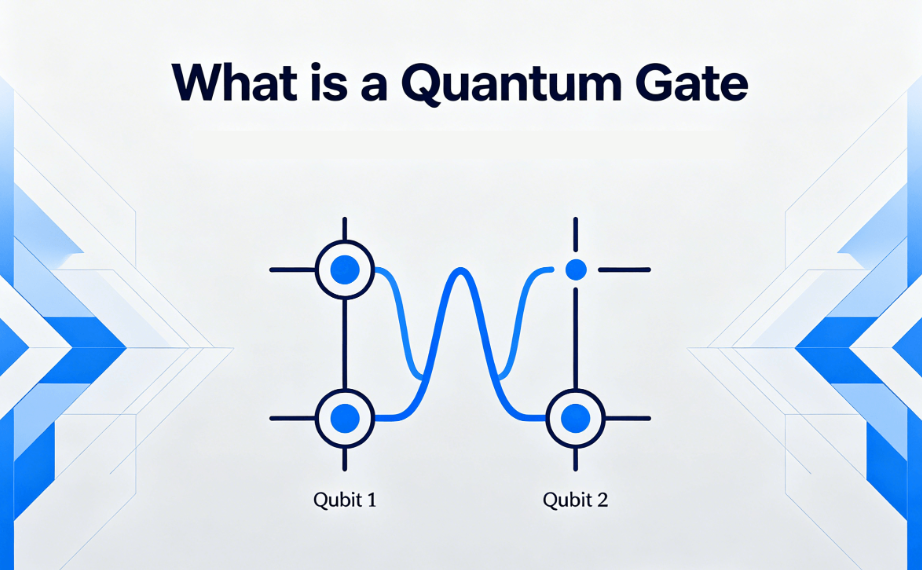
Quantum gates work differently. Think of them more like a light prism. Instead of routing a single track, they reshape the probability of where the train might end up. They operate on qubits, which can exist in a superposition of 0 and 1 simultaneously. A quantum gate doesn't just switch states—it rotates a qubit's state across a mathematical sphere (the Bloch sphere, if you want the technical term) and can even tie two qubits together so their measurements become interdependent (entanglement).
| Feature | Classical Logic Gate | Quantum Gate |
|---|---|---|
| Input/Output | Binary bits (0 or 1) | Qubits (superposition of 0 & 1) |
| Determinism | Always predictable | Deterministic evolution; Probabilistic measurement |
| Reversibility | Most are irreversible (AND, OR) | Always reversible (unitary) |
| Primary Action | Logical switching | State rotation & phase manipulation |
| Multi-qubit coupling | Requires wiring/sequential logic | Built-in entanglement capability |
How Do Quantum Gates Actually Work?
At their core, quantum logic gates are mathematical operations represented by unitary matrices. If matrix algebra gives you flashbacks, don't worry: think of a unitary matrix as a strict instruction that transforms a qubit's state without deleting information.
Three rules govern every quantum gate:
- Reversibility: You can always run a quantum gate backward to recover the original state. This is why you won't find a quantum equivalent of a classical AND gate that loses input data.
- Continuity: Gates don't jump between states. They rotate qubits smoothly through infinite intermediate states.
- Information Preservation: The total probability of all possible outcomes always adds up to 100%. Gates redistribute probability; they never destroy it.
In physical systems, engineers trigger these operations using precise external controls: microwave pulses for superconducting qubits, targeted lasers for trapped ions, or beam splitters for photonic chips. The hardware changes, but the gate's mathematical behavior remains consistent.
The Most Common Types of Quantum Gates
You don't need to memorize complex linear algebra to work with quantum computing gates. Here's a practical breakdown of the standard set you'll encounter in frameworks like Qiskit, Cirq, QPanda:
| Gate | Symbol | Plain-English Function | What It Does to the Qubit |
|---|---|---|---|
| Pauli-X (Quantum NOT) | X | Flips |0⟩ to |1⟩ and vice versa | Behaves like a classical NOT, but works cleanly on superposed states |
| Hadamard | H | Creates equal superposition | Turns |0⟩ into a 50/50 blend of |0⟩ and |1⟩; essential for parallelism |
| Pauli-Z | Z | Shifts phase, no bit flip | Leaves 0/1 probabilities untouched but flips the quantum wave's direction |
| Phase (S) | S | 90° phase rotation | Fine-tunes interference patterns; a stepping stone to universal gates |
| CNOT (Controlled-NOT) | ⊕ | Flips target only if control is |1⟩ | The primary gate for generating entanglement between two qubits |
| T (π/8) | T | 45° phase rotation | Non-Clifford gate required for fault-tolerant, universal quantum computing |
Pro tip: No single gate does everything. But when you combine the Hadamard, CNOT, and T gates, you get a universal quantum gate set. That means any valid quantum algorithm can be decomposed into sequences of these operations, much like how classical programs compile down to NAND gates.
How Quantum Gates Build Real Quantum Circuits
A lone quantum gate is powerful, but the real engineering happens when you chain them into a quantum circuit. Picture it like sheet music: each gate is a note, the order is the tempo, and the final measurement is the performance.
Unlike classical circuits that push data forward linearly, quantum circuits exploit interference. Poorly designed gate sequences amplify wrong answers. Carefully crafted sequences cause incorrect paths to cancel out (destructive interference) while correct paths reinforce (constructive interference). This is why algorithms like Grover's search or Shor's factorization aren't just "faster code"—they're entirely new information architectures built on strategic qubit manipulation.
Most early-stage systems operate in the NISQ (Noisy Intermediate-Scale Quantum) era, meaning circuits typically run 20–150 gates before decoherence washes out the signal. That's why gate fidelity, calibration, and error mitigation dominate current research.
Frequently Asked Questions
Q: Is a quantum gate a physical chip or just math?
It's an abstract operation. The hardware executes it using pulses, fields, or photons. The gate itself lives in the programming layer.
Q: Can quantum gates replace classical CPU logic?
No. They're optimized for entirely different workloads. Classical gates still dominate everyday computing. Quantum gates excel at molecular simulation, combinatorial optimization, and cryptographic analysis.
Q: Are quantum gates perfect?
Not yet. Environmental noise, thermal drift, and imperfect control pulses introduce gate errors. Quantum error correction and fault-tolerant architecture are active engineering frontiers, not solved problems.
Q: Where can I actually see quantum gates in action?
Our quantum cloud provide cloud access to real hardware. You can write a 3–5 gate circuit, run it, and watch probability distributions collapse into measurement results.
So, what is a quantum gate? It's the fundamental, reversible instruction that manipulates qubit states, enabling computers to navigate exponential solution spaces that classical machines can't efficiently map. They're applied linear algebra, calibrated physics, and carefully structured interference.If you're exploring quantum computing basics, start small. Simulate a Hadamard + CNOT combo, observe how superposition and entanglement emerge, and track how gate sequences change measurement probabilities.
Contact Us
 (+86) 177 3001 9472
 market@originqc.com