Quantum Observer Effect: Does Watching Change Reality?
Key Takeaways:
- What it is: The quantum observer effect occurs when measuring a subatomic system inevitably alters its state through physical interaction or quantum entanglement.
- Not about consciousness: An "observer" does not require a human brain—any physical sensor, stray air molecule, or photon counts.
- Not the Uncertainty Principle: The observer effect is an interaction problem during measurement, whereas Heisenberg's uncertainty principle is a fundamental mathematical limit of nature.
Stick a pressure gauge onto your car tire, and you immediately change what you are trying to measure. To read the internal air pressure, the gauge has to let a tiny hiss of air escape into its mechanical chamber. You get your number, sure. You also end up with slightly less air in your tire than you had a second ago.
In everyday life, that tiny loss of air is trivial. Nobody loses sleep over a fraction of a pound per square inch. Down at the scale of atoms and electrons, however, that exact same principle breaks reality in half.
When physicists try to watch subatomic particles in action, the particles seem to change their behavior the instant a detector switches on. Left alone, an electron acts like a diffuse, rippling wave. Put a sensor in place to see where it goes, and it snaps into behaving like a tiny, solid billiard ball. This strange phenomenon is known as the quantum observer effect, and it sits at the center of one of the deepest puzzles in modern science.
What Is the Quantum Observer Effect?
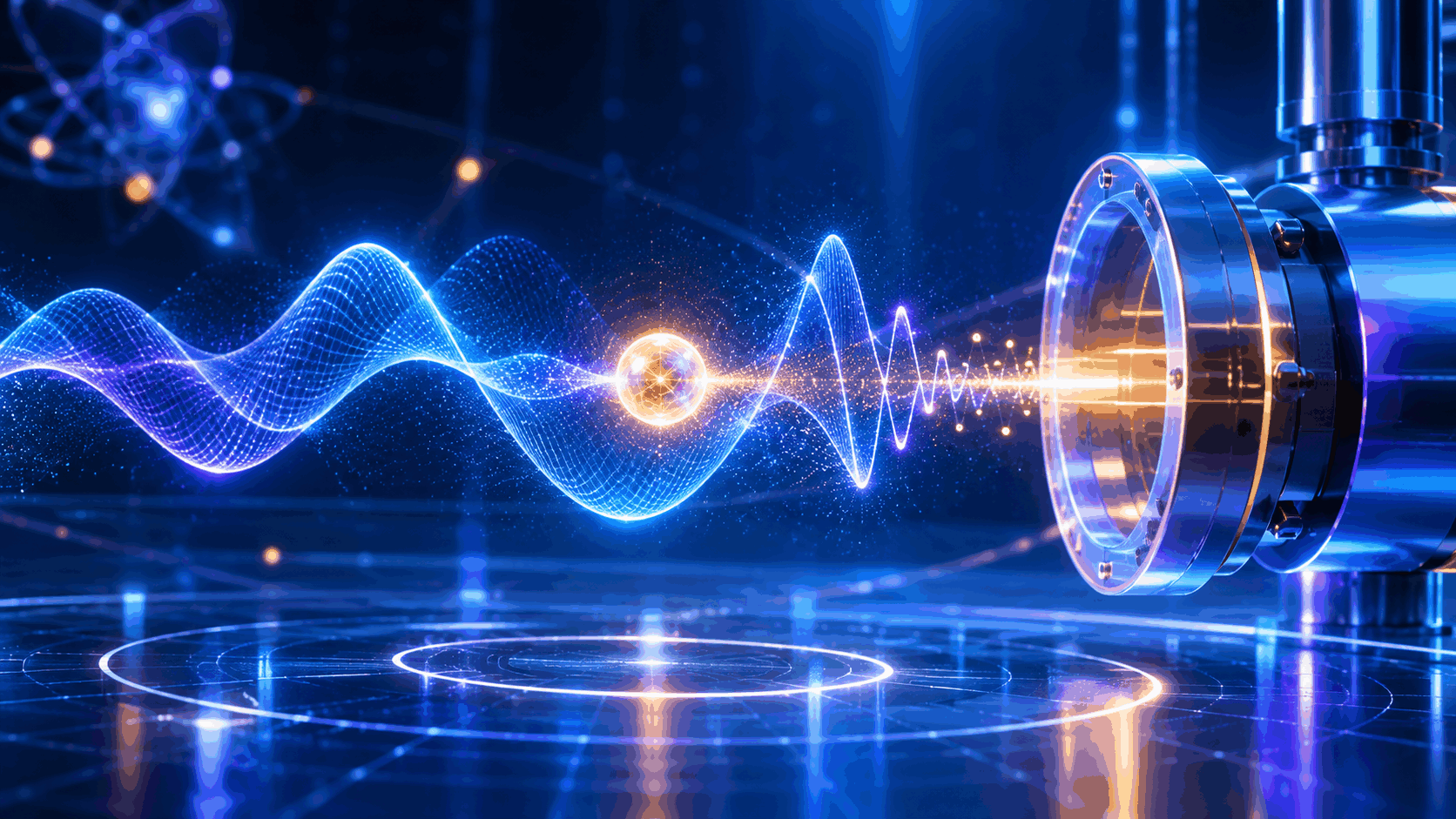
The quantum observer effect occurs when the act of measuring a subatomic system inevitably alters its physical state. At the quantum scale, observing a particle requires an interaction—whether by bouncing energy (such as a photon) off it or entangling it with a detector to capture path data. That physical coupling disrupts the particle's wave-like behavior, forcing it into a single, definite state.
That simple definition hides a profound experimental headache. In classical physics, you can measure a rolling bowling ball without knocking it off course. Bouncing sunlight off a bowling ball exerts a force so microscopic that the ball never notices. You are a passive spectator.
At the quantum scale, passive spectators do not exist. Every particle is fragile, and every measurement tool is a blunt instrument. To see what happens when physicists try to peek behind the curtain, we have to look at the most famous experiment in physics.
The Double-Slit Experiment: Watching Particles Change Their Minds
Starting in 1801—and formally illustrated with his classic double-slit diagram in 1807—English polymath Thomas Young demonstrated how light beams split through narrow apertures overlap on a screen behind them. Instead of seeing two bright vertical lines, observers see a series of alternating light and dark bands. That striped display is an interference pattern, and it happens when overlapping waves reinforce each other in some spots and cancel out in others.
Young’s work proved that light travels as a wave. Fast-forward to the twentieth century, when physicists pushed this test into the quantum realm—first firing beams of electrons through double slits in 1961, and later achieving true single-electron experiments (firing electrons one by one) in 1974 and 1989.
Think of firing tiny paintballs at a wall with two vertical slots. Common sense says you should get two vertical splatters on the back screen, directly behind the two openings. Instead, as thousands of single electrons hit the detector screen over time, they build up the exact same striped interference pattern that water waves and light waves produce.
Wait—how can a single, solid particle interfere with itself? In quantum mechanics, an unobserved electron does not travel along one neat trajectory. It moves as a probability wave, spreading out and passing through both slits simultaneously before colliding with itself on the other side.
Naturally, physicists wanted to catch the electron in the act. First envisioned as a thought experiment by Richard Feynman and later realized in modern quantum optics and mesoscopic experiments, researchers devised setups to place detectors near the slits to record which-path information—a log showing whether each particle went through the left slit or the right slit.
The moment those detectors turned on, the striped interference pattern vanished. Completely. On the back screen, the electrons suddenly piled up into two plain vertical bands, behaving just like tiny paintballs.
Turn the detectors off, and the interference stripes return. Turn them back on, and the stripes disappear again. It looks, for all the world, as if the electrons know they are being watched and alter their behavior to hide their tracks.
Why "Looking" Means Colliding
The electron does not know anything. It has no eyes, no brain, and no desire for privacy. The secret lies in what "looking" actually requires in a physics lab.
When you look at a coffee mug on your desk, your eyes are not shooting invisible laser beams at the ceramic. You are simply catching ambient photons from the ceiling light that bounced off the mug and landed on your retina. Because a coffee mug contains trillions upon trillions of atoms, those incoming photons bounce off without budging the mug by a nanometer.
Now shrink the target down to a single electron. An electron is unimaginably light—roughly 1/1,836th the mass of a single proton. If you want to detect where that electron is using light, you have to bounce a photon off it and catch that photon in a sensor.
Here is the catch: a photon carries momentum. When a photon-electron interaction takes place, the photon slams into the electron like a cue ball hitting an eight ball. To pinpoint the electron’s exact position near one of the two slits, you need light with a very short wavelength, which means packing even more energy and punch into each photon.
That violent collision transfers a jolt of momentum to the electron, scrambling its delicate phase relationships. Before the hit, the electron’s possible paths were synchronized like marching soldiers, allowing them to overlap and create an interference pattern. After the collision, that mathematical harmony breaks apart.
From Wave Function Collapse to Quantum Decoherence
Physicists describe this transition through two closely related concepts: wave function collapse and quantum decoherence.
Before measurement, an electron is governed by a mathematical equation called a wave function, which maps out all the places the particle might be found. When a detector interacts with the particle, that spread-out cloud of possibilities snaps into a single, localized outcome—a process textbook physics calls wave function collapse.
Modern physicists explain the mechanics behind that snap using quantum decoherence. Imagine you are trapped in a pitch-black warehouse, trying to find the exact location of a floating ping-pong ball. Your only tool is a bucket of heavy basketballs. You throw basketballs into the dark until you hear a sharp click, signaling a hit.
You now know where the ping-pong ball was at the moment of impact. You also just sent it rocketing across the room at fifty miles per hour, completely destroying its original path.
In the quantum world, that collision entangles the electron with its surrounding environment. Once the slit detector—or even a stray gas molecule—absorbs which-path information from the electron, the particle’s wave-like coherence leaks out into the wider room. The interference pattern disappears because the electron is no longer an isolated quantum wave. It has become physically entangled with the macro world.
Observer Effect vs. The Heisenberg Uncertainty Principle
At this point, even careful science readers often trip over a famous piece of physics terminology. If bouncing a photon off an electron knocks it off course, isn't that just the Heisenberg uncertainty principle?
No. Not anymore.
In 1927, German physicist Werner Heisenberg used a famous thought experiment involving a "gamma-ray microscope" to illustrate why you cannot measure both the exact position and exact momentum of an electron at the same time. To see the electron clearly, you need a high-energy gamma-ray photon; when that photon hits the electron, it kicks the electron’s momentum into uncertainty. Because of that early analogy, generations of textbooks blurred the two concepts together.
Modern quantum mechanics draws a razor-sharp line between them. The quantum observer effect is a physical interaction problem caused by measurement instruments. The Heisenberg uncertainty principle, by contrast, is a built-in mathematical property of nature itself.
A quantum particle is not a tiny marble hiding a secret position and speed that our clumsy tools fail to read. Because particles behave as wave packets, position and momentum are mathematically linked like the pitch and duration of a musical note. A short, sharp clap has a precise moment in time, but no clear musical pitch. A long, pure violin note has a precise pitch, but stretches out across time.
Even if you built a magical, zero-interference detector that touched nothing and transferred zero energy, a particle still could not possess an exact position and an exact momentum simultaneously. That limit exists inside the math before any scientist ever steps into the lab.
| Feature | Quantum Observer Effect | Heisenberg Uncertainty Principle |
|---|---|---|
| Core Definition | The act of measuring a system physically alters its state through interaction. | Conjugate properties (like position and momentum) cannot simultaneously have exact values. |
| Underlying Cause | Physical energy or momentum exchange between a detector and a particle. | Fundamental wave-particle duality and the mathematics of quantum wave packets. |
| Role of Measurement | Requires an active physical probe, sensor, or environmental interaction to occur. | Applies universally, even in a completely isolated system with zero measurement. |
| Can Better Tech Fix It? | Minimized via weak measurements, though never reduced to absolute zero. | Impossible. It is a hard ceiling built into the laws of physics, not engineering. |
Understanding this boundary solves half the confusion surrounding quantum mechanics. It also clears the deck for tackling the single biggest myth in popular science.
Human Consciousness Does Not Create Reality
If you spend five minutes searching the internet for quantum physics, you will inevitably run into self-help gurus claiming that human thoughts shape physical matter. They point directly to the quantum observer effect as their smoking gun. Their argument usually sounds like this: if particles change their behavior when a scientist observes them, then human consciousness must have the power to collapse wave functions and bend reality to our will.
That claim is complete nonsense. It relies entirely on a linguistic accident.
When physicists use the word "observer," they are using shorthand for any physical apparatus or environmental particle that interacts with a quantum system. An observer does not need a brain. It does not need eyes, a heartbeat, or a PhD in physics.
Consider what happens when physicists run a double-slit experiment in a completely empty room. Suppose we set up automated detectors at the two slits, fire a million electrons through the barrier, and have the computer save the which-path information onto an encrypted hard drive. Nobody looks at the monitor. Then, an automated script wipes the hard drive clean before any human being ever enters the building.
What shows up on the back detector screen? Two plain vertical bands. No interference pattern.
The math does not care if you are watching. The interference pattern vanished because the physical detectors interacted with the electrons and irreversibly recorded that path data into the macroscopic environment (generating heat and decoherence in the hardware). Whether a conscious human mind ever reads that data is completely irrelevant to the universe.
In fact, a single stray air molecule floating inside the vacuum chamber acts as an "observer" if it bumps into a passing electron. Sunlight streaming through an open lab window acts as an observer. Cosmic rays passing through the concrete roof act as observers.
These microscopic collisions trigger quantum decoherence around the clock, millions of times every second. That relentless environmental chatter is the exact reason your kitchen table stays solid and predictable instead of dissolving into a blurry probability wave—and why engineers building quantum computers must isolate qubits inside ultra-cold dilution refrigerators to prevent stray photons or vibrations from acting as unwanted observers. Consciousness has nothing to do with it.
Trying to use the quantum observer effect to justify the "Law of Attraction" or mystical manifestation confuses a photon hitting an electron with a person wishing for a sports car. One is a measurable transfer of momentum in a vacuum chamber. The other is wishful thinking dressed up in borrowed physics vocabulary.
Why the Measurement Problem Still Keeps Physicists Awake
Stripping away the pseudoscience does not make the quantum observer effect boring. Far from it. Once you remove human consciousness from the equation, physicists are left staring straight at the measurement problem—one of the most stubborn unresolved questions in theoretical physics.
Here is why it bothers scientists so much. Quantum mechanics uses two completely different rulebooks depending on whether a system is being measured:
- Rulebook One (Unobserved): When nobody and nothing is measuring a particle, its wave function evolves smoothly, continuously, and predictably according to the Schrödinger equation.
- Rulebook Two (Observed): The instant a measurement interaction occurs, that smooth equation abruptly breaks down, and the wave function snaps into one random, definite outcome.
Where is the exact boundary line between a quantum system and a measuring device? A silicon detector chip is itself made of atoms, electrons, and quarks, all of which obey quantum mechanics. Why does a small group of atoms behave like a wave, while a large clump of atoms acting as a detector forces that wave to collapse?
Decoherence explains how interference patterns get scrambled and hidden in the surrounding environment, yet physicists still debate the exact mathematical threshold where a spread-out probability turns into a single concrete fact.
Engineering Around the Observer Effect
While theorists debate the foundations, experimental physicists and engineers have to wrestle with the observer effect every day as a practical hardware limitation.
Look at modern optical atomic clocks—the most precise timekeeping instruments ever built. These clocks measure time by tracking the natural vibrations of trapped strontium or ytterbium atoms. To read the clock, lasers have to probe those atoms. Every laser pulse nudges the atoms slightly, introducing tiny frequency shifts that engineers must meticulously calculate and subtract out so the clock doesn't lose a second over billions of years.
The same challenge hits ultra-sensitive quantum sensors used to detect faint gravitational waves or tiny fluctuations in Earth’s magnetic field. At instruments like LIGO, giant lasers bounce off suspended mirrors to detect ripples in spacetime smaller than one-ten-thousandth the width of a proton. At that extreme level of precision, the sheer pressure of the laser photons slamming into the mirrors creates "quantum radiation pressure noise," physically pushing the mirrors around and threatening to drown out the signal.
To fight back, physicists have developed clever workarounds like "quantum non-demolition" measurements. Instead of hitting a particle head-on with a heavy probe, researchers couple the target particle to an auxiliary quantum system and measure the partner indirectly—like gauging the wind speed by watching leaves rustle across the street rather than sticking your hand into a hurricane.
The same delicate balancing act governs modern quantum computing. Reading out the final state of a superconducting or trapped-ion qubit inherently forces it to collapse into a classical 0 or 1—making non-destructive intermediate checks and quantum error correction essential for fault-tolerant quantum processors.
Frequently Asked Questions
Does the quantum observer effect require a human to watch?
No. In physics, an "observer" simply means any physical system—a photon detector, a stray gas molecule, or ambient light—that interacts with a quantum particle and records path information. Automated detectors running in an empty room still collapse the interference pattern.
Is the quantum observer effect the same as the Heisenberg uncertainty principle?
No. The observer effect is an experimental disturbance caused by physically interacting with a system during measurement. The Heisenberg uncertainty principle is an intrinsic mathematical limit of quantum wave packets—it applies even if no measurement is taking place.
Why does measuring an electron stop it from acting like a wave?
When a sensor interacts with an electron to determine which slit it passed through, the particle becomes entangled with the detector and its surrounding environment. This process, known as quantum decoherence, scrambles the phase synchronization needed for waves to interfere, leaving behind particle-like behavior.
Can scientists measure a quantum particle without disturbing it?
Scientists cannot reduce measurement disturbance to absolute zero, but they can minimize it using techniques like weak measurements and quantum non-demolition (QND) measurements, which infer a particle's state indirectly through a coupled auxiliary system.
Contact Us
 (+86) 177 3001 9472
 market@originqc.com