Quantum Annealing vs. Gate-Based Quantum Computing: Which Fits?
Key Takeaways:
- Purpose: Quantum annealing is an analog heuristic solver built for combinatorial optimization and sampling; gate-based computing is a digital, universal model capable of running any quantum algorithm.
- Qubits aren't equal: Annealing qubits cannot be compared 1:1 with gate-based physical or error-corrected logical qubits.
- Timeline: Hybrid annealing is used in optimization pilots today, while transformative gate-based applications (chemistry, breaking RSA) await fault-tolerant logical qubits.
The core distinction in quantum annealing vs. gate-based quantum computing is this: an annealer is a special-purpose analog device that encodes your problem as an energy landscape and lets quantum dynamics settle toward a low valley, while a gate-based machine is a programmable digital device that applies sequences of quantum logic gates and uses interference to make correct answers stand out. One is built to optimize. The other is built, in principle, to compute anything a quantum computer can compute.
That single difference explains why the qubit counts don't compare, why annealers are already tested inside hybrid industrial scheduling workflows, and why gate-based teams have largely moved past the raw-qubit race of the early NISQ (noisy intermediate-scale quantum) era toward error correction. What follows is a physicist's tour of both machines: how they work, where the marketing outruns the hardware, and what each can honestly do for you now.
Same Quantum Physics, Two Very Different Architectures
Both approaches begin from identical raw material. A qubit can hold a quantum superposition of 0 and 1, several qubits can become entangled, and quantum systems can pass through energy barriers that a classical particle would have to climb. Nothing about the underlying physics forks into two versions.
The fork happens in engineering philosophy. One path is analog: you build a physical system whose natural evolution resembles the problem you want solved, then read out where it lands. The other is digital: you build a register of qubits you can address individually, apply discrete operations in a chosen order, and treat the whole thing as a programmable processor. It's the difference between shaping a physical model and writing a program.
Historically, the circuit picture grew out of 1980s work on simulating physics with quantum machines, and it inherited the logic-gate vocabulary of classical computing. The annealing lineage emerged in the late 1990s alongside adiabatic quantum computing, formalized around the turn of the millennium: start a quantum system in an easy ground state, slowly morph its Hamiltonian into one that encodes your problem, and hope the system stays in the lowest-energy configuration throughout.
Think of it this way: one machine is a landscape you sculpt, the other is a score you conduct. Both use quantum mechanics. Neither resembles the other in practice.
How Quantum Annealing Works: Hunting for the Lowest Valley
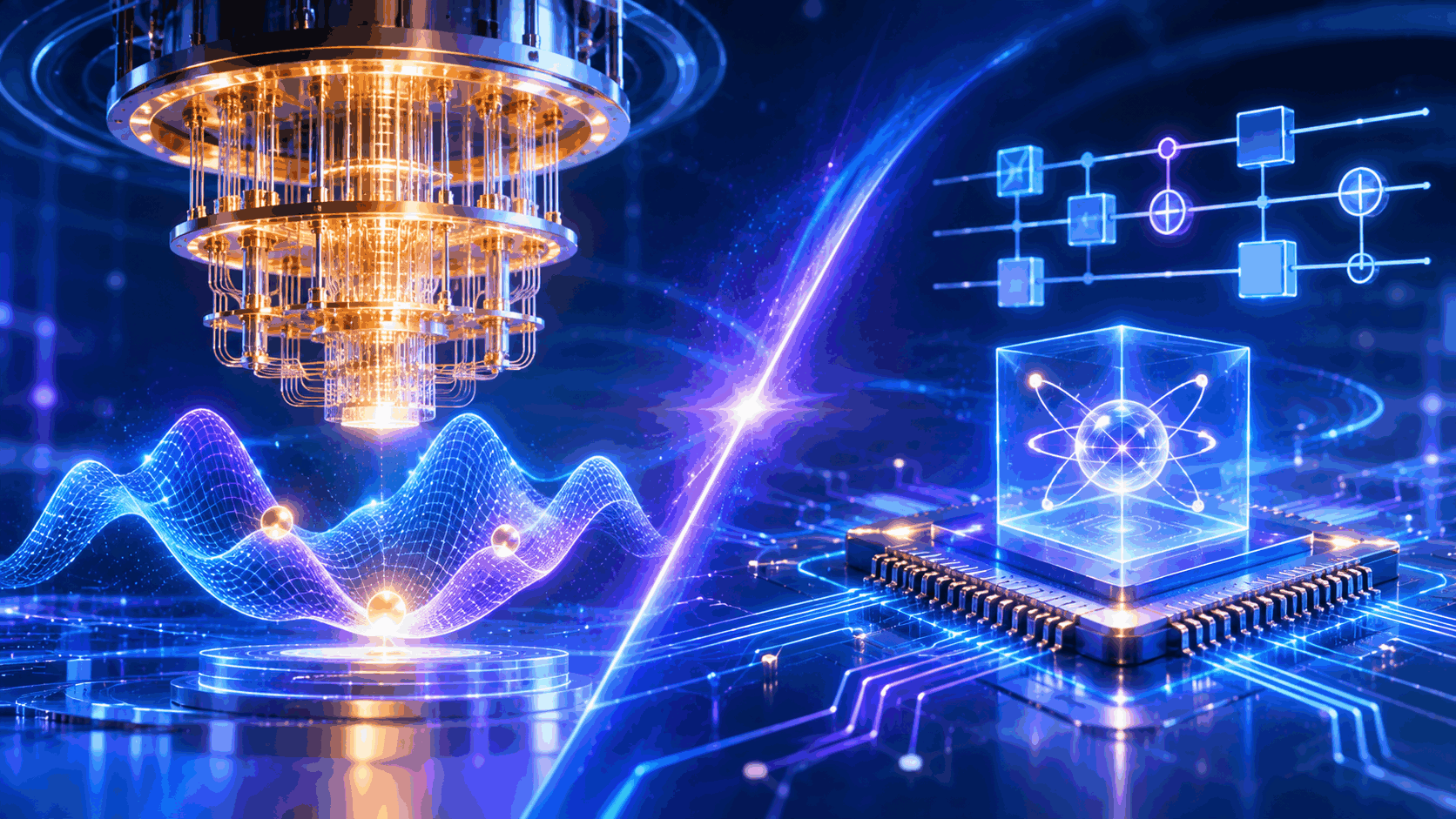
Picture a vast mountain range at night, with a marble somewhere on the slopes. Valleys are candidate solutions; the deepest valley is the best one. Your job is to find low ground without a map.
Real problems get translated into that terrain mathematically. Most annealing work is expressed as a QUBO — quadratic unconstrained binary optimization — which is a compact way of saying: here are yes/no decisions, here are the costs of each decision, and here are the penalties for pairs of decisions that conflict. Assign a binary variable to each truck route, each time slot, each asset weight, and the total cost function becomes an energy landscape over spin configurations, the same mathematics physicists use for magnetic materials. The machine's job is to find a low-energy spin arrangement.
Classical solvers get trapped. A greedy search rolls downhill into the nearest basin and stays there, because every nearby move costs energy. Simulated annealing adds thermal jitter to hop over ridges, but tall, wide ridges take exponentially long to climb.
Quantum annealing adds a different escape route. The processor starts with a strong transverse field that keeps qubits delocalized, then gradually turns the field down while turning the problem Hamiltonian up. During that sweep, quantum tunneling lets the system pass through narrow barriers instead of over them. Tall but thin walls — exactly the ones that stall thermal hopping — can become permeable. That's the physical intuition behind the hoped-for advantage, and it's why rugged landscapes with sharp spikes are the interesting target.
Now the honest boundary. Ideal adiabatic quantum computing, run slowly enough at zero temperature with the right Hamiltonians, is provably equivalent in computational power to the circuit model. Commercial annealers are not that. They run fast and noisy at finite cryogenic temperatures rather than zero Kelvin, with limited connectivity and no error correction, which makes them heuristic optimizers: they often return very good answers, with no guarantee of the global optimum and no general proof of speedup. An annealer also cannot run Shor's algorithm. It has no gate set, no circuit depth, and no way to express a quantum Fourier transform. RSA is safe from this machine.
How Gate-Based Quantum Computing Works: Choreographing Interference
A classical processor manipulates bits with AND, OR, and NOT gates. A gate-based quantum computer manipulates qubits with reversible operations — rotations, phase shifts, and two-qubit entangling gates such as CNOT — applied in a specified order. That ordered list is a quantum circuit, and it's what you actually write when you program IBM, Google, or Quantinuum hardware.
Here is where people usually get tripped up. A quantum computer does not "try every answer at once." A superposition over 2n states is not 2n parallel computers, because measurement gives you one outcome, chosen by the amplitudes. If you do nothing clever, you get a random answer and no advantage at all.
The clever part is quantum interference. Each computational path carries a probability amplitude, a quantity with a sign or phase, much like a wave. Gates rearrange those phases so that paths leading to wrong answers arrive out of step and cancel, while paths leading to right answers arrive in step and reinforce. Superposition supplies the many paths, entanglement correlates them across qubits, and interference does the actual selection. Grover's search amplifies a marked item this way; Shor's algorithm uses a quantum Fourier transform so that the periodicity hiding inside a factoring problem shows up as a sharp interference peak.
Because a small universal gate set can approximate any unitary operation, this model is a universal quantum computer. Chemistry, cryptanalysis, linear algebra, optimization — all expressible as circuits. That generality is the prize.
The price is fragility. Interference only works if phases stay coherent, and stray heat, vibration, and control noise scramble them within microseconds to seconds depending on the platform. Every gate adds error. So the field's answer is quantum error correction (QEC): spread one protected logical qubit across many physical qubits, measure stabilizers continuously, and decode the syndrome without disturbing the computation. That's the whole ballgame now — not qubit totals, but how many high-quality logical qubits you can keep alive.
Quantum Annealing vs. Gate-Based Quantum Computing
| Dimension | Quantum Annealing | Gate-Based Quantum Computing |
|---|---|---|
| Core principle | Analog evolution down an energy landscape, aided by quantum tunneling | Digital circuits shaping amplitudes through quantum interference |
| Universality | Special-purpose optimizer and sampler | Universal quantum computer in principle |
| Programming model | Specify QUBO/Ising coefficients, then sample | Compose quantum logic gates into circuits |
| Qubit scale and nature | Thousands of analog, fixed-topology qubits (4,400+ on Advantage2's Zephyr graph) | Hundreds to low thousands of physical qubits; a growing handful of logical qubits |
| Noise strategy | Inherent analog robustness, no full QEC; noise distorts the problem itself | Active QEC, syndrome decoding, fault-tolerant roadmaps |
| Maturity today | Production hybrid solvers used in industrial optimization pilots | Early logical-qubit era; chemistry and cryptanalysis still ahead |
| Representative hardware | Superconducting flux qubits (D-Wave) | Superconducting (IBM, Google), trapped ions (Quantinuum), neutral atoms (QuEra) |
Noise and Error Correction: Two Different Battles
Annealers tolerate quantum noise partly because they aren't trying to preserve delicate phase relationships across a long computation. But that tolerance has a cost: analog control errors quietly deform the energy landscape, so the machine may faithfully solve a slightly wrong problem. There is no known scalable path to full fault tolerance for commercial annealers.
Gate-based machines fight the opposite battle. They need exquisite phase fidelity, so they need QEC — and QEC has recently crossed a genuine threshold. Google's Willow chip showed logical error rates dropping as surface-code patches grew larger, the signature of operating below threshold. Quantinuum and QuEra, with academic partners, have run computations on dozens of error-detected or error-corrected logical qubits. Breaking RSA-2048 still demands resources far beyond current devices; recent estimates have fallen below a million physical qubits, which is progress, not a delivery date.
Sculpting a Landscape vs. Writing a Circuit
The programming mindset diverges sharply. Annealing work is modeling work: choose binary variables, tune penalty weights so constraints dominate costs, embed the graph, sample thousands of times, and post-process. Get the penalties wrong and you'll receive beautifully optimized nonsense.
Circuit work is algorithm design: pick a decomposition, manage gate depth, respect connectivity, compile efficiently. Annealing rewards a good formulation. Gate-based computing rewards a good algorithm. Teams that miss this distinction usually blame the hardware.
What Each Machine Does Today, and What It Promises Tomorrow
Annealing's practical footprint is optimization, and almost always in hybrid quantum-classical form: classical software decomposes a large problem, ships the hard subproblem to the QPU, and stitches the results back together.
- Logistics and routing: vehicle assignment, delivery sequencing, warehouse flow.
- Scheduling: gate and crew allocation, manufacturing job shops, grid and workforce planning.
- Finance: portfolio selection under constraints, arbitrage-style combinatorial searches.
- Physics: simulating quantum magnetism and spin dynamics, where the hardware's native Ising structure is a natural fit rather than a translation.
These are pilots and production trials, not proven blanket speedups. The value proposition today is solution quality or time-to-solution on specific hard instances, benchmarked against strong classical heuristics.
Gate-based computing aims at problems classical machines genuinely cannot represent:
- Quantum chemistry: correlated electronic structure for catalysts, drug binding, and reaction pathways.
- Materials: battery electrolytes, superconductors, magnetic phases.
- Cryptanalysis: Shor's algorithm against RSA and elliptic-curve systems — a fault-tolerance-era capability, and the reason post-quantum cryptography migration is underway now.
- Search and amplitude estimation: Grover-style quadratic gains for unstructured search and some Monte Carlo workloads.
None of the chemistry or cryptanalysis items are commercially available yet. They are the payoff for the logical-qubit race.
Which Should You Choose Today?
Your choice depends entirely on the problem and your timeline. If you are tackling large-scale combinatorial optimization—such as routing, scheduling, or resource allocation—and want to benchmark hybrid quantum-classical solvers against classical heuristics right now, quantum annealing is the more accessible near-term tool. If your roadmap centers on molecular simulation, quantum chemistry, linear algebra, or long-term cryptographic resilience, gate-based quantum computing is the track that matters.
Frequently Asked Questions
Is quantum annealing "real" quantum computing?
Yes. Quantum annealers use superconducting qubits exhibiting superposition, entanglement, and quantum tunneling. However, they are special-purpose analog processors rather than universal, programmable gate-based quantum computers.
Can quantum annealing break RSA encryption?
No. Breaking RSA requires Shor's algorithm, which depends on a universal gate set and quantum Fourier transforms. Quantum annealers cannot express quantum circuits and pose no threat to RSA or elliptic-curve cryptography.
When will gate-based quantum computers overtake classical supercomputers for commercial tasks?
Broad commercial advantage in chemistry, materials science, and cryptanalysis requires fault-tolerant machines with hundreds to thousands of high-fidelity logical qubits. While below-threshold error correction milestones arrived in 2024–2025, scaling to large fault-tolerant systems remains a multi-year engineering effort.
Contact Us
 (+86) 177 3001 9472
 market@originqc.com