Quantum Eraser Experiment Explained: Did We Rewrite History?
Drop a coffee mug on the floor. It shatters. You can glue it back together, sweep up every shard, even burn the security footage. But the event happened. The past is locked. That's how reality works—or so your gut tells you.
Now imagine a world where you peek at a sealed envelope, then somehow erase every trace of your peeking, and the envelope behaves as if you never looked. Sounds like a plot hole in a bad sci-fi movie, right?
Except physicists actually built this. They called it the quantum eraser experiment. And no, it doesn't let you rewrite history. But what it does reveal is stranger than any time-travel fantasy. Let's unpack it, step by step, starting from the very beginning.
The Double-Slit Experiment and the Price of Peeking
Before we can understand the eraser, we need to see what's written on the page. That page is the famous double-slit experiment—the single most mind-bending setup in all of physics.
Fire photons one at a time toward a barrier with two narrow slits. Behind the barrier sits a screen. If photons were tiny bullets, you'd expect two neat bands on the screen. Instead, you get a zebra-striped pattern—bright and dark bands alternating like ripples from two stones dropped in a pond. Each photon somehow interferes with itself, as if it passed through both slits simultaneously.
Here's where it gets weird. Place a detector at the slits—a tiny camera that records which slit each photon actually goes through. The moment you do this, the zebra stripes vanish. The photons snap into two boring bands, behaving like ordinary marbles. The act of gaining "which-path" information kills the wave behavior.
So the burning question at the heart of quantum measurement becomes: is it the physical bump from the detector that destroys the pattern? Or is it simply the existence of the information—the fact that the universe now "knows" which path was taken? That question is the seed from which the quantum eraser grows.
The First Eraser: Scrubbing the Diary Clean
If the problem is a leaked secret, what happens if we re-seal the envelope before anyone reads it? That's the revolutionary concept physicists Marlan Scully and Kai Drühl proposed in 1982.
While the original 1982 paper proposed an atomic transition scheme, modern optical versions bring this concept to life using light polarization. Imagine placing tiny polarizing waveplates over each slit: photons passing through the left slit are tagged "horizontal," while those through the right slit become "vertical." The which-path information now exists in principle—you could read it. And just as predicted, the interference stripes disappear.
Now for the eraser. Right before the photons hit the screen, you insert a diagonal polarizing filter set at 45 degrees. This filter scrambles horizontal and vertical into the same indistinguishable state. The labels are gone. The secret is shredded. Nobody—not even the universe—can tell which slit any photon took.
And the stripes come back. Full interference pattern, as if the tagging never happened. The takeaway is profound: what kills the wave isn't a physical collision. It's whether the which-path information exists in principle anywhere in the universe. Information itself is the switch.
The Ultimate Twist: What If You Erase After the Photon Has Already Landed?
So far, the eraser acts before the photon reaches the screen. That's already strange, but at least the timeline is tidy. Now crank the weirdness up a notch.
What if the photon has already hit the screen, left its mark, become a settled fact—and only then do we decide whether to erase the which-path information? Can a future decision retroactively change a past event?
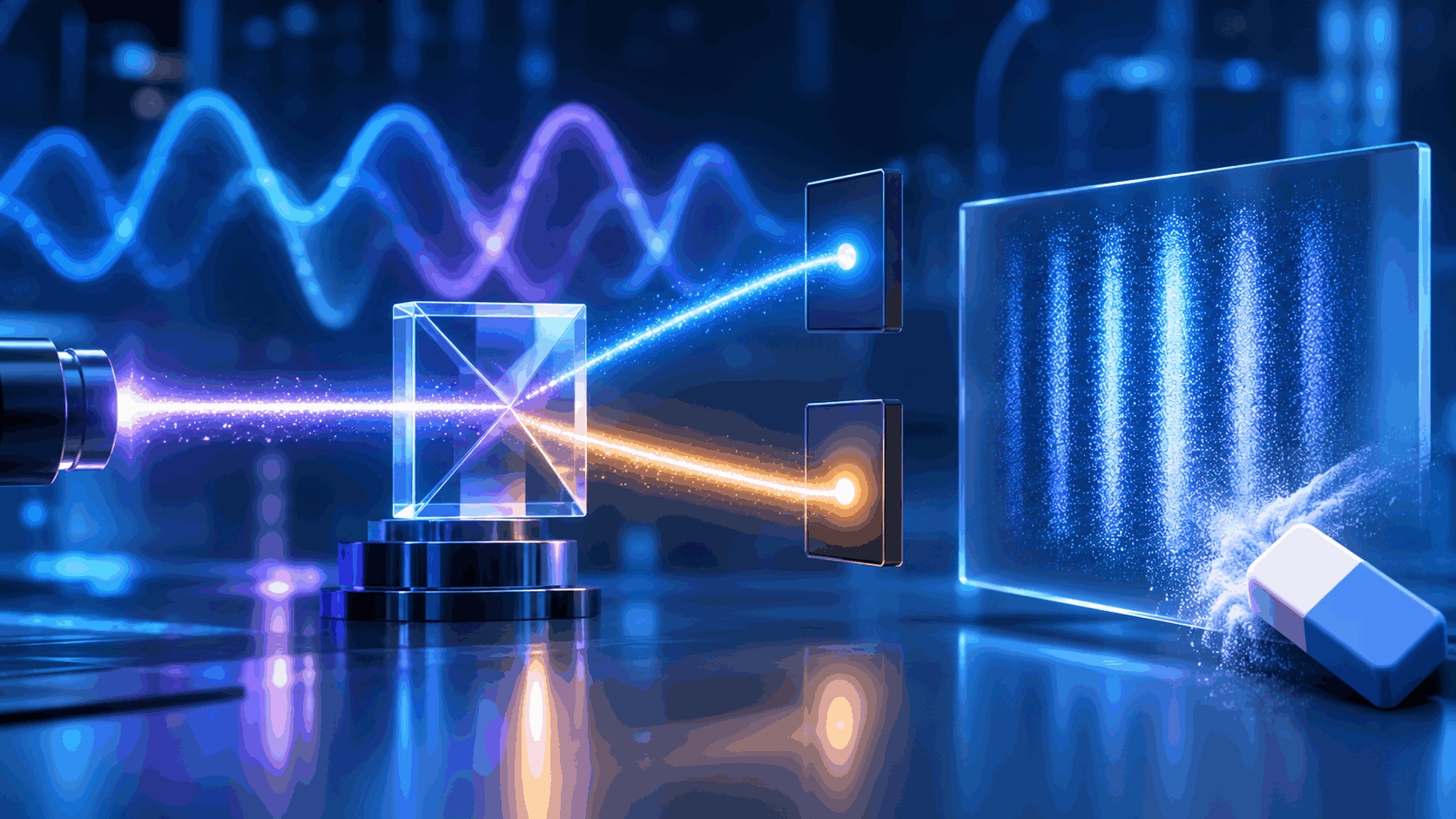
John Wheeler first posed this as a thought experiment in the 1970s. In 1999 (published in 2000), Yoon-Ho Kim, R. Yu, S. P. Kulik, Y. H. Shih, and Marlan Scully experimentally realized it using a nonlinear BBO crystal (via spontaneous parametric down-conversion). Their setup remains the definitive "delayed-choice quantum eraser" referenced throughout quantum physics. Let's walk through it carefully.
The Twin-Photon Setup
In the Kim et al. setup, a pump laser shines on a double slit. Directly behind each slit sits a nonlinear BBO crystal that converts incoming photons into an entangled photon pair via spontaneous parametric down-conversion. Think of them as entangled twins:
- Photon A ("Signal" Photon): Fired directly toward a movable primary detector (traditionally labeled Detector D0) on a short path.
- Photon B ("Idler" Photon): Sent into an optical prism and routed through a long, delayed maze of mirrors, prisms, and beam splitters.
Because Photon A takes a short path, it slams into D0 almost immediately. Photon B's path is lengthened by optical delay lines, arriving at its detectors roughly 8 nanoseconds later. Photon A's fate is sealed on the screen before Photon B even reaches its final crossroads.
Now here is the crux: Photon B's maze has four possible exits. Which detector clicks determines whether the which-path information survives or is permanently erased.
The Four Exits: A Quick Reference
| Detector | What Happens to Path Info | Analogy | Effect on Photon A's Pattern |
|---|---|---|---|
| D3 | Path info is preserved | A one-way street with a clear sign: "Came from Slit 1" | No interference (when sorted) |
| D4 | Path info is preserved | A one-way street with a clear sign: "Came from Slit 2" | No interference (when sorted) |
| D1 | Path info is erased | Two roads merge into one; you can't tell which one was taken | Interference pattern appears (when sorted) |
| D2 | Path info is erased | Same merge, but the pattern is shifted by half a fringe | Complementary interference pattern (when sorted) |
Notice the critical timing detail: when Photon B is still bouncing around inside the maze—maybe hasn't even reached the first beam splitter yet—Photon A has already struck the screen and been recorded. The "decision" about erasure happens after the fact.
So did the future reach back and rewrite the past? This is where most pop-science articles wave their hands and say "quantum weirdness!" We're going to do better than that.
The Future Did Not Change the Past
Here's the fact that almost every sensational headline skips: if you look at the main screen where Photon A lands, you see nothing but a featureless blob. No stripes. No pattern. Just a fuzzy smear of dots, regardless of what Photon B eventually does.
Wait—didn't we just say D1 and D2 produce interference? Yes, but with a massive caveat. You only see those stripes after you take Photon B's detector log and use it as a sorting key.
Think of it this way. The blob on the screen is actually two overlapping jigsaw puzzles dumped on top of each other. One puzzle (linked to D1) shows stripes. The other puzzle (linked to D2) shows stripes shifted by exactly half a fringe. Stacked together, they cancel out into a uniform smear. You need the "decoder key"—the record of which twin-B went to D1 versus D2—to separate the two images.
That decoder key—scientifically recorded via a coincidence counter—only becomes available after Photon B completes its journey. So no signal traveled backward in time. No retrocausal magic occurred. The physical marks on screen D0 never changed. What changed was your ability to isolate the correlations once the entangled partner's time-stamped log arrived.
The quantum eraser doesn't let you edit the past. It reveals that entangled particles share a correlation so deep that the "meaning" of one particle's measurement is locked until you compare it with its twin. Information was never sent backward. It was always distributed across both particles, waiting to be assembled.
Frequently Asked Questions
Does this experiment prove that human consciousness controls reality?
No. Not even close. The "observer" in quantum mechanics is any physical interaction that records information—a detector, a crystal, a stray air molecule. No human brain is required. The quantum eraser works perfectly in a fully automated lab with zero conscious beings present. The word "observer" is an unfortunate historical label, not a statement about minds.
Did the photon travel backward in time?
No. Photon A hit the screen at time T₁. Photon B was measured at time T₂, where T₂ > T₁. Nothing reversed. The confusion arises because we tend to think of the interference pattern as something that must "form" on the screen in real time. It doesn't. The pattern only emerges during post-processing, after both photons have been detected. The timeline is perfectly forward-moving.
Can we use this to send messages into the past or faster than light?
Absolutely not. The raw screen always shows a random blob. You cannot encode a message in that blob because you have no control over which individual dot lands where. The pattern only appears after classical communication—limited by the speed of light—tells you how to sort the data. No usable information crosses the gap faster than light. Relativity remains intact.
The Real Takeaway
The quantum eraser experiment doesn't hand us a time machine. It doesn't prove that consciousness shapes the cosmos. What it does is something quieter and, honestly, more beautiful.
It shows us that in the quantum world, information is physical. Not metaphorically physical—actually, measurably physical. Whether a which-path fact exists or has been erased determines whether a photon behaves like a wave or a particle. Reality at the smallest scale is woven from information as much as from matter and energy.
That's not magic. It's not mysticism. It's the universe telling us, in its own strange language, that knowing and being are more tangled together than our coffee-mug intuition ever suspected.
Contact Us
 (+86) 177 3001 9472
 market@originqc.com