How Quantum Key Distribution Works: The Ultimate Guide
Right now, most of your online secrets—bank passwords, private messages, government intel—are protected by math problems. RSA encryption, the backbone of modern security, relies on the assumption that factoring enormous prime numbers is impossibly hard for classical computers. But quantum computers are coming. Shor's algorithm, running on a sufficiently powerful quantum machine, could crack RSA-2048 in hours. The mathematical fortress is crumbling.
This is where quantum key distribution (QKD) enters the picture. Instead of betting on math puzzles, QKD bets on the laws of physics themselves. And physics, unlike math, doesn't get easier just because someone builds a faster calculator. If you've been searching for a clear explanation of how quantum key distribution works, you're in the right place.
What Is Quantum Key Distribution (QKD) Actually Doing?
Here's the biggest misconception about QKD, and I see it everywhere: people think it sends secret messages through quantum channels. It doesn't.
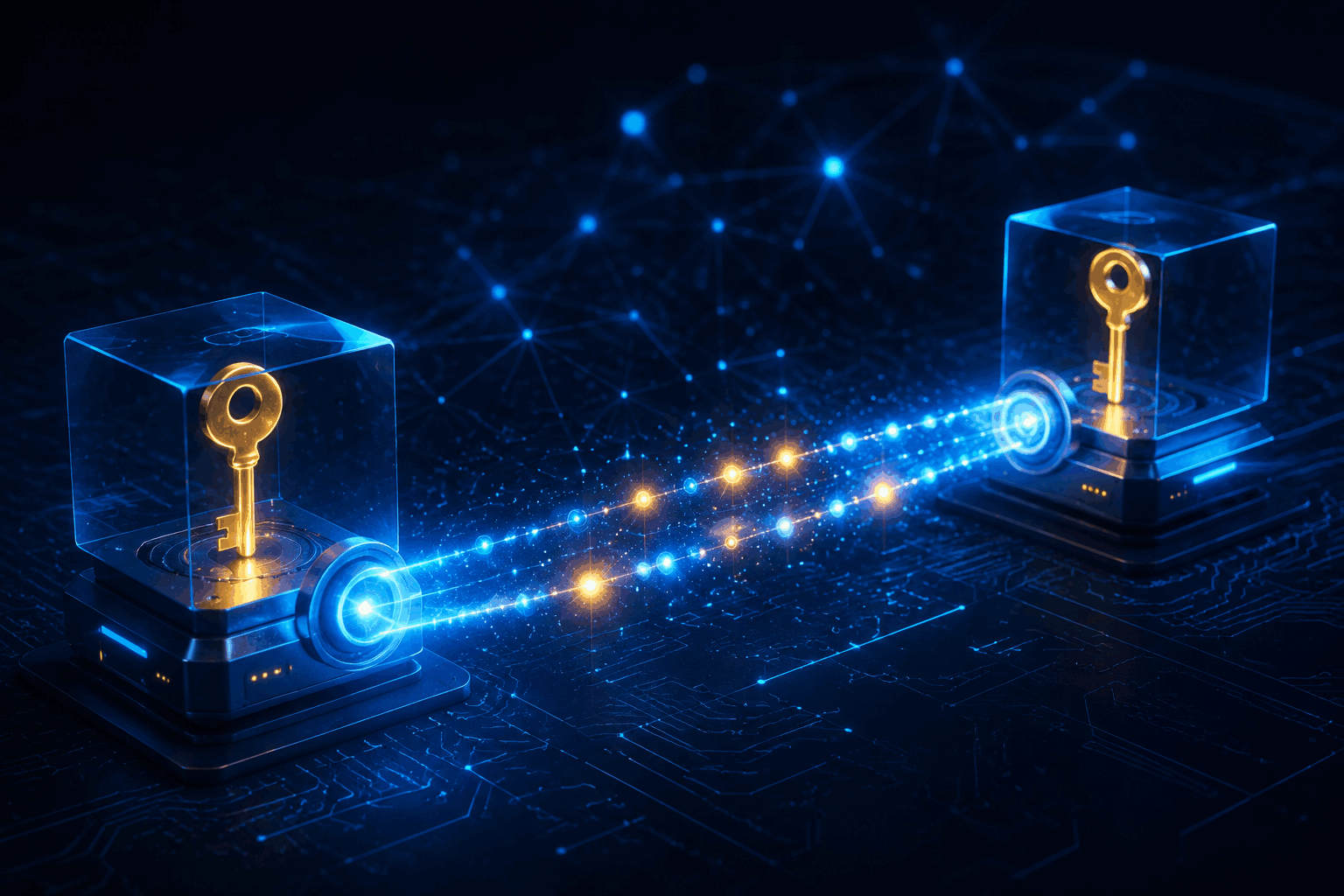
QKD transmits a random secret key—a string of 0s and 1s—that two parties (let's call them Alice and Bob) will later use to encrypt and decrypt their actual messages using classical channels. Think of it like this: you're not mailing the treasure through a quantum tunnel. You're mailing a unique, one-use-only key to a treasure chest, and the quantum tunnel guarantees that if anyone peeked at the key during transit, both you and the recipient would know instantly.
Once Alice and Bob share this perfectly secret key, they can combine it with an encryption method called the One-Time Pad—a technique proven to be mathematically unbreakable, as long as the key is truly random, used only once, and kept completely secret. QKD solves the hardest part of that equation: getting the key to the other person without anyone else seeing it.
How Quantum Key Distribution Works
To explain how quantum key distribution works in practice, we'll walk through the most famous QKD method: the BB84 protocol, invented by Charles Bennett and Gilles Brassard in 1984. Grab your coffee. This is where the physics gets beautiful.
Step 1: Alice Encodes Keys into Light (Photons)
Alice wants to send Bob a secret key. She starts by generating a completely random string of bits—say, 1, 0, 1, 1, 0, 1, 0, 0. But she can't just email these bits. She needs to encode them into something that the laws of quantum mechanics will protect.
Her weapon of choice? Individual photons—single particles of light.
Each photon has a property called polarization, which describes the direction its electromagnetic wave vibrates. Think of polarization like slipping a letter through a mail slot. If the slot is horizontal, you slide the letter in flat. If it's vertical, you turn the letter sideways. Alice uses a special laser to fire single photons, each polarized in a specific direction, to represent her 0s and 1s.
But here's the clever part. Alice doesn't just use one "alphabet." She randomly switches between two different encoding systems, called bases:
- Rectilinear basis (+): Horizontal polarization (↔) means 0, vertical polarization (↕) means 1. Think of this as a regular pair of sunglasses that only lets horizontal or vertical light through.
- Diagonal basis (×): Diagonal-right polarization (⤢) means 0, diagonal-left polarization (⤡) means 1. Now imagine tilting those sunglasses 45 degrees.
So if Alice's random bit string is 1, 0, 1, 1, and she randomly picks the bases +, ×, ×, +, she would send:
- Bit 1 in basis + → vertically polarized photon (↕)
- Bit 0 in basis × → diagonal-right polarized photon (⤢)
- Bit 1 in basis × → diagonal-left polarized photon (⤡)
- Bit 1 in basis + → vertically polarized photon (↕)
Alice writes down which bits and which bases she used. Then she fires these photons, one by one, through a fiber optic cable (or sometimes through open air) toward Bob.
Step 2: Bob Measures the Incoming Light
Bob is sitting at the other end, and he knows the general plan: photons are coming, and he needs to measure their polarization. But he has a problem. He doesn't know which basis Alice used for each photon.
Remember our sunglasses analogy? Bob has two pairs of "quantum sunglasses"—a rectilinear filter (+) and a diagonal filter (×). For each incoming photon, he must randomly guess which filter to use.
When Bob's filter matches Alice's basis, everything works perfectly. A vertically polarized photon passing through a rectilinear filter will come out clearly as "vertical," and Bob correctly reads it as 1.
But when Bob guesses wrong—say, Alice sent a diagonally polarized photon and Bob uses a rectilinear filter—quantum mechanics throws a curveball. The photon doesn't just get blocked or pass through cleanly. Instead, it randomly "snaps" to one of the filter's allowed states. A diagonal photon hitting a rectilinear filter has a 50/50 chance of coming out as horizontal or vertical. Bob gets a result, but it's basically a coin flip. The original information is scrambled.
This isn't a bug. This is the feature that makes the entire system secure, and we'll see exactly why in a moment.
Step 3: The Public Comparison
Now Alice has sent, say, 1,000 photons. Bob has received and measured them all. Both of them have a notebook full of data: Alice knows her bits and bases, Bob knows his chosen bases and measurement results.
Here's where things get counterintuitive. Alice picks up a regular phone—or sends an unencrypted email—and tells Bob: "Hey, for photon #1 I used the + basis, for photon #2 I used ×, for photon #3 I used +..."
Wait. She's sharing this information on a public, potentially monitored channel? Yes! Because she's only revealing which bases she used, never the actual bit values. The bases alone are useless to an eavesdropper without the photons themselves—and those photons have already been measured and destroyed.
Bob compares Alice's basis list with his own. Wherever they both used the same basis, they know Bob's measurement is correct. Wherever they used different bases, Bob's result is garbage (remember the 50/50 coin flip), so they throw those photons away.
Statistically, they'll match about half the time. So from 1,000 photons, they keep roughly 500. This process is called sifting, and the result is a shared "sifted key."
Step 4: Sifting and Error Correction
Even after sifting, the key might not be perfect. Tiny imperfections in the fiber optic cable, detector noise, or—critically—an eavesdropper could have introduced errors. So Alice and Bob run a final round of classical post-processing:
- Error estimation: They publicly compare a small random sample of their sifted key bits. If the error rate is below a certain threshold (typically around 11% for BB84), they proceed. If it's too high, they abort—someone might be listening.
- Error correction: Using classical algorithms (like Cascade or LDPC codes), they fix the remaining discrepancies without revealing the actual key values.
- Privacy amplification: They compress the corrected key through a mathematical hash function, shrinking it down so that any partial information an eavesdropper might have gathered becomes completely useless.
The final output? A shorter, but perfectly identical and perfectly secret string of bits that only Alice and Bob know. Mission accomplished.
What Happens When Someone Tries to Hack It?
Let's introduce Eve, our eavesdropper. She's tapped into the fiber optic cable between Alice and Bob, and she's intercepting every photon. Can she read the key?
Short answer: No. And she can't even try without getting caught.
Here's why. Quantum mechanics has two ironclad rules that make eavesdropping physically impossible to hide:
1. The Heisenberg Uncertainty Principle (Observation Changes Reality)
In the quantum world, you cannot measure a particle without disturbing it. When Eve intercepts a photon to read its polarization, she faces the exact same problem Bob did: she doesn't know which basis Alice used. So Eve guesses randomly. If she guesses wrong, she collapses the photon's quantum state into the wrong basis, permanently altering it.
Think of the photon as a sealed envelope made of ice. The only way to read the message inside is to melt it open. Once you've read it, you can try to refreeze the water into a new envelope, but the recipient will notice the seal is different. Eve can try to send a replacement photon to Bob based on her measurement, but if she measured in the wrong basis, her replacement photon carries the wrong polarization.
2. The No-Cloning Theorem (You Can't Copy What You Can't Fully Know)
Maybe Eve thinks she's clever: "I'll just make a perfect copy of each photon, keep one, and send the original to Bob." Nice try, Eve. The no-cloning theorem states that it is physically impossible to create an identical copy of an unknown quantum state. You can't duplicate what you can't fully measure. This isn't a technological limitation—it's a fundamental law of the universe.
So here's what actually happens when Eve interferes:
- Eve intercepts a photon, randomly guesses a basis, and measures it. About half the time, she guesses wrong and corrupts the photon's state.
- Eve sends a new photon (based on her corrupted measurement) to Bob.
- Bob measures this photon. Even if Bob uses the correct basis, he'll get the wrong result roughly 25% of the time because of Eve's interference.
- During Step 4, when Alice and Bob compare their sample bits, they'll see an error rate around 25%—far above the safe threshold.
- Alice and Bob immediately know the channel is compromised. They discard the key and try again on a different channel.
QKD vs. Traditional Key Exchange (Comparison Table)
To truly understand why quantum key distribution is revolutionary, let's see how it stacks up against the key exchange methods we rely on today.
| Feature | Traditional Key Exchange (RSA / Diffie-Hellman) | Quantum Key Distribution (QKD) |
|---|---|---|
| Security Basis | Computational hardness of math problems (e.g., factoring large primes) | Fundamental laws of quantum physics |
| Vulnerable to Quantum Computers? | Yes — Shor's algorithm breaks RSA and DH | No — physics doesn't change with better computers |
| Eavesdropping Detection | Impossible to detect passive interception | Any interception alters quantum states and triggers alarms |
| Forward Secrecy | Risky — intercepted encrypted data can be stored and decrypted later ("harvest now, decrypt later") | Guaranteed — the key is never exposed, even in the future |
| Key Randomness | Pseudorandom (algorithm-dependent) | True quantum randomness |
| Distance Limitation | Unlimited (works over any standard network) | Currently limited (~100–300 km over fiber; satellite QKD extends range) |
| Infrastructure Cost | Low — runs on existing hardware | High — requires specialized photon detectors and quantum hardware |
The tradeoff is clear: QKD offers theoretically perfect security but demands specialized hardware and has distance limitations. Traditional methods are cheap and universal but rest on mathematical assumptions that quantum computers will soon shatter. Most experts expect a hybrid future, where QKD protects the most critical communications while post-quantum cryptography handles the rest.
Frequently Asked Questions About How QKD Works
1. Does QKD actually encrypt my messages?
No. This is the most common mix-up I see. QKD is strictly a key delivery service. It doesn't encrypt your emails, bank transfers, or private photos. Think of it like an armored truck delivering a master key to a bank vault. The truck (QKD) guarantees the key arrives safely and hasn't been copied, but you still need to use that key with a classical lock (like the AES encryption algorithm) to actually secure the gold inside the vault. QKD just handles the hardest part: getting the key to you without anyone intercepting it.
2. What happens if an eavesdropper causes too many errors during transmission?
Alice and Bob hit the kill switch. During the final check (Step 4), they compare a small sample of their keys. If the error rate spikes above a safe threshold—usually around 11% for the BB84 protocol—they instantly trash the entire batch. They don't try to "patch" a leaky key. High errors mean Eve was definitely snooping, and she might have grabbed partial data. The beauty of QKD is its absolute paranoia: you either get a 100% perfect, secret key, or you get nothing at all. Then, you just hang up, assume the line is burned, and try again later.
3. Can a future quantum computer hack a QKD system?
Short answer: Absolutely not. Long answer: Quantum computers are terrifying for math-based encryption (like RSA) because they can crunch through complex equations at mind-boggling speeds. But QKD doesn't rely on math puzzles. It relies on the fundamental hardware of the universe. A quantum computer trying to break QKD is like using a supercomputer to try and change the law of gravity. The no-cloning theorem and the observer effect aren't computational hurdles; they are physical brick walls. Even a quantum machine with infinite processing power can't copy an unknown quantum state.
Contact Us
 (+86) 177 3001 9472
 market@originqc.com