What Is a Quantum Circuit? A Simple, Code-Free Guide
What Exactly Is a Quantum Circuit?
If you typed "what is quantum circuit" into a search engine, you probably expected to see a picture of a circuit board — something with metallic traces, tiny chips, and maybe a few blinking LEDs. That mental image is perfectly reasonable. It is also completely wrong.
A quantum circuit is not a physical layout of wires and switches. It is an abstract sequence of operations — think of it as a choreography script, a recipe card, or a piece of sheet music — that tells a set of qubits and superposition states how to evolve over time. It specifies which transformations to apply, in what order, and to which qubits. There are no electrons flowing through copper. There are no physical logic gates bolted to a board. Instead, there is a timeline of instructions, and each instruction nudges a fragile quantum state a little closer to a useful answer.
To put it in a single sentence: a quantum circuit is a time-ordered sequence of quantum logic gates applied to a register of qubits, ending with a measurement that produces a classical result.
The Paradigm Shift: Classical Circuits vs. Quantum Circuits
Before we can truly understand how quantum circuits work, we need to demolish the single biggest misconception that trips up every beginner. And that misconception is the word "circuit" itself.
The Classical Mental Model: Data on a Conveyor Belt
Picture the processor inside your laptop. Inside that chip, billions of microscopic transistors are wired together in fixed, physical arrangements — AND gates here, OR gates there, NOT gates everywhere. These gates are physically etched into silicon. They do not move. They do not change. When your computer performs a calculation, it is the data (in the form of electrons carrying 0s and 1s) that travels through stationary wires, passing through these permanently installed gates like boxes rolling along a factory conveyor belt.
The Factory Analogy: Imagine a juice factory. Oranges (your data) roll along a fixed conveyor belt (the copper wires). Along the belt, there are permanently bolted machines: a peeler, a squeezer, a filter. Each machine is hardwired into the production line. The oranges move; the machines stay put. This is how every classical digital circuit on Earth operates.
The Quantum Mental Model: Dancers Under Spotlights
Now, throw that mental model away.
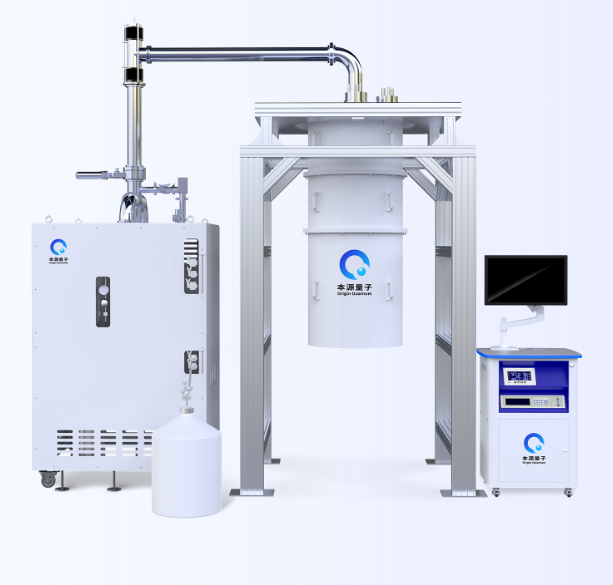
In a quantum computer, the qubits (the quantum equivalent of bits) are fixed in place on a chip — they might be tiny superconducting loops cooled to near absolute zero, or individual atoms trapped in a vacuum by electromagnetic fields. They do not travel. They sit still, locked in their designated positions.
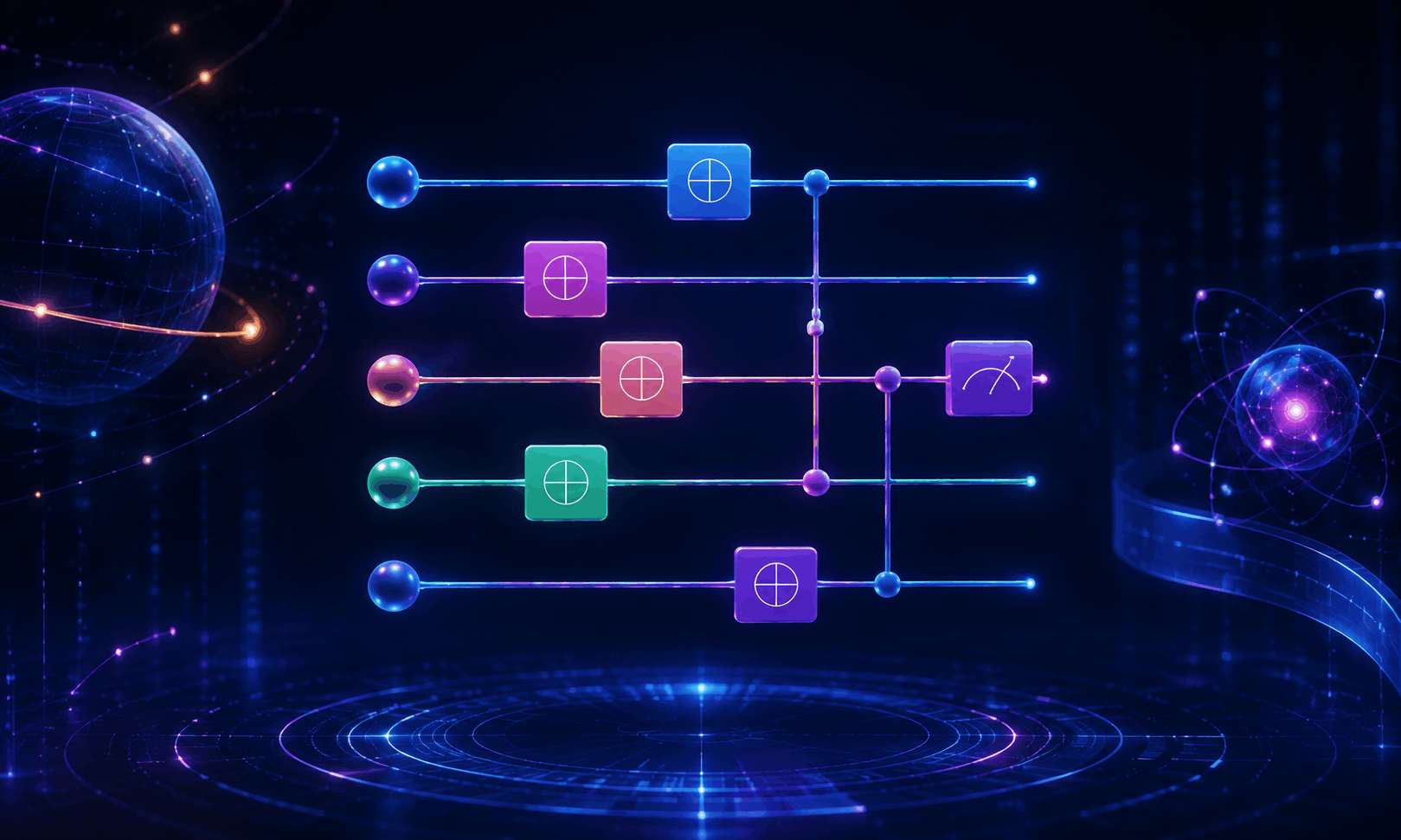
What moves — or more accurately, what changes over time — are the operations applied to those stationary qubits. The "lines" in a quantum circuit diagram do not represent physical wires. They represent the passage of time for each qubit. The "gates" placed along those lines do not represent physical hardware components. They represent pulses of energy — carefully tuned bursts of microwaves or laser light — fired at specific qubits at specific moments.
The Dance Analogy: Imagine a stage with five dancers, each standing on a marked spot. They never change positions. Instead, the choreographer's score tells each dancer what move to perform at each beat. At beat 1, Dancer A spins. At beat 2, Dancer A and Dancer B link arms. At beat 3, everyone freezes. The "circuit" is the score. The dancers are qubits. The moves are quantum gates. Nothing physical moves along a wire — only instructions unfold across time.
A classical circuit diagram is a spatial blueprint showing where wires go. A quantum circuit diagram is a temporal score showing when operations happen.
Side-by-Side Comparison
| Dimension | Classical Circuit | Quantum Circuit |
|---|---|---|
| Physical Medium | Copper wires, silicon transistors etched in place | Microwave pulses or laser beams fired at stationary qubits |
| What the "Lines" Represent | Actual physical wires that carry electrons | Timelines showing a qubit's existence from past to future |
| What the "Gates" Represent | Fixed hardware components soldered onto a board | Energy pulses applied at specific moments in time |
| What Moves | Data (electrons) moves through stationary gates | Operations (gates) are applied to stationary data (qubits) |
| Output | Deterministic: same input always gives same output | Probabilistic: output is sampled from a probability distribution |
The Three Core Components
Every quantum circuit diagram you will ever encounter — no matter how intimidating it looks — is built from exactly three visual elements. Let us pull them apart one by one.
1. The Wires — Timelines, Not Cables
Open any quantum computing textbook or drag-and-drop circuit builder, and the first thing you will see is a stack of horizontal lines running from left to right. Typically, each line is labeled on the far left with something like q0, q1, q2, and so on.
Here is the critical thing to internalize: each horizontal line represents one qubit's journey through time. The left edge of the line is the starting moment — typically, every qubit begins in its ground state, a calm, undisturbed "0." As you move your eyes to the right along the line, you are traveling forward in time. By the time you reach the right end of the line, the computation is complete, and the qubit is ready to be measured.
If you see three parallel horizontal lines, that means the circuit uses three qubits. If you see fifty, it uses fifty. This horizontal-line-per-qubit convention is universal across every quantum computing platform in the world.
At the very beginning of each wire, before any gates are applied, the qubit simply exists in its default state. Think of a spinning top sitting motionless on a table — it has potential energy, but it has not been set in motion yet. The gates that follow are what bring that potential to life.
2. The Quantum Logic Gates — Energy Pulses, Not Hardware
Scattered along the wires, you will see boxes, circles, and other symbols. These are the quantum logic gates, and they are the heart of every quantum circuit. Just as classical computers use AND, OR, and NOT gates to manipulate bits, quantum computers use an entirely different vocabulary of gates to manipulate qubits.
But remember: these gates are not physical objects. They are instructions to fire a precisely calibrated pulse of energy at a specific qubit at a specific moment. The nature of that pulse depends on the hardware. In a superconducting quantum chip, the gate might be a burst of microwave radiation lasting a few tens of nanoseconds. In a trapped-ion computer, it might be a finely focused laser beam.
Let us look at the most common gates you will encounter, explained without a single equation:
Single-Qubit Gates: Stirring One Coin
Imagine a coin lying flat on a table, showing Heads (this represents the state "0"). A single-qubit gate is an instruction to do something to that one coin.
- The X Gate (the "Flip"): This is the simplest gate. It flips the coin over. If it was showing Heads (0), it now shows Tails (1), and vice versa. In the classical world, this is identical to a NOT gate. Straightforward.
- The H Gate — Hadamard (the "Spin"): This is where quantum magic enters. Instead of flipping the coin, the H gate spins it. While the coin is spinning, it is neither purely Heads nor purely Tails — it is a blur of both. This is the famous superposition state. The coin exists in a hazy combination of 0 and 1 simultaneously. Only when you slap your hand down to stop the coin (i.e., measure it) will it randomly settle on one face or the other.
- Other rotation gates (Y, Z, S, T, etc.): These are more nuanced spins — imagine tilting the coin's axis of rotation this way or that. You do not need to memorize them now; just know that each one rotates the qubit's state in a slightly different direction.
Multi-Qubit Gates: Tying Coins Together
Things get truly interesting when gates start connecting two or more qubits. This is where quantum circuits gain their extraordinary power — and where they depart completely from anything classical circuits can do.
- The CNOT Gate (Controlled-NOT): This is the most important two-qubit gate, and you will see it in virtually every quantum circuit ever designed. Here is how it works: you pick two qubits — a "control" qubit and a "target" qubit. The gate says: "Look at the control qubit. If it is 1, flip the target qubit. If it is 0, do nothing." Simple enough on the surface — but when the control qubit is in superposition (spinning, both 0 and 1 at once), the CNOT gate creates entanglement: the two qubits' fates become permanently linked, no matter how far apart they are. In our coin analogy, it is as if you tied an invisible elastic band between two spinning coins, so that whatever one lands on, the other instantly correlates with.
- Other multi-qubit gates (SWAP, Toffoli, Fredkin, etc.): These involve three or more qubits and perform more elaborate conditional operations, but the underlying principle is the same — they create complex correlations between multiple qubits that would be impossible in classical computing.
Why This Matters: Single-qubit gates create superposition (spinning coins). Multi-qubit gates create entanglement (linked coins). The interplay between these two phenomena — orchestrated across the timeline of a quantum circuit — is what gives quantum computers their theoretical advantage over classical ones.
3. The Measurement — Slapping Down the Coin
At the far right end of each wire in a quantum circuit diagram, you will typically see a small symbol that looks like a gauge or a meter — often drawn as a semicircle with a needle, sometimes accompanied by a double line branching off the main wire.
This is the measurement operation, and it is the grand finale of every quantum circuit.
Remember our spinning coin? Measurement is the act of slamming your palm down on it. The instant you do, the blur of superposition vanishes. The coin is forced to commit: it is either Heads (0) or Tails (1). There is no in-between. This is what physicists call wave function collapse, though you can think of it simply as "forcing nature to pick a side."
Here is the twist: you cannot predict with certainty which face the coin will land on. You can only know the probability. A qubit that has been spun by an H gate has a roughly 50/50 chance of collapsing to 0 or 1. A qubit that has been through a more complex sequence of gates might have a 70/30 split, or 90/10, or any ratio you can engineer by choosing the right combination of gates.
This is why quantum computations are probabilistic. You typically run the same quantum circuit many times — hundreds or thousands of "shots" — and collect the statistics of the outcomes. The answer to your problem is encoded in the distribution of those results.
How to Read a Quantum Circuit Diagram
Now that you know the components, let us put them together and learn to sight-read a quantum circuit diagram the way a pianist sight-reads sheet music.
Example: A Simple 2-Qubit Quantum Circuit (Bell State)
Here is exactly what you are looking at, narrated step by step:
- Two horizontal wires (q0 and q1) — this circuit uses two qubits. Both start in the default "0" state.
- An H gate on q0 — the first qubit gets "spun" into a superposition. It is now a blur of 0 and 1 simultaneously.
- A CNOT gate connecting q0 (control) and q1 (target) — the spinning first qubit is linked to the second qubit, creating entanglement. Their fates are now intertwined.
- Measurement symbols on both qubits — both coins are slapped down, and each produces a classical output (0 or 1). Because of the entanglement, the two outputs will always agree: either both 0 or both 1, with roughly 50% probability each. This is called a Bell state, and it is the "Hello World" of quantum circuits.
Reading Direction: Left to Right, Always
Every quantum circuit diagram in the world is read from left to right. The leftmost edge is the past (qubits in their initial state), and the rightmost edge is the future (measurement and output). Time flows horizontally. There are no exceptions to this convention.
Two Key Metrics: Width and Depth
When quantum engineers evaluate a circuit, they talk about two dimensions:
Circuit Width is simply the number of horizontal lines — the number of qubits the circuit uses. A wider circuit requires more qubits, which means more hardware resources. Today's quantum computers typically support anywhere from 5 to over 1,000 qubits, so circuit width is a real constraint.
Circuit Depth is the number of "time steps" from left to right — essentially, how many sequential layers of gates must be applied before measurement. Depth is critically important because qubits are fragile. The longer a circuit runs (the deeper it is), the more likely the qubits are to lose their quantum properties through a process called decoherence — think of it as the spinning coins gradually wobbling and falling over on their own before you get a chance to measure them. Keeping circuit depth as short as possible is one of the central challenges in quantum algorithm design.
Your Next Step
Let us circle back to the question that brought you here: what is a quantum circuit?
It is not a tangle of copper wires. It is not a microscopic city of silicon transistors. It is a score — a time-ordered list of instructions that tells a group of stationary qubits how to evolve, step by step, from a simple starting state to a complex entangled state that encodes the answer to a problem. The lines in the diagram are timelines. The gates are energy pulses. The measurement is the final curtain call, where quantum possibility collapses into classical certainty.
If you take away only one insight from this article, let it be this: the power of a quantum circuit lies not in any single gate, but in the choreography — in the precise sequencing of superposition-creating operations and entanglement-forging operations, arranged so that wrong answers destructively interfere and cancel each other out, while right answers constructively interfere and rise to the top of the probability distribution. That is the essence of quantum algorithm design, and it all plays out on the timeline canvas of a quantum circuit.
The best way to make this knowledge permanent is to build something. Open the Origin Quantum Cloud, drag an H gate onto the first wire, drop a CNOT between two wires, add measurement symbols at the end, and hit "Run." Within seconds, a real quantum computer on the other side of the planet will fire microwave pulses at a superconducting chip cooled to near absolute zero.
Contact Us
 (+86) 177 3001 9472
 market@originqc.com