What Is Calibration in Quantum Computing? 2026 Need to Know
You walk into a piano room. The instrument was tuned last month, maybe even last week. But someone left the window open over the weekend, the humidity climbed, and now middle C sounds flat. You press a key expecting a clean note and get something murky instead.
Quantum processors have the same problem. A qubit that drifts out of tune doesn't just produce a sour note — it produces wrong answers. And unlike a piano that can sit for weeks between tunings, a quantum chip can lose its alignment in a matter of hours.
So what is calibration in quantum computing? It is the process of measuring how qubits currently behave and adjusting the control signals that drive them, so that each gate lands where the math says it should. Without calibration, the microwave pulses that implement quantum algorithms hit their targets with the accuracy of a blindfolded archer.
Why Quantum Computers Drift Out of Tune
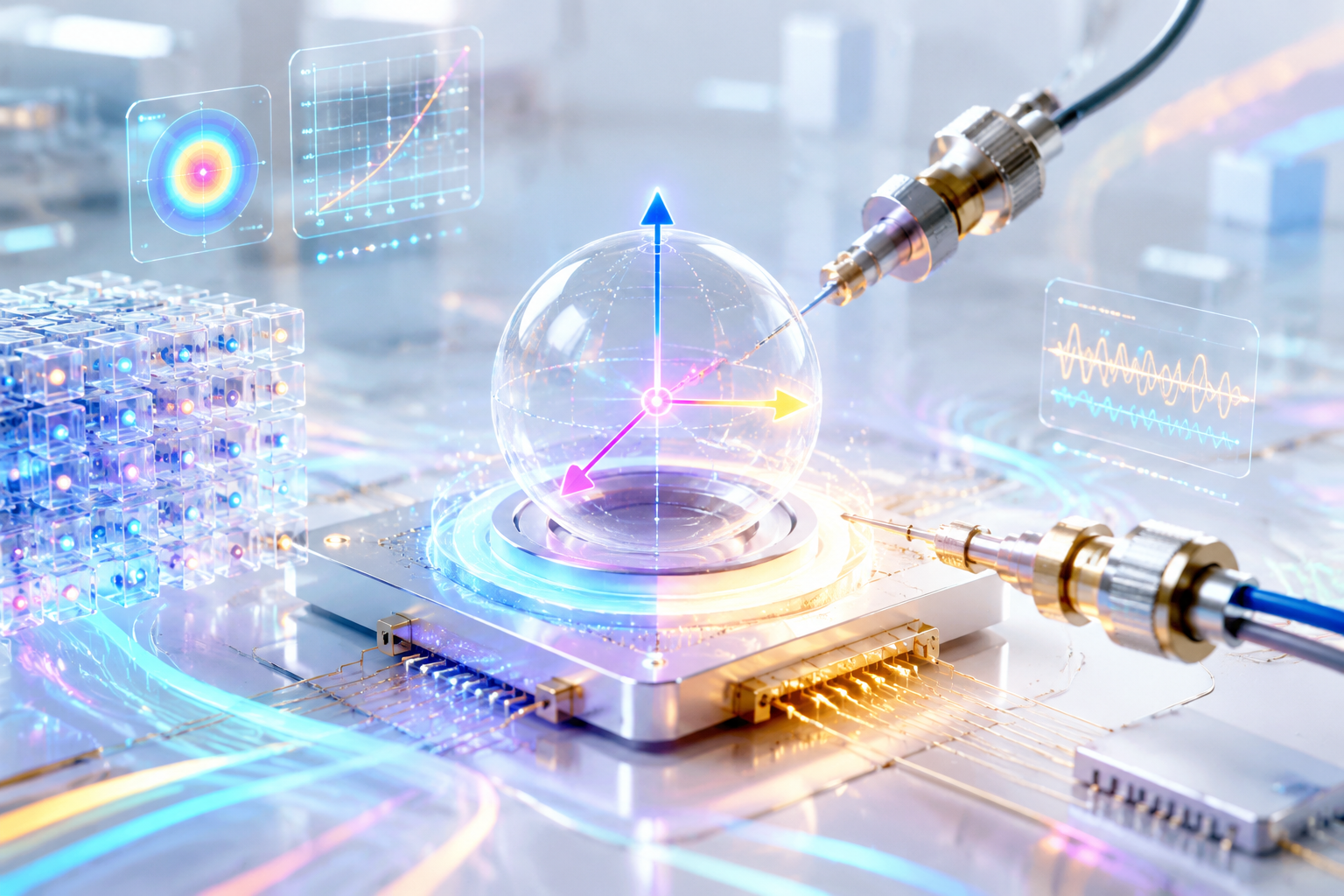
A classical bit sits at 0 or 1 and stays there until you tell it otherwise. The voltage threshold that separates the two states is wide — hundreds of millivolts — and ordinary circuit noise barely dents it. A qubit lives in a superposition of both states, represented by a point on the Bloch sphere. That point is defined by phase relationships and energy gaps measured in microelectronvolts. The margin between "working gate" and "random output" is vanishingly thin, and everything in the environment pushes against it.
Three forces push qubits away from their intended behavior. Understanding them matters because each one demands a different calibration response.
Environmental Noise
Stray electromagnetic fields from nearby electronics, temperature ripples in the cryostat wiring, even a cosmic ray striking the chip substrate can couple into the qubit's control lines. Superconducting qubits sit at roughly 15 millikelvin, colder than deep space. The dilution refrigerator achieves this temperature through multiple thermal stages, and each stage is a potential noise injection point. Infrared photons leaking through the signal lines, imperfect low-pass filters on the DC bias lines, microphonics from the pulse tube cooler's vibration — all of these introduce fluctuations that shift qubit frequencies by a few megahertz over the course of hours. A frequency shift of that size is enough to detune a gate pulse that was designed for a specific resonance.
Decoherence
Decoherence in quantum computers is the slow bleed of quantum information as the qubit becomes entangled with its surroundings. Two numbers matter here. T1 measures energy relaxation — how long a qubit holds its excited state before it spontaneously falls back to ground through dielectric loss, quasiparticle tunneling, or Purcell emission into the readout resonator. T2 measures phase coherence — how long the relative phase between |0⟩ and |1⟩ stays meaningful. T2 is bounded by T1 but is often shorter because of low-frequency noise, particularly 1/f flux noise in the materials surrounding the Josephson junction. On a typical superconducting device, T1 runs between 50 and 200 microseconds. T2 might be 30 to 150 microseconds. Any gate that takes longer than these windows will see the signal decay before the computation finishes. Even gates that are fast — single-qubit rotations in 20 to 40 nanoseconds, two-qubit gates in 100 to 300 nanoseconds — accumulate errors when repeated hundreds of times, because each gate operates against a background of active decoherence.
Crosstalk
Drive one qubit with a microwave pulse and its neighbors feel a fraction of that energy. The coupling mechanism varies by architecture. In fixed-frequency transmon designs, the always-on capacitive coupling between neighbors creates a ZZ interaction that shifts transition frequencies depending on the state of adjacent qubits. In flux-tunable designs, the flux pulse used to tune one qubit's frequency also shifts the frequency of nearby qubits through imperfect isolation in the flux bias lines. The effect per neighbor is small — a few kilohertz to a few megahertz of frequency shift — but it accumulates across the chip. In a dense lattice with nearest-neighbor coupling, crosstalk turns a clean single-qubit rotation into a messy multi-qubit disturbance. It also means that the optimal pulse parameters for a given qubit depend on what the other qubits are doing at the same time, which makes calibration a multi-variable problem rather than a per-qubit adjustment.
These effects all push down quantum gate fidelity, which measures how closely a real gate matches its ideal unitary operation. A two-qubit gate at 99 percent fidelity sounds respectable until you chain 200 of them together. The overall success probability drops to roughly 13 percent. Calibration is the discipline of keeping those fidelity numbers as high as the physics permits. It cannot eliminate noise or decoherence — those are physical realities — but it can ensure that the control pulses compensate for drift and that the system operates at its current best possible performance point.
What Gets Adjusted During Calibration
Calibration does not repair broken hardware. It measures the current behavior of each qubit and retunes the control parameters that drive it. The adjustments fall into two categories.
Control Pulses
Every quantum gate is a shaped electromagnetic signal — a microwave pulse for superconducting circuits, a laser pulse for trapped ions. That pulse carries four adjustable parameters.
- Amplitude. How strong the signal is. This sets the rotation angle on the Bloch sphere. Too weak and you under-rotate. Too strong and you overshoot.
- Frequency. Must match the qubit's transition frequency so the pulse drives the intended energy level change. A mismatch of even a few megahertz reduces the gate's effectiveness.
- Phase. Determines the rotation axis. This is what separates an X gate from a Y gate — same amplitude, same duration, different axis.
- Duration. How long the pulse runs. A π-pulse that should flip |0⟩ to |1⟩ needs a precise length. Get it wrong by a nanosecond and you land somewhere between the two states.
Think of quantum control pulses like the steering, throttle, and brake on a car. If the steering ratio shifts by half a degree, you miss your exit. Calibration measures the drift and resets these parameters so each gate lands on target.
Qubit Frequencies
Each qubit has a transition frequency — the energy gap between |0⟩ and |1⟩. That number is not etched in stone. It shifts with temperature, with the state of adjacent qubits, and with aging materials in the chip itself. Qubit tuning means measuring these drifts and updating the control system's lookup tables so pulses stay resonant.
For processors with tunable couplers — devices that switch interactions between qubits on and off — the coupler's bias point also needs calibration. A coupler offset by even a small amount introduces residual ZZ coupling, a persistent error that shows up as unwanted phase accumulation during periods when qubits should be sitting idle.
How Calibration Actually Runs on a Real Machine
Calibration is not a single measurement. It is a pipeline — a sequence of experiments where each step narrows down a different source of error. Here is what a typical cycle looks like on a superconducting processor.
Step 1: Find the qubit frequency. A spectroscopy sweep sends pulses across a frequency range and records which one causes the qubit to flip. The peak response marks the transition frequency. This gives the control system a reference point for everything that follows.
Step 2: Run a Rabi oscillation experiment. With the frequency locked, the system fires pulses of varying durations and measures the probability of finding the qubit in |1⟩. The output is a sine-like curve. Its period tells you exactly how long a π-pulse should last. From this, the pulse amplitude and duration get set.
Step 3: Check phase drift with a Ramsey experiment. A Ramsey sequence applies two π/2 pulses separated by a free-evolution delay. The resulting interference fringes show how much the qubit's phase wanders during idle time. This measurement feeds into the calibration of virtual Z gates and provides a T2 estimate.
Step 4: Benchmark gate fidelity. Randomized benchmarking sends random sequences of Clifford gates and tracks how error accumulates as the sequence grows. The decay slope gives an average gate error rate. This is the number teams watch most closely — it tells you whether the last round of calibration helped or hurt.
Step 5: Tune two-qubit gates. Entangling gates like the controlled-Z or the iSWAP require coupling qubits together for a precise duration. Calibration sweeps the coupling time and measures the resulting entanglement fidelity, then locks the pulse shape that produces the cleanest operation.
The full cycle takes anywhere from a few minutes on a small test chip to several hours on a multi-qubit system. On most cloud-accessible quantum computers, this cycle runs overnight. The calibration data — gate fidelities, T1 and T2 values, readout error rates — gets published each morning so users know which parameters their jobs will run under.
Why Manual Calibration Does Not Scale
Calibrating a five-qubit chip by hand is tedious but manageable. A graduate student can write a few scripts, run the experiments, and adjust parameters in a couple of days. Now picture a processor with a thousand qubits. Each qubit needs frequency sweeps, Rabi curves, Ramsey checks, and two-qubit gate tuning. The number of pairwise couplings grows quadratically. Manual tuning stops being slow — it becomes impossible.
Automated calibration addresses this by replacing human-driven parameter sweeps with optimization algorithms that navigate the high-dimensional error landscape on their own. Three approaches have gained traction.
Bayesian optimization. Instead of scanning every parameter combination, Bayesian methods build a probabilistic model of the error surface and pick the next measurement point to maximize information gain. In published experiments, this approach has cut the number of required calibration shots by roughly tenfold compared to exhaustive sweeps.
Machine learning–driven tuning. Neural networks can learn the mapping from raw measurement traces to optimal pulse parameters after observing enough calibration cycles. Once trained, these models suggest starting points already close to optimal, which reduces warm-up time on fresh hardware.
Closed-loop feedback systems. A few groups have built systems where calibration runs continuously in the background while the processor accepts user jobs. The system detects frequency drift in real time and applies micro-corrections without interrupting computation. This is still in the research phase, but it points toward a future where calibration is a transparent maintenance layer rather than scheduled downtime.
The move from manual to automated calibration is not just about speed. It is about reproducibility. When a person tunes a qubit, the final parameters reflect their judgment calls. An automated system produces a documented, repeatable procedure — which matters when you need to compare results across different machines or different months.
FAQs
What is the difference between calibration and quantum error correction?
Calibration works before computation. It adjusts the physical control signals — pulse amplitudes, frequencies, durations — to minimize the raw error rate of each gate. Quantum error correction works during computation. It encodes logical information across multiple physical qubits and detects plus corrects errors as they happen. Calibration reduces the baseline error; error correction handles what leaks through.
Do different quantum hardware types calibrate differently?
Yes. Superconducting qubits are calibrated with microwave pulses generated by room-temperature electronics and sent down coaxial lines into a cryostat. Trapped-ion systems use laser pulses tuned to atomic transitions, calibrated by measuring fluorescence rates. Spin qubits in silicon rely on radio-frequency gate voltages. The calibration experiments — Rabi, Ramsey, randomized benchmarking — are conceptually similar across platforms, but the physical control signals and timescales differ significantly.
Can I see the calibration data for a quantum computer I am using?
Most cloud quantum computing providers publish daily calibration data for each device. If you are running circuits on any major platform, this data is accessible and worth checking before you submit jobs.
Contact Us
 (+86) 177 3001 9472
 market@originqc.com