Quantum Computing Prerequisites: What You Actually Need Before Starting
You open a quantum computing tutorial. Three paragraphs in, you hit a wall of Greek letters, matrices with complex entries, and a sentence that says "the state vector evolves unitarily in a Hilbert space." You close the tab.
It happens every time. The problem is almost never the reader's ability. It's the gap between what a quantum computing course assumes you already know and what you actually bring to the table. That gap has a name: prerequisites.
Most guides list prerequisites like a bare checklist — linear algebra, Python, "some physics." But you need to know how deep to go in each area, which parts you can safely skip, and how these pieces actually connect when you start reading about qubits and quantum gates. That's what this guide covers.
The Real Barrier Isn't What You Think
People assume quantum computing means advanced physics. It doesn't. The actual bottleneck is linear algebra — specifically, how comfortable you are with matrix multiplication, vector spaces, and the idea that a quantum state is a vector, not a number.
Here's the full list, ranked by importance:
- Linear algebra — vectors, matrices, matrix multiplication, dot products, eigenvalues, eigenvectors, tensor products. Every quantum algorithm is expressed in this language. There's no working around it.
- Complex numbers — addition, multiplication, magnitude, phase, Euler's formula (e to the power of i-theta equals cosine theta plus i sine theta). Quantum amplitudes live in the complex plane. Real numbers won't cut it.
- Basic probability — independent events, conditional probability, expected value. The rules of probability change in the quantum world, but you need the classical version first to see what changes.
- Python programming — variables, functions, loops, lists, basic array operations. All major quantum computing frameworks use Python as their interface.
- Two or three physics concepts — superposition, measurement, entanglement. That's it. No mechanics course required.
If you're checking off items and feeling uneasy about linear algebra, good — that's where most people stall. It's also where this guide spends the most time.
The Math Foundation
Math is the operating system of quantum computing. You don't need to be a mathematician, but you do need to be fluent in a specific set of tools. Let's go through each one with enough depth so you'll know when you're ready to move on.
Linear Algebra: The Core Language
Every quantum state is a vector. Every quantum gate is a matrix. Every multi-qubit system uses tensor products. If those words mean nothing to you yet, start here.
Below is what you need to be comfortable with, along with why each piece matters:
- Vectors and vector spaces — A qubit state is a vector in a two-dimensional complex vector space. You need to understand what a vector is geometrically (an arrow with direction and magnitude) and algebraically (an ordered list of numbers). The concept of a basis is critical: the computational basis states |0⟩ and |1⟩ are simply the standard basis vectors [1, 0] and [0, 1].
- Matrix multiplication — Applying a quantum gate means multiplying a matrix by a state vector. You should be able to do this by hand for 2x2 and 4x4 matrices. Practice until it feels automatic. Take the Hadamard gate: it's the matrix [[1/sqrt(2), 1/sqrt(2)], [1/sqrt(2), -1/sqrt(2)]]. Multiply it by [1, 0] and you get a superposition state.
- Inner products and norms — The inner product of two vectors gives you a probability amplitude. The norm (length) of a state vector must equal 1 — that's the normalization condition. When you measure a qubit, the probability of each outcome is the squared magnitude of the corresponding amplitude.
- Eigenvalues and eigenvectors — These show up everywhere in quantum algorithms. Phase estimation, for example, extracts eigenvalues of unitary operators. You need to recognize what an eigenvalue equation looks like (A times v equals lambda times v) and know how to solve it for small matrices.
- Tensor products — This is how you combine multiple qubits. A two-qubit system lives in a four-dimensional space formed by the tensor product of two two-dimensional spaces. Tensor product is not a direct sum — it multiplies dimensions. That's why n qubits give you a state space of size 2 to the power of n. This exponential growth is where quantum computing gets its potential power.
What you can skip: singular value decomposition, Gram-Schmidt orthogonalization in full generality, vector space theory over arbitrary fields. Stick to complex vector spaces of finite dimension and you'll have everything you need for introductory quantum computing.
Complex Numbers: Why Real Numbers Are Not Enough
Classical probabilities are real numbers between 0 and 1. Quantum probability amplitudes are complex numbers. This isn't a cosmetic difference — it's the source of interference, which is the mechanism behind quantum speedups.
Here's what you need:
- Representation — A complex number z equals a plus bi, where i is the square root of negative 1. You should be comfortable plotting complex numbers on the complex plane, with the real part on the horizontal axis and the imaginary part on the vertical axis.
- Magnitude and phase — The magnitude of z is the square root of a squared plus b squared. The phase is the angle theta where z equals magnitude times e to the power of i-theta. In quantum computing, phase controls interference patterns. Two amplitudes with the same magnitude but opposite phase can cancel each other out — that's destructive interference, and it's how algorithms like Grover's search amplify the correct answer.
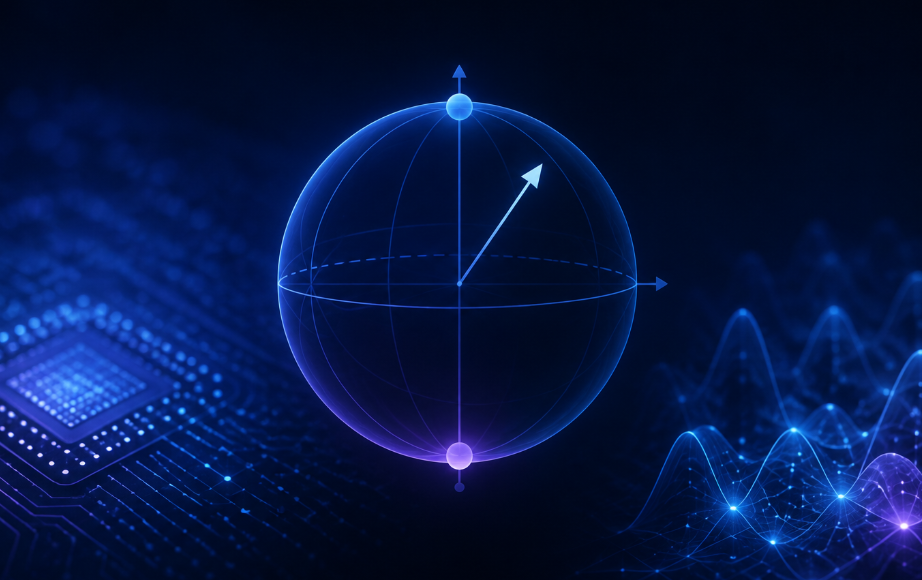
- Euler's formula — e to the power of i-theta equals cosine theta plus i sine theta. This formula connects exponential functions to trigonometry and is used constantly in quantum computing, especially when describing rotations on the Bloch sphere.
- Complex conjugation — The complex conjugate of a plus bi is a minus bi. Inner products in quantum mechanics use complex conjugation: the probability of measuring a state is the amplitude multiplied by its complex conjugate, giving you the squared magnitude.
Skip complex analysis, contour integration, analytic function theory. You need arithmetic and geometric intuition, nothing more.
Probability Theory: The Rules Change
Classical probability is straightforward: events have probabilities that sum to 1, and the probability of two independent events both happening is the product of their individual probabilities. Quantum probability plays by different rules. You need the classical version down cold so you can spot where it diverges.
- Sample spaces and events — The set of all possible outcomes and the subsets you can assign probabilities to. In quantum computing, the sample space is the set of measurement outcomes, but the probabilities come from amplitudes, not direct assignment.
- Conditional probability — The probability of A given B. This becomes relevant when you consider sequential measurements and how measuring one qubit affects the state of another in an entangled system.
- Expected value and variance — These come up when you analyze quantum algorithms probabilistically. Many quantum algorithms, including Shor's factoring algorithm, produce the correct answer with high probability but not certainty. You need a feel for what "high probability" means in practice.
Here's the critical difference: in the classical world, probabilities add directly. In the quantum world, amplitudes add first, and then you square the result to get probabilities. Two paths to the same outcome can interfere — their amplitudes can add constructively (making the outcome more likely) or destructively (making it less likely). That's the mechanism quantum algorithms exploit, and it's exactly why complex numbers are essential rather than optional.
Programming Skills That Matter
You can read about quantum computing without writing a single line of code. If you want to actually build circuits, test algorithms, or run experiments on real quantum hardware, though, you need programming. The good news: the bar is low.
Python as the Starting Point
Every major quantum computing framework — Qiskit, Cirq, QPanda — uses Python as its primary interface. You don't need to be a software engineer. These are the specific skills you should be comfortable with:
- Variables and data types — integers, floats, strings, booleans. Use these to set gate parameters and track measurement results.
- Functions — defining and calling functions with parameters and return values. Quantum circuits are often built as functions that take rotation angles as parameters.
- Loops — for loops and while loops. You'll use loops to run circuits multiple times (shots) and collect statistics.
- Lists and arrays — creating, indexing, iterating over collections. Measurement results come back as arrays of bit strings.
- Basic NumPy — creating arrays, matrix multiplication, computing norms. NumPy is the bridge between the math you've learned and the code you'll write.
A practical benchmark: if you can write a Python function that takes a 2x2 matrix and a 2-element vector, multiplies them, and returns the result, you're ready to start with quantum computing tutorials.
What You Can Skip
People tend to over-prepare on the programming side. Here's what you can safely leave for later:
- C++ or Rust — Used for building quantum computing frameworks, not for using them. You don't need systems programming to write quantum circuits.
- GPU programming or CUDA — Quantum simulation on GPUs is a niche research area. Standard quantum computing runs on CPUs and cloud-based quantum hardware.
- Web development or databases — Irrelevant for learning quantum computing. You might run into these if you build a full-stack quantum application later, but they're not prerequisites.
- Advanced algorithms and data structures — You don't need to implement a red-black tree to understand Grover's algorithm. The quantum algorithms you'll learn are self-contained.
Physics Background: How Much Is Enough?
This is the most misunderstood prerequisite. People hear "quantum" and assume they need a physics degree. They don't. Quantum computing abstracts away most of physics and treats quantum mechanics as a set of mathematical rules for how information behaves.
Classical Mechanics Is Not Required
Skip Newton's laws, Lagrangian mechanics, Hamiltonian dynamics. You don't need wave equations or the physics of actual particles. Quantum computing treats qubits as abstract two-level systems — they could be superconducting circuits, trapped ions, or photon polarization states. The underlying physics varies, but the mathematical description of the qubit stays the same across all platforms.
Translation: skip the physics textbooks. Go straight to the quantum information perspective, which treats quantum mechanics as a generalization of probability theory rather than a theory of particles and waves.
The Concepts You Must Understand
There are three ideas from quantum mechanics you need to grasp intuitively before quantum computing makes sense:
- Superposition — A classical bit is either 0 or 1. A qubit can be in a state that's "partially 0 and partially 1" at the same time. More precisely, the qubit state is a linear combination of |0⟩ and |1⟩ with complex coefficients. Measure it and you get 0 or 1, with probabilities set by those coefficients. Superposition isn't about the qubit physically being in both states at once — it's about the math allowing combinations classical bits can't represent.
- Measurement — Measuring a quantum state changes it. Before measurement, a qubit might sit in a superposition. After, it collapses to something definite — 0 or 1. This isn't a limitation of our instruments. It's a fundamental property of quantum systems. Measurement extracts classical information from a quantum state and destroys the superposition in the process.
- Entanglement — Two qubits can be correlated in ways classical bits can't match. When qubits are entangled, measuring one instantly tells you something about the other, no matter the distance. This isn't faster-than-light communication — no usable information moves between them. But entanglement is a resource quantum algorithms use to create correlations that classical algorithms can't replicate efficiently.
You can leave these aside: the double-slit experiment in detail, the Schrödinger equation, spin physics, interpretation debates (Copenhagen, many-worlds, etc.). Fascinating stuff, but not prerequisites for writing your first quantum circuit.
How These Pieces Fit Together
Knowing the prerequisites in isolation isn't the same as being ready to use them together. Here's how the math, programming, and physics concepts combine when you actually run into a quantum algorithm.
Take the simplest non-trivial quantum circuit: apply a Hadamard gate to a qubit, then measure it.
Initial state is |0⟩, which is the vector [1, 0]. The Hadamard gate is a 2x2 matrix. Multiply the matrix by the vector — that's linear algebra. The result is [1/sqrt(2), 1/sqrt(2)], a superposition state. The entries happen to be real here, but in general they're complex numbers. When you measure, the probability of getting 0 is the squared magnitude of the first entry — 1/2. Same for 1. That's probability theory.
Now run it in Python using a quantum framework. You create a circuit, add a Hadamard gate, add a measurement operation, execute it 1,000 times. You get roughly 500 zeros and 500 ones. That's programming.
Each piece is simple on its own. The trick is holding all of them in your head at once. That's why the prerequisites matter — if any one of them is shaky, the whole picture falls apart.
A Realistic Learning Path
Here's a concrete sequence for building the prerequisites, assuming you're starting from high school math and no programming experience:
| Phase | Focus | Estimated Time | Readiness Check |
|---|---|---|---|
| Phase 1 | Linear algebra basics: vectors, matrices, matrix multiplication, dot products | 3-4 weeks | Can multiply 2x2 and 4x4 matrices by hand without errors |
| Phase 2 | Complex numbers: arithmetic, magnitude, phase, Euler's formula | 1-2 weeks | Can convert between rectangular form (a + bi) and polar form (magnitude and phase) |
| Phase 3 | Python basics: variables, functions, loops, lists, NumPy arrays | 2-3 weeks | Can write a function that performs matrix-vector multiplication |
| Phase 4 | Advanced linear algebra: eigenvalues, eigenvectors, tensor products, unitary matrices | 3-4 weeks | Can compute eigenvalues of a 2x2 matrix and explain what a tensor product does to dimensions |
| Phase 5 | Quantum concepts: superposition, measurement, entanglement, Dirac notation | 2-3 weeks | Can write a qubit state in Dirac notation and compute measurement probabilities |
| Phase 6 | First quantum circuit: build, simulate, and measure using a quantum framework | 1-2 weeks | Can create a Bell state circuit and verify entanglement through measurement statistics |
Total time from scratch: roughly 12 to 18 weeks of consistent study at 5 to 10 hours per week. If you already have some of these skills, you can compress that timeline. A computer science student who knows linear algebra and Python can reach Phase 6 in 4 to 6 weeks.
Frequently Asked Questions
Do I need a physics degree to learn quantum computing?
No. Most introductory quantum computing courses require only a basic grasp of a few key concepts — superposition and measurement, for starters. You don't need a full physics degree. The mathematical tools — linear algebra and complex numbers — matter far more than advanced physics coursework.
How much math do I need to know before starting quantum computing?
Three areas: linear algebra (vectors, matrices, matrix multiplication, eigenvalues and eigenvectors), complex numbers (addition, multiplication, magnitude, Euler's formula), and basic probability (independent events, conditional probability, expected value). You don't need calculus beyond basic derivatives. Differential equations aren't necessary for introductory quantum computing either.
Can I learn quantum computing without knowing how to code?
You can follow the theory without coding, sure. But to actually run quantum circuits or experiment with algorithms, you'll need basic programming skills. Python is the standard language for quantum computing frameworks. Variables, loops, functions, working with arrays — that's enough. You don't need advanced software engineering chops.
What is the fastest path to start learning quantum computing?
If you already know high school math and basic Python, you can start an introductory quantum computing course in about 4 to 6 weeks of focused study on linear algebra and complex numbers. Starting from scratch? Expect 3 to 6 months to build the math foundation before tackling quantum-specific material.
Do I need to understand quantum physics to learn quantum computing?
You need a small set of concepts from quantum mechanics: superposition, entanglement, measurement, and the idea that quantum states are vectors in a complex vector space. You don't need the Schrödinger equation, Hamiltonian mechanics, or quantum field theory for most quantum computing courses.
Is quantum computing harder to learn than classical machine learning?
They're hard in different ways. Quantum computing demands more abstract mathematical thinking — you're working with complex vector spaces and probability amplitudes that have no classical equivalent. Machine learning leans more on statistical intuition and hands-on data experimentation. If you're comfortable with linear algebra, quantum computing is often easier to get into than the math-heavy side of machine learning.
Contact Us
 (+86) 177 3001 9472
 market@originqc.com