What is a Quantum Computer? The Ultimate Beginner's Guide
If you've been following tech news lately, you've probably heard the buzz: Quantum Computing is coming. It's being hailed as the next great leap forward, promising to solve problems that would take today's supercomputers millions of years to crack.But if you're like most people, you're probably asking: "What is a quantum computer, really?" Is it just a faster version of the laptop I'm using right now?Spoiler alert: No. It is something entirely different.In this guide, we're going to strip away the complex physics jargon and break down exactly how quantum computers work, what they look like inside, and why they cost a fortune to build.
The Core Concept
To understand a quantum computer, you first have to understand the computer you are using right now.
Classical Computers (The Light Switch)
Your phone, laptop, and the servers running Google are "classical" computers. They process information in bits. Think of a bit like a light switch—it can be either ON (1) or OFF (0). Everything you see on your screen—photos, videos, text—is just a massive stream of millions of these 1s and 0s.
Quantum Computers (The Spinning Coin)
A quantum computer uses Quantum Bits, or Qubits.
Imagine a coin on a table. If it's lying flat, it's heads (1) or tails (0). That's a classical bit. But what if you spin that coin? While it's spinning, it is effectively both heads and tails at the same time.
How It Works: The "Magic" Behind the Machine
Quantum mechanics is notoriously difficult to understand, but we can boil it down to two main "superpowers" that allow these machines to calculate so fast.
1. Superposition
As we mentioned with the spinning coin, Superposition is the ability of a quantum system to be in multiple states at once.
- Classical: You have to try one key on a keyring at a time to open a door.
- Quantum: You try every key simultaneously.
2. Entanglement
This is what Einstein famously called "spooky action at a distance." When qubits become entangled, they form a connection where the state of one qubit instantly influences the state of another, even if they are miles apart.
The Result: In a classical computer, adding more bits gives you linear power (1+1=2). In a quantum computer, adding more qubits gives you exponential power. A machine with just 300 perfect qubits could theoretically hold more information than there are atoms in the known universe.
What Does a Quantum Computer Look Like?
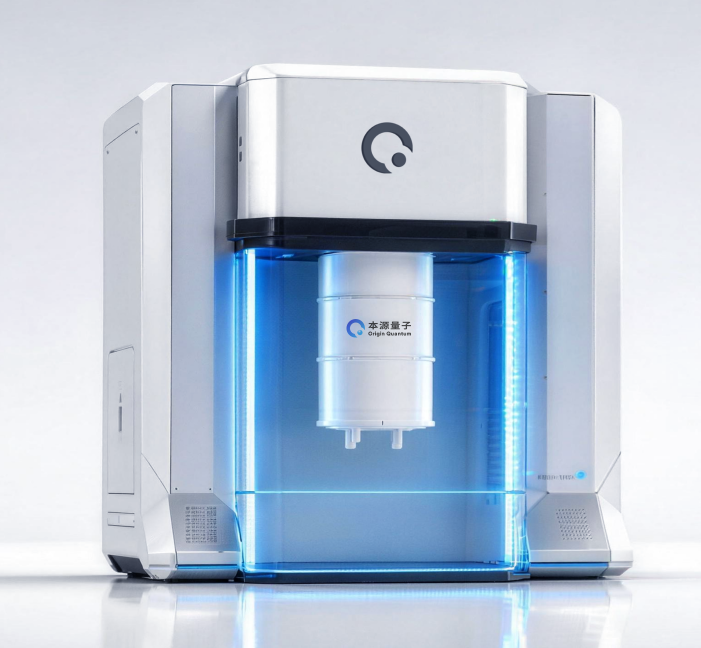
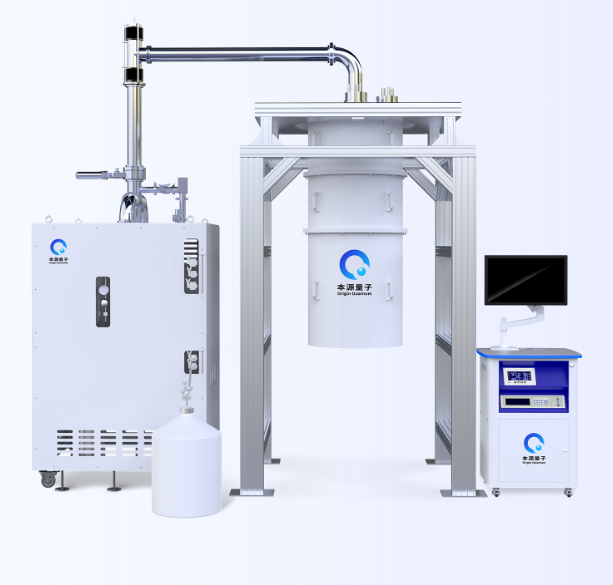
If you were to walk into a lab housing a quantum computer (like those made by Oringin Quantum), you wouldn't see a sleek black box. You would see something that looks like a golden chandelier hanging inside a giant silver tank.
Here is a breakdown of the anatomy of a quantum computer:
| Component | Function | Why is it needed? |
|---|---|---|
| The Qubit Chip | The "Brain" | This is where the actual calculation happens. It's often made of superconducting loops. |
| Dilution Refriger | The "Cooler" | Qubits are incredibly fragile. They need to be kept at near absolute zero (-273°C) to prevent heat from causing errors. |
| Control Electronics | The "Nervous System" | A massive array of wires and microwave generators that send signals to the qubits to tell them what to do. |
| Shielding | The "Armor" | Protects the qubits from external noise like radio waves, Wi-Fi, and even cosmic rays. |
Why So Cold?
Quantum states are delicate. A slight vibration or a tiny change in temperature can cause the qubits to lose their data—a process called decoherence. To keep them stable, the computer must be colder than deep space.
The Price Tag: How Much Does It Cost?
You won't be picking up a quantum computer at Best Buy anytime soon. The cost of building these machines is astronomical.
1. The Hardware Costs
The Dilution Refrigerator alone—the machine used to cool the processor—can cost upwards of $500,000 to $1 million. When you factor in the custom shielding, the microwave control wiring (which can cost millions for large systems), and the specialized chips, a full-scale quantum computer can easily run into the millions of dollars.
2. The "Cloud" Solution
Since buying one is expensive, most people access them via the cloud. Services like Origin Quantum Cloud allow researchers and developers to rent time on a quantum computer.
Why Do We Need Them? (Use Cases)
If they are so expensive and hard to build, why bother? Because for specific problems, they are hundred million of times faster than classical supercomputers.
- Drug Discovery: Simulating how molecules interact is hard for classical computers because nature is quantum. Quantum computers can simulate these molecular bonds perfectly, potentially curing diseases faster.
- Cryptography: Current internet security relies on math problems that are hard for classical computers to solve (like factoring large numbers). A powerful quantum computer could theoretically break these codes in hours, which is why the world is racing to build "Quantum-Safe" encryption.
- Optimization: From managing traffic flow in a massive city to optimizing financial portfolios, quantum computers can look at millions of variables at once to find the perfect solution.
What is a quantum computer? It is a machine that harnesses the fundamental laws of physics to process information in a way that was previously thought impossible.While we are still in the early days—often called the "NISQ" era (Noisy Intermediate-Scale Quantum)—the potential is limitless. We aren't replacing your laptop; we are building a new kind of engine to solve the universe's hardest puzzles.
Contact Us
 (+86) 177 3001 9472
 market@originqc.com